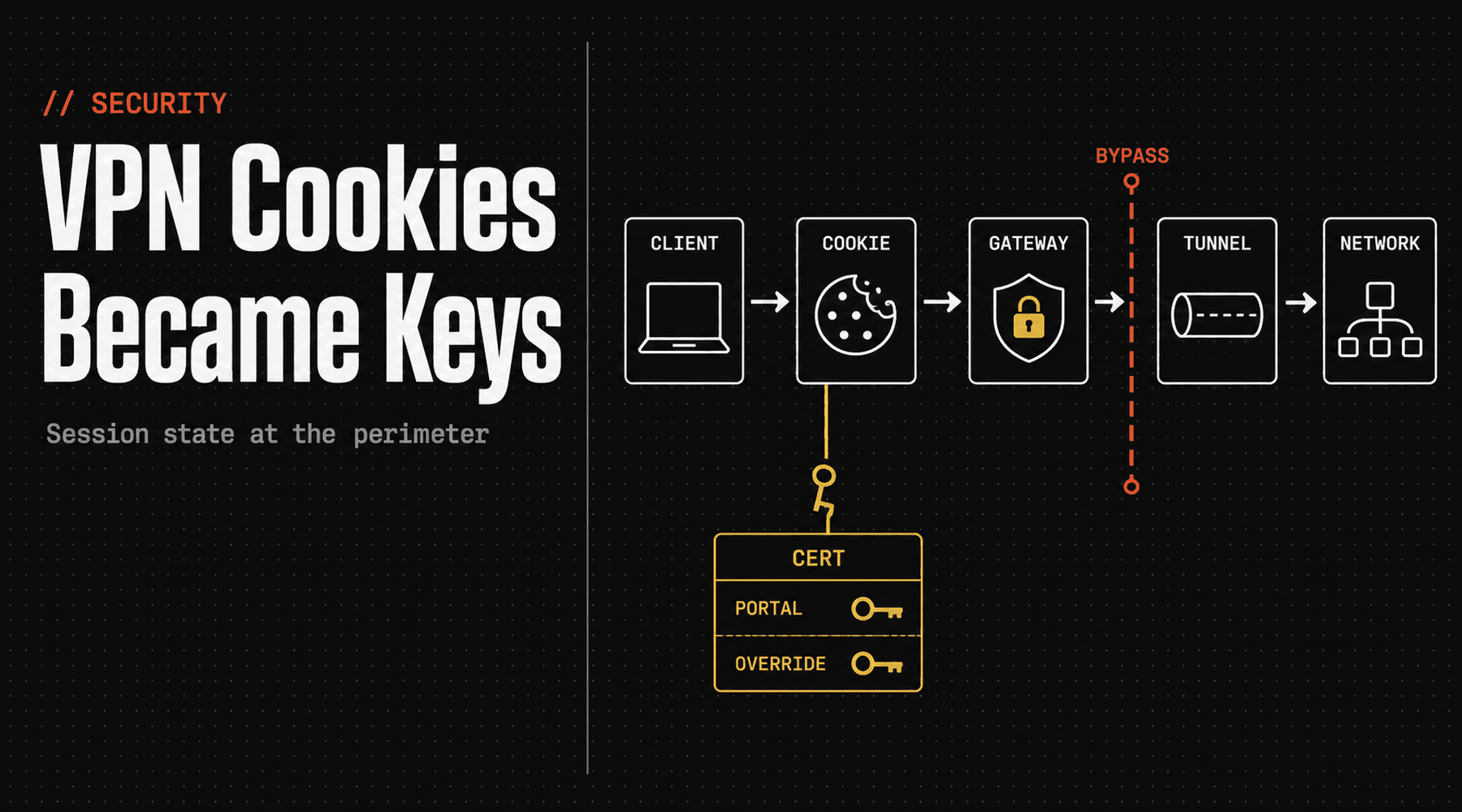
The most interesting part of Palo Alto Networks' new GlobalProtect problem is not that a VPN appliance has another vulnerability. Internet-facing security boxes have become a routine target. The sharper lesson is that a small convenience feature can quietly become an authentication system of its own.
CVE-2026-0257 affects PAN-OS and Prisma Access GlobalProtect portals and gateways in a specific configuration. Palo Alto says the bug lets a remote unauthenticated attacker bypass security restrictions and establish an unauthorized VPN connection. The advisory was published on May 13, updated on May 29, and now lists the exploit maturity as attacked with highest urgency.
The exposure is not every Palo Alto firewall. It is the combination that matters: GlobalProtect portal or gateway configured, authentication override cookies enabled, and the wrong certificate setup around those cookies. Palo Alto's mitigation guidance is blunt. Upgrade to a fixed PAN-OS release, use a dedicated certificate only for authentication override cookies, or disable authentication override entirely.
That sounds like configuration plumbing, but it is perimeter security plumbing. Authentication override cookies exist because users and enterprises hate friction. If a device has already authenticated, the portal can remember enough state to spare the user another full login. That is useful. It is also dangerous when the remembered object is trusted too broadly, protected by reusable key material, or accepted by a gateway that sits directly between the public internet and internal network access.
Rapid7's incident response write-up explains why defenders should not read the original medium-looking severity as a comfort blanket. Its MDR team says it saw successful exploitation across multiple customers, with the earliest observed activity on May 17. The observed behavior included suspicious cookie authentication to a local admin account from hosting-provider infrastructure, followed in some cases by VPN IP assignment. Rapid7 says it did not see lateral movement from those devices in its customer set, but the important boundary had already been crossed.
CISA added CVE-2026-0257 to the Known Exploited Vulnerabilities catalog on May 29. Its entry describes the same unauthorized VPN connection risk and orders federal civilian agencies to apply vendor mitigations or discontinue use if mitigations are unavailable. That is the right instinct. A bypass on an edge VPN is not just another patch ticket. It is a question of who may be inside the network while defenders are still debating severity labels.
The broader pattern is familiar. Security products increasingly carry features that make them feel like application platforms: portals, cookies, local accounts, device posture checks, cloud identity hooks, plugins, telemetry, and admin APIs. Each feature is reasonable in isolation. Together they create complicated trust chains on systems that are deliberately exposed to hostile traffic. When one link gets fuzzy, the box protecting the network becomes a highly privileged app server at the front door.
There is also a design lesson here for every identity-heavy system, not just Palo Alto customers. A cookie is not safer because it is called an override. A certificate is not harmless because it is already used by the portal. Reusing trust material across different purposes can turn a contained failure into a full authentication bypass. The old cryptographic instinct still applies: separate keys by purpose, make tokens narrow, make acceptance rules explicit, and assume anything reachable from the internet will eventually be probed at scale.
For operators, the immediate work is concrete. Inventory GlobalProtect portals and gateways. Check whether authentication override cookies are generated or accepted. Confirm the PAN-OS release is one of the fixed versions. If a maintenance window delays the upgrade, disable authentication override or move those cookies onto a dedicated certificate that is not reused by the portal or gateway. Then review GlobalProtect logs for cookie-based admin authentications, odd hostnames, repeated MAC addresses, and source infrastructure that does not match the user population.
The less immediate work is cultural. Edge appliances should be treated like production identity systems, not like sealed network boxes. They need fast patch paths, configuration review, logging that security teams actually ingest, and blast-radius thinking around every feature that bypasses a fresh login. The moment a VPN cookie can stand in for a user, it deserves the same suspicion as a password, session token, or signing key.
The takeaway is simple: perimeter trust keeps moving upward into software objects. In this case, the object was a GlobalProtect authentication override cookie. If that cookie can open the tunnel, it is not a convenience artifact. It is a key, and keys need sharper boundaries than this.
Sources: Palo Alto Networks advisory for CVE-2026-0257, Rapid7 observed exploitation report, CISA Known Exploited Vulnerabilities catalog JSON, BleepingComputer coverage of active exploitation.
// Discussion
Comments
No comments yet. Start the thread.