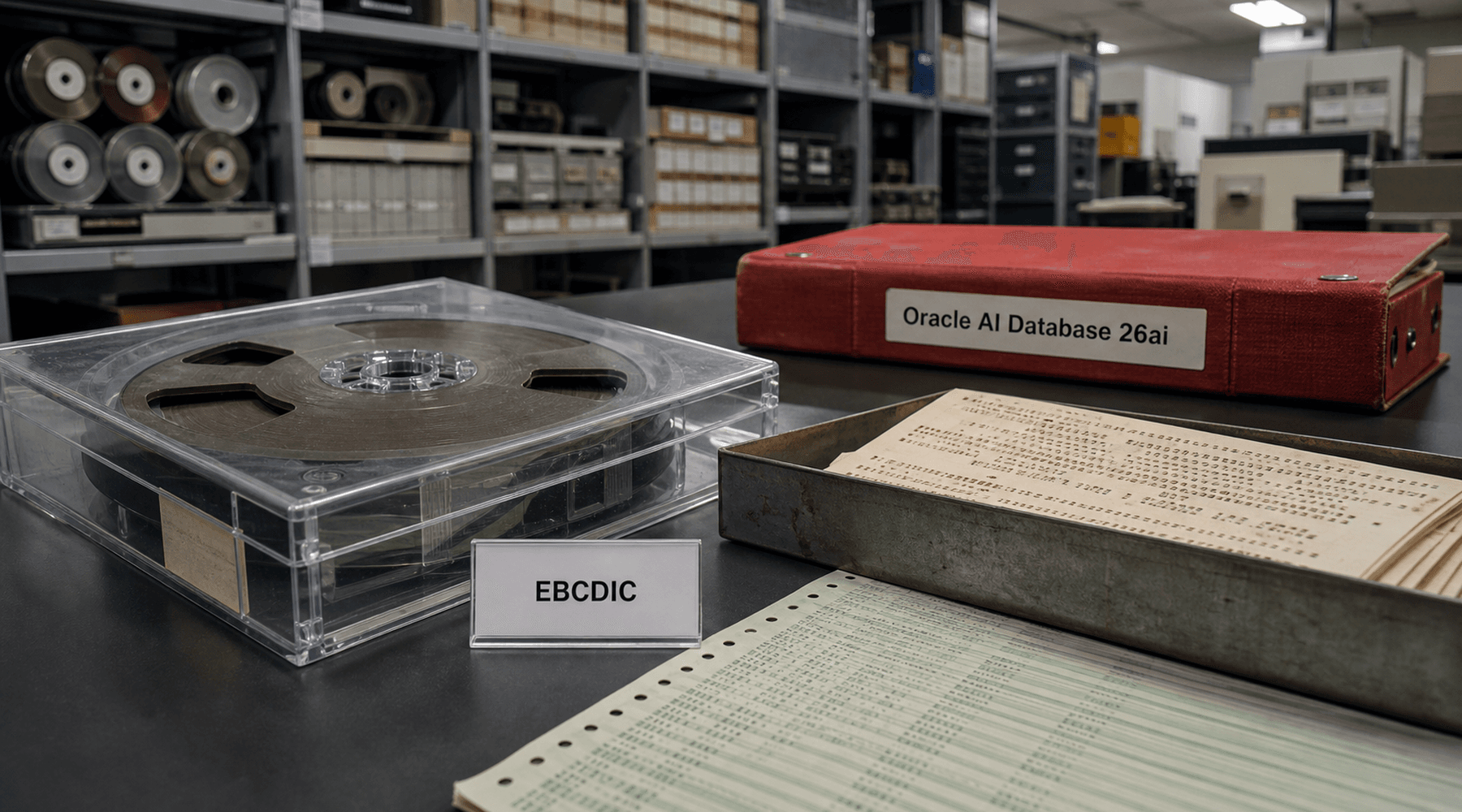
Mainframe migration usually gets sold as a story about moving data out of one place and into another. That framing is too small. Some of the oldest systems in production are not only holding records. They are holding assumptions about how characters compare, how ranges sort, and what an application thinks the next row should be.
That is why the July 30 InfoWorld feed item on Oracle's EBCDIC compatibility work, syndicated from CIO, is more interesting than a database feature announcement first appears. Oracle is adding EBCDIC character-set compatibility features to Oracle AI Database for customers moving legacy databases and applications away from IBM mainframe environments.
The technical post from Oracle Database Globalization Engineering describes the target plainly: migrations from IBM mainframe code pages into ASCII-based database environments have to preserve both character conversion and the binary ordering behavior that old applications expect. If that ordering changes, the application may keep running and still return the wrong business answer.
legacy path
  COBOL app
  EBCDIC data
  EBCDIC sort assumptions
  range predicates that worked for years

migration risk
  same rows
  new database character set
  different binary order
  quietly different query results
The Old Encoding Is Part Of The Interface
EBCDIC is often described as a character encoding, which is true but incomplete for migration planning. In a long-lived estate, the encoding becomes part of the application interface. Batch jobs, report writers, COBOL programs, SQL predicates, sort utilities, and reconciliation procedures may all have grown around the way that source system orders character values.
That is the detail Oracle is trying to absorb into the database layer. Its announcement points to IBM CDRA-compatible EBCDIC client character sets for predictable source-to-target conversion, plus EBCDIC-compatible collations so migrated SQL comparisons, range searches, and order-by behavior can continue to match the mainframe estate where required.
This is not glamorous platform work. It is the kind of work that prevents a migration from becoming an expensive semantic fork. A test suite can verify that a row moved. It also has to verify that the old query still means what it used to mean.
A migration is not correct because the bytes arrived. It is correct when the old business rules still land on the same records.
Compatibility Is Useful, But It Is Not Modernization
The CIO piece includes the right caution from analysts and consultants: EBCDIC support removes a real blocker, but it does not magically modernize the workload. It does not rewrite COBOL. It does not replace decades of operational practice. It does not reproduce every mainframe resilience property by itself. It also can shift dependency from one platform to another if the compatibility layer becomes the new permanent architecture.
That does not make the feature unimportant. It makes it easier to place. For many enterprises, the hardest systems to move are the ones that cannot be cleanly rewritten before the deadline. A compatibility layer can reduce migration risk, buy time, and let teams move one boundary at a time. The mistake would be treating that bridge as proof that the old model has been retired.
The Test Plan Has To Get Weirder
The practical lesson is for the migration runbook. Data conversion checks are not enough. Teams need fixtures that prove sort order, range filters, blank handling, comparison behavior, and report totals against the legacy system. They need representative records from the weird parts of the code page, not only customer names and numeric account IDs.
That means old-school validation still matters. Keep golden reports. Keep before-and-after query captures. Ask the users who own month-end reports which lines they manually reconcile. Make the database prove that the compatibility layer is preserving application meaning, not only loading rows without throwing errors.
- Character conversion: verify that source code pages map predictably into the target database path.
- Binary ordering: test comparisons, sorts, and ranges where EBCDIC order was an implicit dependency.
- Application behavior: compare business outputs, not only table counts and checksums.
- Exit strategy: decide which compatibility settings are transitional and which are becoming part of the new platform contract.
The Takeaway
Oracle's EBCDIC work is a useful reminder that legacy is not just old hardware. Legacy is also hidden behavior. It lives in ordering rules, batch assumptions, downstream reports, and the comfortable silence of systems that have been giving the same answers for years.
The small story is that Oracle AI Database is getting more mainframe-friendly migration features. The larger story is that serious migrations have to preserve meaning before they chase architecture purity. If the new platform changes what an old query means, the migration has not escaped the mainframe. It has only moved the bug somewhere newer.
// Discussion
Comments
No comments yet. Start the thread.