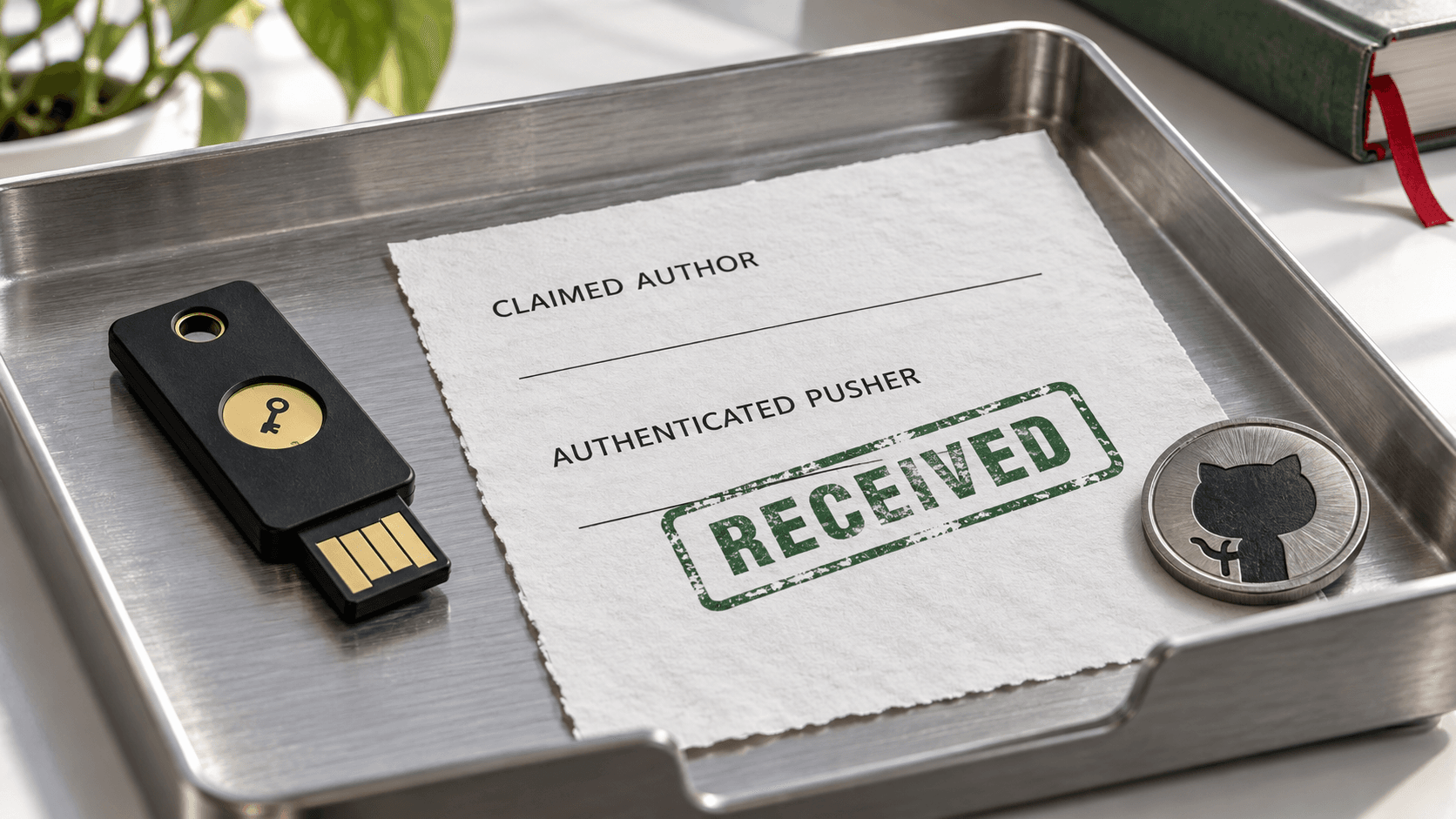
A familiar name in Git history can make a change feel familiar before anyone reads it. That is useful for navigating a project, but it is a poor substitute for knowing which authenticated account delivered the change.
GitHub's October 12 announcement, "Push attribution for commits in limited public preview," adds a durable pusher identity alongside author and committer metadata. The feature is a limited public preview for GitHub Enterprise customers, with access requested through an account team. It is not a generally available setting for every repository.
The release also introduces a ruleset condition, Committer must match pusher. It rejects a push when the committer email does not match a verified email of the authenticated pusher. This gives repositories an enforcement option as well as an additional record to inspect.
The name attached to a change and the account that delivered it answer different questions.
Git Records A Claim
Git's author and committer identities are supplied by the client. The git-commit documentation describes author overrides and environment variables for both identities. This flexibility supports ordinary workflows: applying another contributor's patch, importing history, or preserving authorship through a maintenance branch.
It also means a name in a commit is not evidence that the person authenticated to the hosting service. A repository can contain accurate attribution while somebody else legitimately transports the change.
Three questions about one change

Author       Who is credited with writing it?
Committer    Who is recorded as creating this commit?
Pusher Which authenticated account delivered it?Consider an original example. A contributor sends a patch. A maintainer applies it, preserving the contributor as author, and a release automation account pushes the resulting commit. That sequence contains three useful identities. Flattening them into one person would make the history less informative.
The question for a repository policy is which differences are expected and which should trigger review. The answer depends on how the team actually ships changes.
Delivery Is A Separate Event
A commit describes a particular state of the repository and its relationship to earlier commits. Delivery describes an interaction with a service. Keeping evidence for both makes an incident easier to reconstruct.
Suppose a suspicious change carries the name of a senior maintainer. A responder should be able to ask whether the maintainer's account delivered it, whether automation delivered it, or whether an unrelated account did. The answer narrows the investigation without requiring the responder to trust the displayed name.
A pusher identity is still an account-level fact. If an account or its credential was compromised, successful authentication does not establish that the account owner intended the change. Teams still need credential history, access controls, review records, and a timeline.
The practical improvement is a clearer starting point. A responder can investigate an observed delivery identity rather than infer one from a field supplied inside the delivered object.
A Signature Answers Another Question
Commit signature verification provides evidence about a signed commit and its signing identity. Push authentication provides evidence about access to the hosting service. A signed commit can be transported by another account, so a verified signature and an authenticated pusher are complementary records.
Neither record says the code is correct. A trusted identity can write a bug, approve an unsafe dependency, or accidentally expose a secret. Identity evidence supports accountability; review and tests assess the change itself.
This distinction is especially useful when building dashboards. A single reassuring badge can hide several different assertions. A review interface should let someone inspect authorship, signature status, delivery, and approval without treating them as interchangeable.
Test The Rule Against Real Workflows
Before enforcing identity equality, a team should map its normal write paths. Include local development, browser edits, patch application, cherry-picks, release bots, mirrors, and any service that creates commits.
The purpose is to understand which account supplies the committer metadata and which account performs delivery in each path. A policy that fits direct developer pushes may need deliberate changes to an automation workflow.
- Use a test repository to exercise ordinary pushes and automation paths.
- Document the identities expected from each writer.
- Check rejected operations for both intended blocking and legitimate workflow failures.
- Keep automation credentials scoped to the repositories and operations they need.
- Include pusher identity in investigation procedures alongside review and signature evidence.
Those are editorial rollout criteria, not a claim that any particular workflow is unsupported by the preview. The announcement establishes the rule's intent; a team's own test establishes how it interacts with its configuration.
Evidence Should Survive The Investigation
For security teams, the larger lesson is about where evidence comes from. A typed name is a claim by the client. An authenticated delivery record is an observation by the receiving service. A signature is a cryptographic assertion. An approval is a decision within a review process.
Each is useful when its meaning remains intact. Trouble starts when systems promote one into proof of all the others.
The same principle applies to automated development. A bot or coding agent may create and deliver changes using delegated credentials. Teams should preserve that delegation rather than make every operation appear to have been performed manually by a developer.
GitHub's preview adds a useful piece of that record. Its value will come from how clearly repositories expose it, how deliberately teams enforce identity rules, and how well responders combine it with the rest of the change history.
// Discussion
Comments
No comments yet. Start the thread.