Visa just gave ChatGPT the thing every ambitious shopping assistant eventually asks for: a way to pay without making the human do all the button-mashing.
On June 10, Visa announced a strategic collaboration with OpenAI to bring Visa payments into agentic commerce across OpenAI experiences. The short version is simple enough. An AI agent can help find, compare, and buy something. Visa supplies the payment network, tokenization, authorization, fraud monitoring, and the boring grown-up machinery that decides whether the agent is allowed to spend the money.
The important word is not autonomous. The important word is bounded.
That is where this gets interesting. The press-release version sounds like shopping with fewer tabs open. The infrastructure version is a new identity problem with receipts attached. If an AI agent buys a replacement laptop charger, who authorized that transaction? Was the merchant category allowed? Was the price inside the user's limit? Did the agent use a token scoped to this use case, or did someone hand a model the financial equivalent of a loose house key?
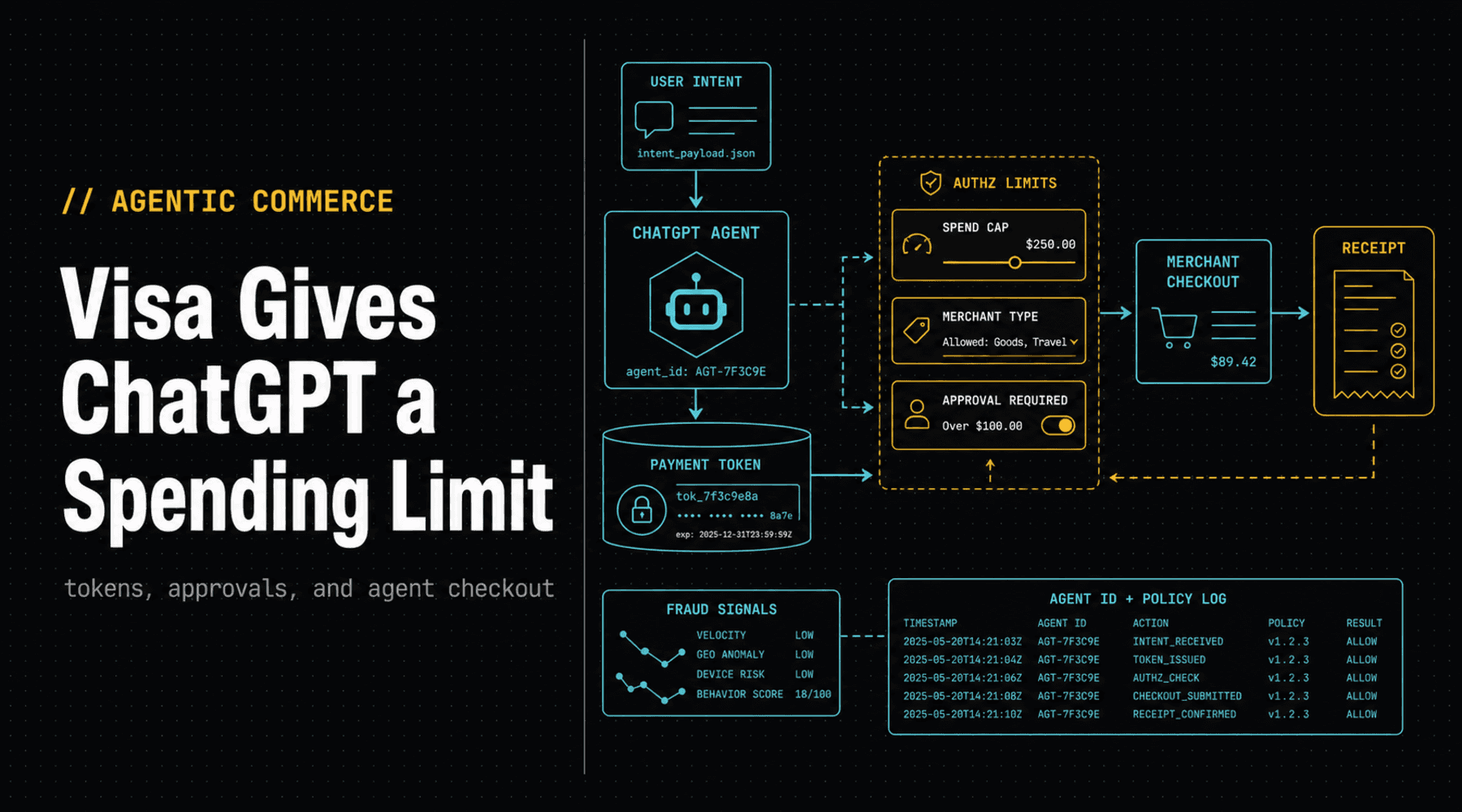
Visa's answer is not to pretend agents are harmless. It is to put them inside controls: spending limits, merchant categories, required approvals, tokenized credentials, real-time authorization, fraud monitoring, and agent identification. That is the right instinct. A checkout agent without policy is just a very polite browser extension with a card number.
The Card Number Is Not the Product
Most people will experience this as convenience. Ask the assistant to find a flight, reorder a part, book supplies, or buy the oddly specific cable that every desk eventually needs. The assistant can narrow options, handle the merchant flow, and ask for approval when policy says approval is needed.
But the product is not the card number. It is the permission envelope around the agent.
User intent
  -> agent task
  -> scoped payment token
  -> policy check
  -> merchant checkout
  -> receipt and audit log
That little chain is the difference between useful delegation and financial slapstick. A good agentic payment system should know the agent, the user, the merchant, the amount, the category, the policy, the approval state, and the resulting transaction. It should also leave enough evidence behind for disputes, fraud review, business accounting, and the inevitable moment when someone asks, "Why did the assistant buy eight patio umbrellas?"
That is not a joke edge case. Agents turn intention into action. Payments turn action into liability. Once those two systems meet, every vague instruction becomes a control-design question.
Visa Is Not Alone on the Starting Line
The timing is loud. The same day, Mastercard launched Agent Pay for Machines, a service aimed at high-frequency, machine-driven commerce. Mastercard's framing leans more toward agents paying other services at machine speed, including microtransactions, multi-rail settlement, credentialing, permissioning, execution, and settlement across cards, accounts, and stablecoins.
That is a different doorway into the same building. Visa is talking about bringing OpenAI's interface onto its global payment network for consumer and developer commerce. Mastercard is talking about machine-to-machine transaction infrastructure for agents that coordinate services in the background. Both are saying the same quiet part out loud: AI agents are not just becoming recommendation engines. They are becoming economic actors that need payment credentials, limits, and trust signals.
The winners here will not be the companies that make agents sound most magical. They will be the ones that make agent spending feel boring in the best way: scoped, logged, revocable, dispute-friendly, and legible to the people who actually own the money.
The Fun Part Is Also the Risky Part
There is a genuinely fun future hiding in this. A founder tells an agent to set up a landing page, buy a domain, license images, schedule email, and keep the whole errand under $300. A family asks a travel assistant to book a weekend trip if the total stays under a preset ceiling. A small business lets an inventory agent reorder boring supplies without dragging a human through checkout screens every Friday.
That is not science fiction. It is the sort of chore automation AI should be good at. The web already made buying easy enough to be dangerous. Agents could make buying easy enough to be invisible.
Invisible spending is only acceptable if the controls are visible. The buyer needs to see what an agent can do before it does it. The issuer needs confidence that the transaction fits the approved envelope. The merchant needs a way to trust the agent without inventing a new checkout protocol for every platform. The agent platform needs to prove that its assistant is acting under instruction, not improvising with a wallet.
- Tokenization keeps raw card data out of the agent's hands.
- Spending caps turn a fuzzy request into a hard boundary.
- Merchant-category rules stop an errand from drifting into nonsense.
- Required approvals keep high-risk purchases human-visible.
- Agent identity gives issuers and merchants something to evaluate.
- Audit logs give everyone a trail when the receipt looks weird.
This is where old payments infrastructure becomes weirdly modern. Fraud scoring, authorization, token vaults, chargebacks, settlement, and risk operations are not glamorous. They are exactly what AI commerce needs if it wants to leave the demo stage without turning every checkout into a trust fall.
Codex Is the Odd Little Clue
Visa also says the companies will explore enterprise applications, including developer-focused experiences powered by Codex. That line is easy to skim past, but it points at a much broader pattern.
Agentic payments are not just about ChatGPT buying shoes. A coding agent might provision a service, buy a domain, generate a test account, pay for an API, or spin up infrastructure within a company policy. A business agent might negotiate with a SaaS vendor's machine-readable pricing layer. A logistics agent might buy temporary data, reserve capacity, or settle a tiny fee that would be absurd for a person to approve one at a time.
The control plane starts to matter more than the shopping cart. Who can spend? On which rail? For which purpose? Against which budget? With what approval? With what evidence? The answer cannot be "the prompt seemed confident."
The Takeaway
Visa and OpenAI are not just adding payments to a chatbot. They are sketching the first serious version of checkout for delegated software. Mastercard's machine-payments push shows the same thing from the other side: once agents can act, commerce needs credentials, controls, and settlement paths built for non-human operators.
The sane future is not an AI that can buy anything. The sane future is an AI that can buy the right thing, within the right limit, from the right kind of merchant, with the right receipt, and with a human still holding the leash.
That may sound less dramatic than autonomous shopping. Good. Money should be the least dramatic part of the agent stack.
// Discussion
Comments
No comments yet. Start the thread.