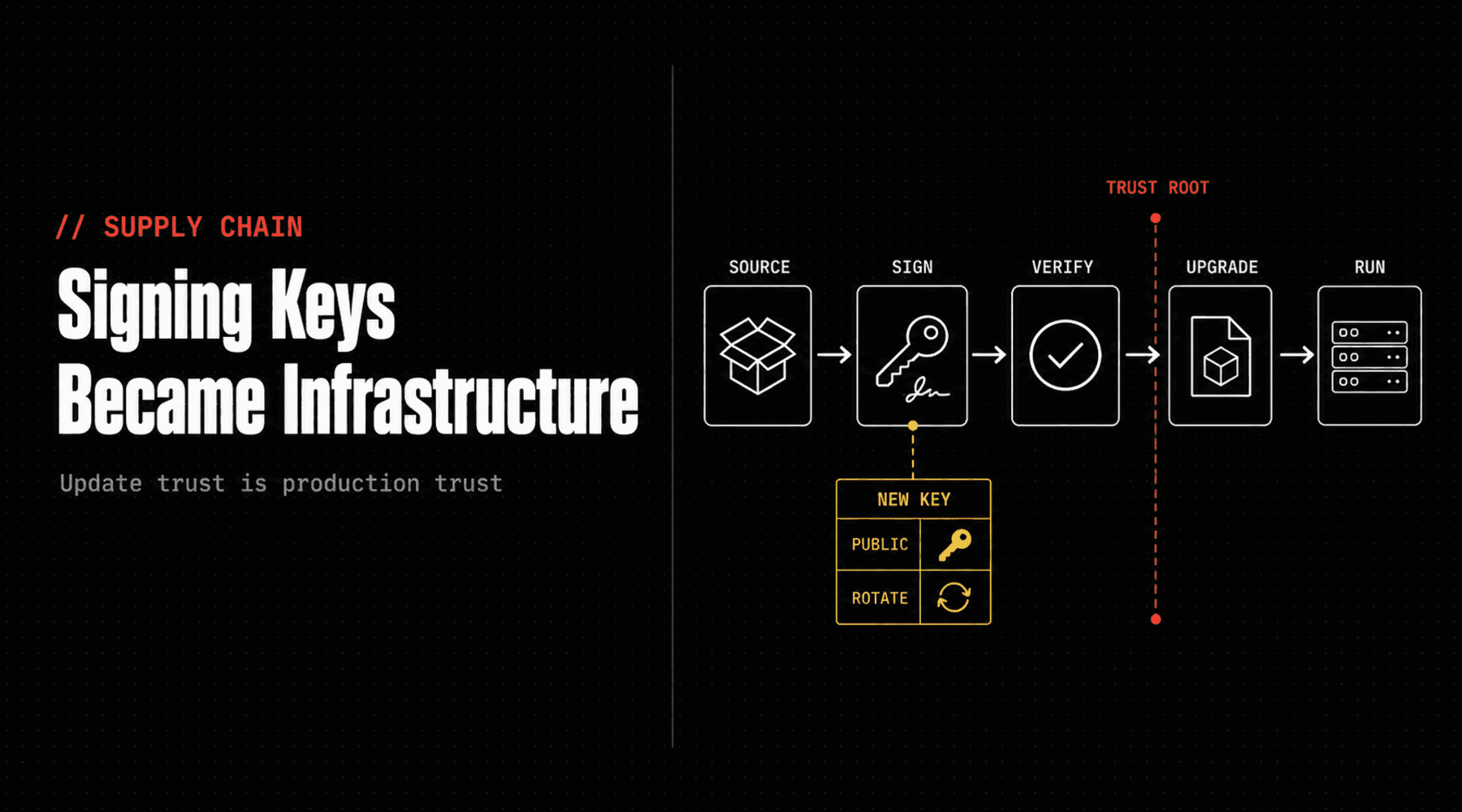
The most useful way to read GitHub's Enterprise Server signing-key rotation is not as a footnote to a breach. It is an operations warning. The public key that lets an on-prem GitHub appliance decide whether a future update really came from GitHub is now part of every customer's patch pipeline, incident response plan, and trust inventory.
GitHub updated its investigation note on May 26 after a compromise that began with a poisoned third-party Visual Studio Code extension. The company says the incident involved exfiltration of GitHub-internal repositories and that it has no evidence of impact to customer repositories, organizations, or enterprises outside those internal repositories. Still, GitHub is rotating keys out of caution, including the GitHub Enterprise Server signing key.
That key has a narrow-sounding job. GitHub Enterprise Server uses it to validate GitHub as the source during manually initiated update flows. If administrators do not rotate the public key in their instances, future GHES patches and releases signed with the new key will fail verification. GitHub's guidance is direct: run its rotation script, update both admin and root key stores, download future updates only from the official GitHub source URL, and prepare to take GHES security updates faster over the coming months.
This is the part worth pausing on. A signing key can look like vendor-maintained plumbing until the day it becomes the thing standing between a security patch and a failed maintenance window. The key is not merely a cryptographic artifact. It is a trust root wired into the enterprise's ability to accept new code for a core developer platform.
The upstream chain explains why that matters. Nx's postmortem says the malicious Nx Console version 18.95.0 was published on May 18 after a contributor's GitHub CLI OAuth token had been stolen by the earlier TanStack supply-chain compromise. The poisoned extension was available briefly in public extension marketplaces, but the payload targeted developer machines, harvested common credentials, and treated the workstation as a bridge into higher-value systems.
CISA's alert framed the same pattern as a pipeline problem, not a single-package problem. Modern software delivery now depends on extension marketplaces, package registries, CI workflows, repository bots, CLI tokens, endpoint state, and signing keys. Attackers do not need to defeat all of that at once. They only need one trusted developer workstation or one publish-capable path, then they can ride the trust that engineering teams already built for speed.
The GHES rotation turns that abstract supply-chain lesson into an administrator's checklist. Enterprises that self-host GitHub cannot treat the appliance as a static box that only needs ordinary version upgrades. It is a software factory control plane. Its update keys, support artifacts, automation tokens, backup flows, and admin scripts deserve the same inventory discipline as production database credentials or cloud signing material.
There is also a better way to think about vendor guidance. Rotating a key after a related compromise is not an admission that every customer has been breached. It is a reduction of uncertainty. If a platform vendor can make future updates depend on fresh trust material, operators should want that option to work cleanly. The cost of a planned key rotation is small compared with discovering during an emergency patch cycle that your appliance no longer trusts the package it must install.
For GHES administrators, the immediate work is straightforward. Rotate the public keys. Record which instances, nodes, and accounts were updated. Verify the digest of the rotation script if your change-control process requires it. Confirm that future update downloads come from the official GitHub source URL. Then make the less glamorous change: add update-signing trust roots to the asset inventory, with owners, rotation history, and a testable runbook.
The broader takeaway is bigger than GitHub. The developer platform is now production infrastructure, and its trust roots are live operational dependencies. Package signatures, extension publishers, repository automation, CI credentials, and appliance update keys all decide which code gets to run. If those objects are invisible until an incident, the organization is already late.
Signing keys became infrastructure because software delivery became infrastructure. Treat them that way before the next patch window turns into a trust failure.
Sources: GitHub investigation update on Enterprise Server signing-key rotation, Nx Console v18.95.0 supply-chain compromise postmortem, GitHub Security Advisory GHSA-c9j4-9m59-847w, CISA alert on supply-chain compromises impacting Nx Console and GitHub repositories.
// Discussion
Comments
No comments yet. Start the thread.