Hardware compatibility looks simple only from a distance. A SATA drive exposes a feature. A controller advertises support. The kernel tries to save a little power. Then one specific drive model disappears two minutes after boot and the tidy standards story turns into a quirk table.
That is the useful systems lesson in Phoronix's August 1 report on Linux 7.2-rc6 working around several buggy Western Digital SATA drives. The short version: the ATA fixes merged ahead of the next Linux release candidate include device-specific workarounds that disable SATA Link Power Management for several WD drives that have not behaved reliably with recent kernels.
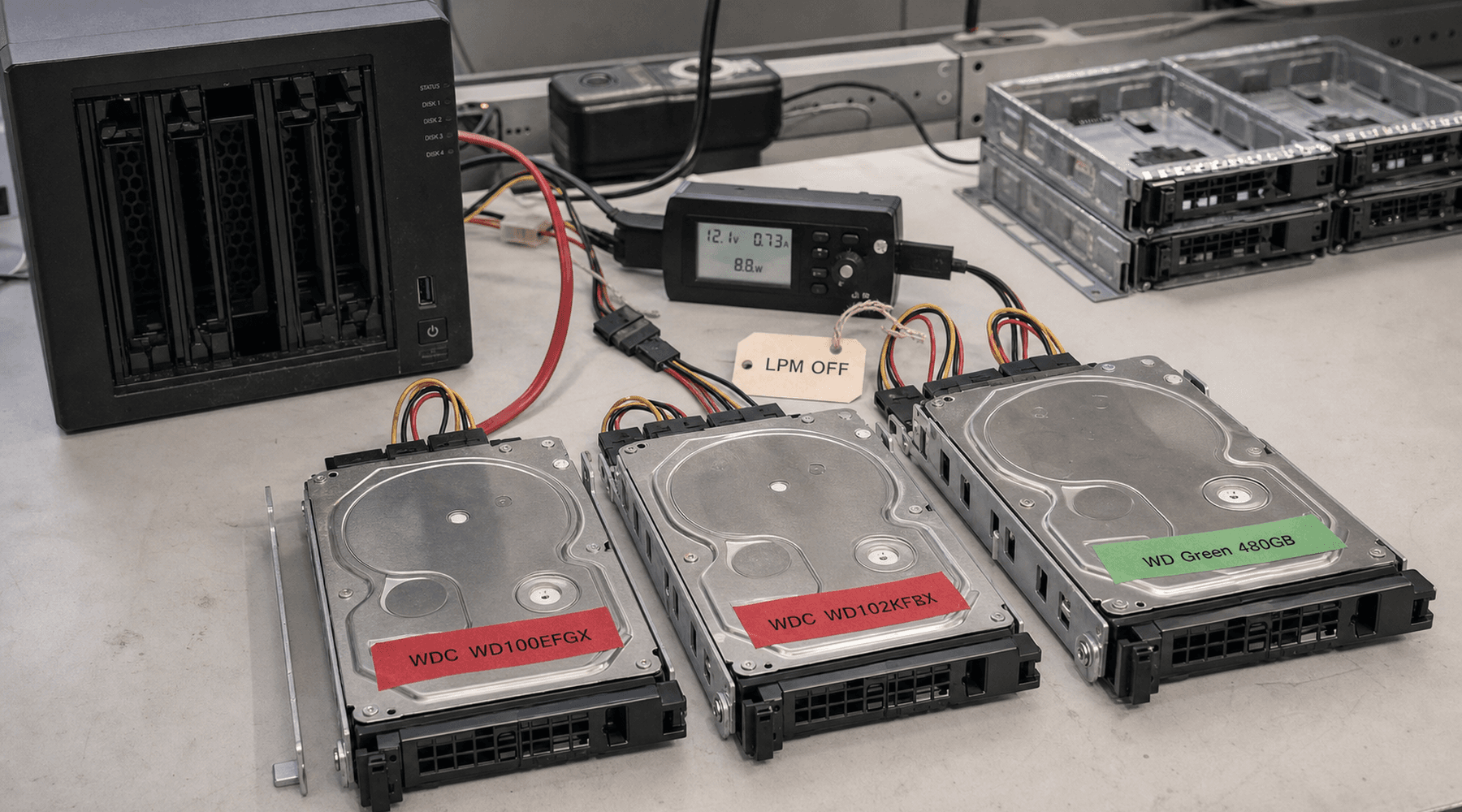
The upstream merge is visible in Linus Torvalds' commit for the ata-7.2-rc6 pull. In drivers/ata/libata-core.c, the quirk list now names WDC WD100EFGX-68CPLN0, WDC WD102KFBX-68M95N0, and WD Green 2.5 480GB with ATA_QUIRK_NOLPM. That is not a glamorous patch. It is exactly the kind of patch that keeps storage boring for the people who need boring storage.
SATA drive boots normally
  -> kernel enables link power management
  -> affected model drops off the bus
  -> filesystem sees the disappearance

kernel workaround
  -> match known-bad model string
  -> apply ATA_QUIRK_NOLPM
  -> keep the link awake
-> trade small power savings for reliabilityPower Saving Has A Failure Mode
SATA Link Power Management exists for a reasonable reason. If the link between the host and the drive can enter a lower-power state when idle, a system can save energy without removing the device. On paper that is the kind of feature operating systems should use automatically.
The problem is that storage is not a place where invisible recovery is good enough. If a drive drops from the bus, the failure is not experienced as a slightly less efficient power state. It is experienced as I/O errors, stalled services, broken arrays, or a machine that only becomes healthy again after a reboot. Phoronix notes that the reported cost of disabling LPM is roughly half a watt to one and a half watts per drive. In a NAS, server, or workstation that depends on the disk remaining present, that is usually the right trade.
A storage power feature is only a win if the disk remains boringly available after the feature wakes back up.
The Quirk Table Is Infrastructure
Kernel quirk tables are easy to dismiss as messy exceptions. They are also one of the reasons Linux works across a huge spread of real machines. The world does not ship as a clean matrix of perfect controllers, perfect firmware, perfect drives, and perfect cables. It ships as model numbers, firmware revisions, old boards, consumer parts in server jobs, and hardware that technically implements a feature but fails under one timing path.
That is why the model strings matter. A broad workaround would punish healthy drives by disabling useful power management everywhere. A narrow quirk says: these exact devices have earned a different default. The operating system carries that memory so every affected user does not have to rediscover the same boot parameter.
For users stuck on older kernels, Phoronix points to libata.force=nolpm as a workaround. That kind of boot parameter is useful for diagnosis and emergency recovery, but it is a blunt instrument. The better long-term answer is what landed here: move the knowledge into the kernel so the affected models get the safer behavior automatically while the rest of the storage stack keeps using LPM normally.
Small Patches Prevent Large Incidents
This is also a reminder that storage incidents are often caused by small assumptions. The system did not need a new filesystem. It did not need a new block layer. It needed a rule saying that three drive identifiers should not be asked to enter a link power state that they cannot reliably survive.
That sort of fix rarely gets the attention of a new scheduler or driver subsystem. It should. Production reliability is full of these edges. A mainline quirk can convert a recurring support thread into a resolved default. It can turn a post-boot disappearance into a normal boot. It can make future distributions inherit the fix without each user learning kernel parameters by hand.
What To Watch
- Stable backports: affected users will care how quickly the quirk reaches distribution kernels, not only mainline release candidates.
- Power budgets: disabling LPM trades small per-drive savings for device presence. Dense storage boxes should account for that explicitly.
- Model specificity: narrow quirks protect unaffected hardware from unnecessary workarounds.
- Diagnostics: disappearing drives should send operators toward link power management tests before they replace healthy disks.
The small story is that Linux is blacklisting SATA LPM for a few Western Digital models. The larger story is that mature operating systems accumulate operational memory. Standards describe how hardware should behave. Quirk tables remember how hardware actually behaved after someone spent the weekend proving the difference.
// Discussion
Comments
No comments yet. Start the thread.