OpenAI has reached the part of the AI boom where the hard problem is no longer making the model look clever in a demo. The hard problem is getting the thing wired into payroll, call centers, compliance reviews, ticket queues, stale SharePoint folders, procurement workflows, data warehouses, and the one business-critical spreadsheet named final_final_real.xlsx.
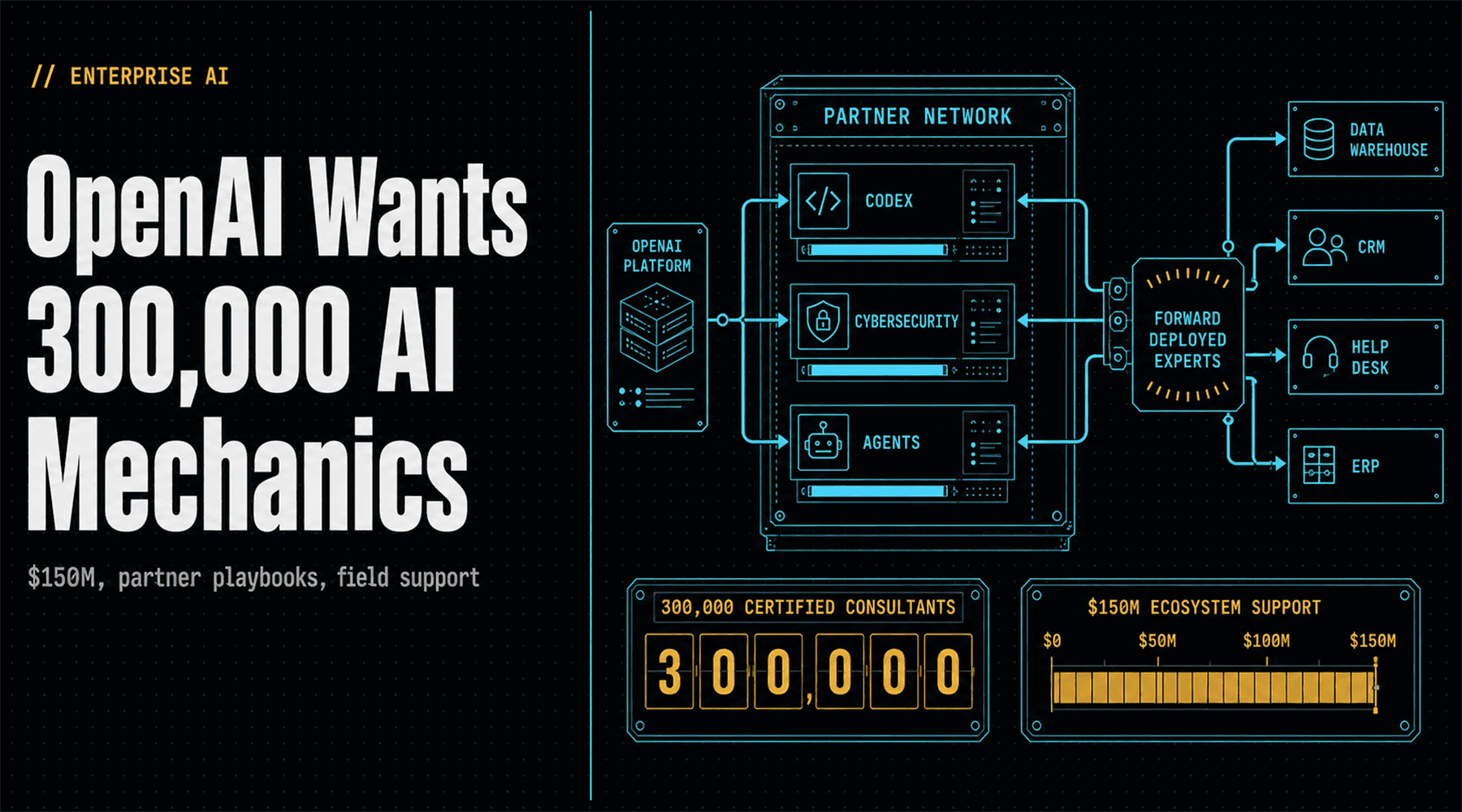
On June 15, OpenAI introduced the OpenAI Partner Network, a global program for companies that build, sell, integrate, and support OpenAI deployments. The headline numbers are not shy: $150 million to support the ecosystem, and a goal to train and enable 300,000 certified consultants by the end of 2026.
This is OpenAI admitting the obvious in a useful way: enterprise AI is not a model rollout. It is plumbing, permissioning, workflow redesign, data cleanup, training, change management, and someone staying late when the procurement bot meets the ERP from 2009.
The Badge Is Not the Interesting Part
Partner programs can be sleepy. A logo wall, a few PDFs, a webinar, and somebody says "ecosystem" until the room gives up. This one matters because OpenAI is turning deployment work into a named layer of the product.
The launch spans systems integrators, management consultants, technology partners, and data companies. The public partner page lists names like Accenture, AWS, BCG, Bain & Company, Capgemini, CGI, Cognizant, Infosys, McKinsey & Company, NTT DATA, PwC, Databricks, and Snowflake. Customer names in the announcement include eBay, Indeed, Paychex, and T-Mobile.
That lineup tells you what OpenAI thinks the bottleneck is. It is not getting executives to believe AI is important. They believe. Some have believed so hard they bought three pilots and a laminated steering committee. The bottleneck is making AI survive contact with the business systems that actually run the company.
Three Hundred Thousand People Is a Deployment Strategy
The 300,000-consultant target is the big tell. OpenAI is not only courting a few elite transformation shops. It wants a huge class of people trained to sell, configure, audit, explain, and repair AI work inside companies that will never have frontier-model researchers on payroll.
model capability
+ partner playbooks
+ data integration
+ workflow ownership
+ security review
+ adoption support
+ measurable outcome
+ maintenance
That stack is less glamorous than a launch video, but it is closer to the truth. A useful enterprise AI system needs access to the right documents, tools, tickets, calendars, databases, and policies. It needs evaluation loops. It needs a rollback path. It needs someone who can tell the difference between a clever prompt and a production control.
OpenAI also says partners will be able to earn specializations in areas such as Codex, cybersecurity, and agents. That is smart. "AI partner" is too broad to mean much. A firm that can help an insurer redesign claims intake may not be the same firm that can govern coding agents inside a regulated bank. Specializations at least give buyers a way to ask sharper questions than "do you do AI?"
Forward Deployed Experts Are the Bridge Crew
OpenAI is also piloting a Forward Deployed Experts program with founding partners. The point is to align qualified partner practitioners with OpenAI's Forward Deployed Engineering teams when a customer needs deeper deployment support.
That sounds corporate until you translate it. OpenAI wants partners who can carry OpenAI-native implementation patterns into customer environments without every hard deployment turning into a direct OpenAI services engagement. The model company cannot personally wire every warehouse, bank, hospital, publisher, retailer, law firm, and airline into agent workflows. The partner network is how it tries to scale that field knowledge without losing the thread.
This is also where the consulting firms get an awkward but real role. Accenture, Bain, BCG, McKinsey, PwC, Capgemini, and friends are not just selling slideware here. At their best, they know where work actually gets stuck: incentives, approvals, fragile internal platforms, data ownership, risk signoff, labor redesign, and the terrifying sentence "we have a custom connector for that."
The Customer Should Be Pickier Now
A bigger OpenAI partner ecosystem should make enterprise AI easier to buy, but it should also make customers less tolerant of vague AI theater. If a partner shows up with a badge and no measurement plan, that is not transformation. That is merch.
The useful questions are concrete:
- Which workflow changes? Name the process, the owner, and the current baseline.
- Which data can the system read? Spell out sensitive fields, retention, indexing, and audit rules.
- What does success measure? Time saved, error rate, revenue lift, support quality, risk reduction, or something else.
- Who can stop it? Agents need kill switches, permission boundaries, and logs.
- Who maintains it after launch? A pilot without an owner is just a dressed-up demo.
This is where OpenAI's move could be healthy for the market. If the Partner Network pushes buyers toward certified skills, explicit specializations, support playbooks, and OpenAI-aligned deployment patterns, it can raise the floor. The floor needs raising. Too many enterprise AI projects still confuse access with adoption.
Why This Matters Beyond Consultants
The OpenAI Partner Network is also a sign that AI companies are becoming platform companies in the old-fashioned sense. Platforms do not win only by being technically excellent. They win when other companies can build businesses around them, staff projects around them, and get fired or promoted based on whether the rollout worked.
That is how Salesforce became furniture in the enterprise. It is how SAP survived generations of jokes. It is how cloud providers turned infrastructure from a server purchase into a profession. Now OpenAI is trying to make ChatGPT, APIs, Codex, agents, and enterprise workflows into a services ecosystem big enough that a buyer can say, "Fine, who can help us actually ship this?"
There is a funny tension here. AI is supposed to automate knowledge work, and now OpenAI is training a small city of human consultants to deploy it. That is not hypocrisy. It is the adoption curve. Before software eats a workflow, someone has to map the workflow, clean up the crumbs, negotiate access, and explain to finance why the agent should not be allowed to approve its own invoices.
The Takeaway
OpenAI's Partner Network is not the sexiest AI announcement of the year. That is probably why it matters. The next phase of AI is less about who can generate the flashiest answer and more about who can make the answer useful inside a messy company with real systems, real constraints, and real people who have to live with the result.
If OpenAI gets this right, the 300,000 AI mechanics will not be famous. They will be the people who turn models into working machinery. That is the job now. Less magic wand, more torque wrench.
// Discussion
Comments
No comments yet. Start the thread.