OpenAI finally put a name on the thing every serious AI company has been circling: the cost of answering people.
The company and Broadcom unveiled Jalapeño, OpenAI's first custom Intelligence Processor, on June 24. It is not a general-purpose GPU in a spicy jacket. OpenAI describes it as a blank-slate accelerator built around LLM inference, the part of AI where models stop training and start doing work for users, developers, agents, and businesses.
That sounds less glamorous than training a frontier model, but it is where the money leaks out of the machine. Every ChatGPT reply, Codex task, API call, tool invocation, and agent loop burns inference capacity. Training gets the spectacle. Inference gets the electric bill.
The Chip Is The Product Strategy
OpenAI says Jalapeño was designed from scratch around the systems it already runs across ChatGPT, Codex, the API, and future agentic products. The company says engineering samples are running ML workloads in the lab at target frequency and power, including GPT-5.3-Codex-Spark. Final performance numbers are not public yet, but OpenAI says early testing shows substantially better performance per watt than current state-of-the-art alternatives.
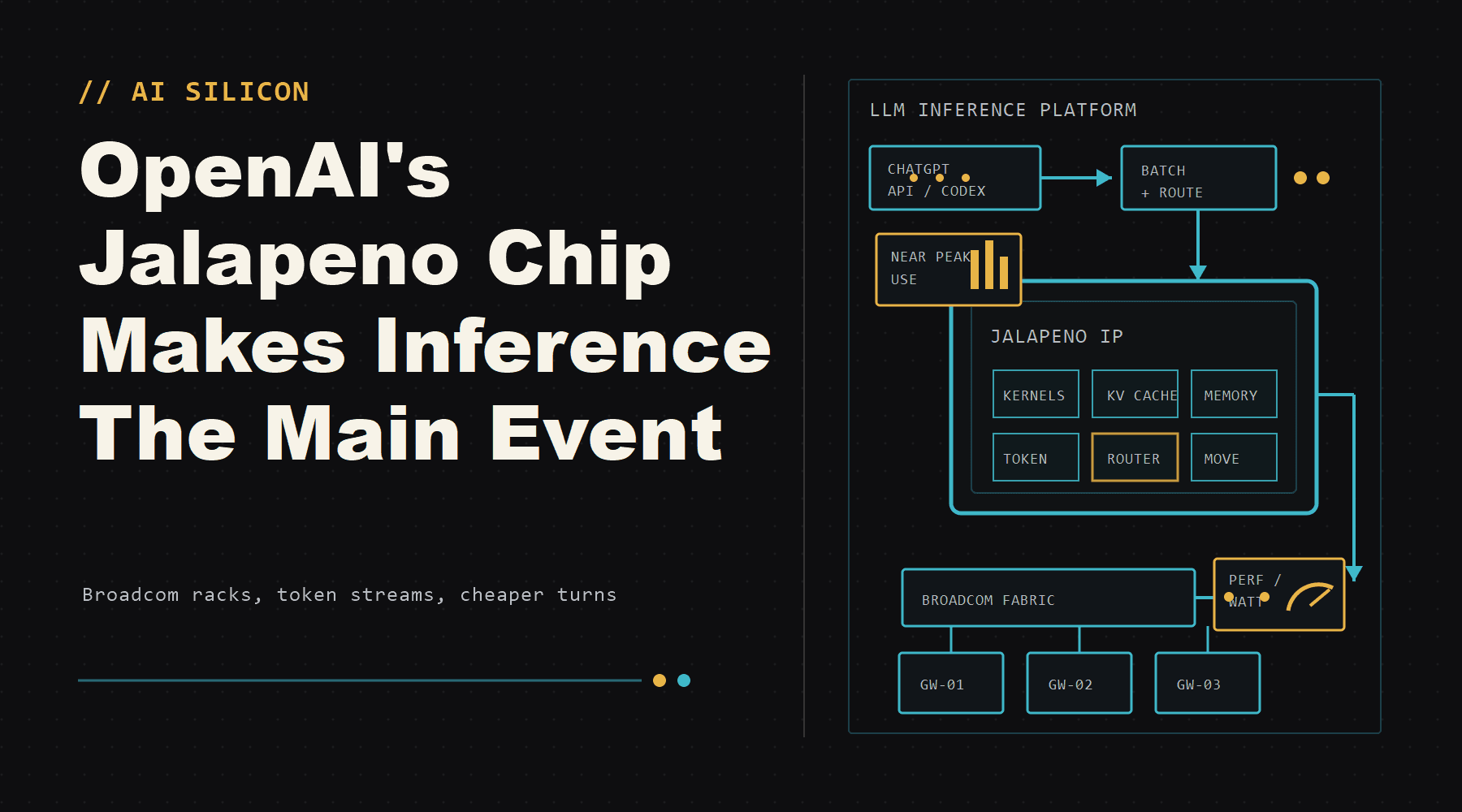
The important bit is not just the chip. It is the control loop around the chip. OpenAI listed the pieces it now wants to optimize together: chip architecture, kernels, memory systems, networking, scheduling, deployment systems, and product experience. That is the whole serving path from a user's prompt to the tokens coming back.
prompt queue -> batch/router -> kernels -> memory movement -> network fabric -> tokensIf you run a giant consumer AI product, shaving waste at any point in that chain is not a lab curiosity. It changes which features are affordable, how long agents can run, how busy the system can get before quality drops, and whether advanced models feel like a luxury item or a utility.
Broadcom Brings The Boring Magic
Broadcom's role is exactly the kind of hardware plumbing that turns an interesting chip idea into racks that can survive a real data center. OpenAI says Broadcom contributed silicon implementation, networking technology, including Tomahawk networking silicon, and large-scale production experience. Celestica is part of the board, rack, and systems side.
This matters because AI chips do not win as lonely squares of silicon. They win as systems. Memory movement, rack networking, thermals, scheduling, and utilization can decide whether a supposedly powerful accelerator spends its life sprinting or waiting around like an expensive intern with no tickets assigned.
OpenAI says Jalapeño went from initial design to manufacturing tape-out in nine months, with OpenAI models helping accelerate parts of the design and optimization process. That line is easy to hype, so keep it grounded: this does not mean an AI casually invented a chip before lunch. It does mean the chip design process itself is now becoming a customer for the tools it will later serve.
Inference Is Where AI Becomes Infrastructure
The industry spent years talking about model size like it was horsepower on a dealership sticker. Now the useful question is more practical: how many high-quality turns can you serve per watt, per rack, per dollar, per second of latency?
That is why an inference processor deserves attention even if it does not replace training clusters. OpenAI will still need a zoo of hardware for different jobs. Nvidia GPUs are not going to vanish because one lab built an ASIC. But the center of gravity is moving. Training creates capability. Inference distributes it. Distribution is where the business gets real.
For developers, cheaper inference means APIs can support heavier tool use, longer tasks, richer context, and more aggressive background work without turning every experiment into a budget crime scene. For consumers, it means faster answers and fewer capacity weirdness moments. For OpenAI, it means margin, independence, and leverage over the suppliers that currently define the physical limits of the AI boom.
The Takeaway
Jalapeño is OpenAI saying the model company wants to be an infrastructure company all the way down. The funny name helps, but the serious part is the vertical move: own more of the stack, tune the hardware to the workload, and make inference boring enough to be everywhere.
That is the quiet prize. Not a chip for a benchmark trophy. A chip for the billions of ordinary model turns that decide whether AI feels scarce, sluggish, and expensive, or just there when you ask for it.
Sources: OpenAI and Broadcom unveil LLM-optimized inference chip; OpenAI and Broadcom announce strategic collaboration to deploy 10 gigawatts of OpenAI-designed AI accelerators.
// Discussion
Comments
No comments yet. Start the thread.