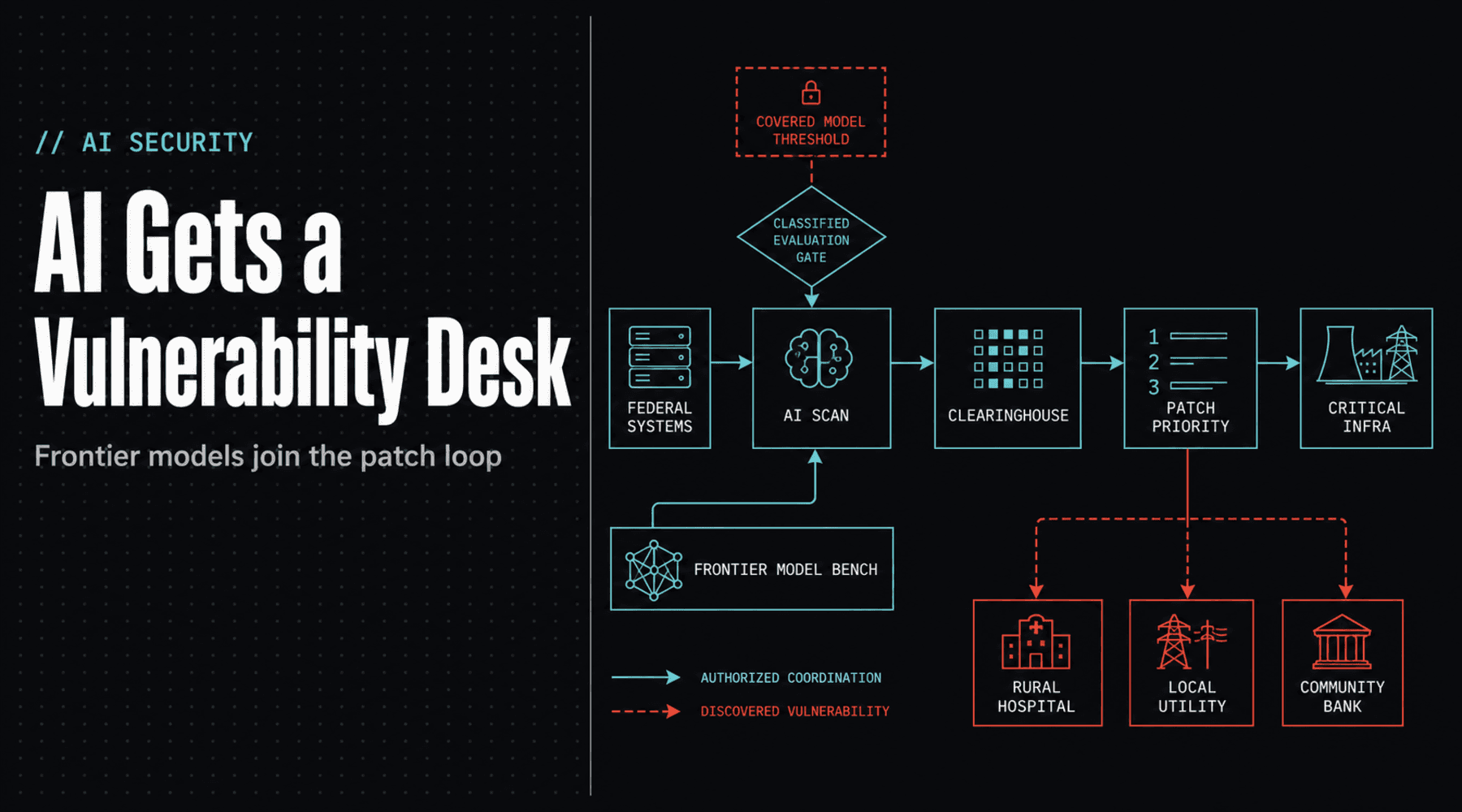
The useful part of the new AI cybersecurity order is not the ceremony around it. It is the plumbing. If frontier models are going to find bugs at machine speed, somebody has to decide who scans what, which findings are real, which patches matter first, and how the smallest operators get help before the loudest exploit wins.
That is the interesting bet inside the June 2 executive order on advanced artificial intelligence innovation and security, later published in the Federal Register on June 5. The order tells federal agencies to stand up an AI cybersecurity clearinghouse with industry and critical infrastructure operators. Its job is to coordinate vulnerability scanning, validate findings, deconflict duplicate work, prioritize remediation, and distribute patches.
Read that closely and it stops sounding like another AI policy memo. It sounds like a proposed dispatch desk for an era when vulnerability discovery becomes cheaper, faster, and more unevenly distributed.
model bench -> AI scan -> clearinghouse -> patch priority -> local operators
                  |             |                 |
              validation    deconflict        remediation queue
The scan is not the system
AI-assisted vulnerability discovery is advancing because models are good at reading unfamiliar code, mapping patterns, generating hypotheses, and running long boring checks that humans skip. That does not mean a model can safely be pointed at national infrastructure and left to improvise. Vulnerability discovery is part of a workflow. The workflow has legal boundaries, operational blast radius, false positives, sensitive targets, embargoes, patch windows, and owners who may not have a security team.
The order names rural hospitals, community banks, and local utilities as examples of the operators that could need access to AI-enabled defensive tools and services. That detail matters. The AI security boom cannot only serve hyperscalers, well-funded labs, and Fortune 100 companies. A model that finds a flaw in a hospital billing system or a water utility appliance has created a coordination problem, not just a technical win.
A clearinghouse is a way to admit that reality. It separates discovery from disclosure, and disclosure from repair. It gives the system a place to ask practical questions: is this finding reproducible, who owns the affected software, is there active exploitation, what dependencies are shared, which patches can be shipped first, and which operators need direct help?
More scanning without coordination is just a faster way to manufacture panic, duplicates, and unpatched risk.
Frontier models become measured tools
The order also calls for a classified benchmarking process to assess advanced cyber capabilities in AI models and determine when a model crosses the threshold for a covered frontier model. Developers could voluntarily engage with the government before release, provide secure early access under confidentiality and cybersecurity protections, and work with trusted partners to improve secure deployment.
That is a delicate lane, but the architecture is sensible if it stays voluntary and operational. Frontier models should not be treated as magic threat objects. They should be measured as tools with concrete capabilities. Can the model chain together exploit steps? Can it reason across a large codebase? Can it discover a bug that standard static analysis misses? Can it help a defender validate a patch without leaking sensitive details?
The important distinction is capability measurement versus licensing. The accompanying fact sheet says the order does not create mandatory licensing, pre-clearance, or permitting for AI model development or release. That line is not cosmetic. If benchmarking turns into a hidden permission regime, builders will route around it. If it becomes a serious test range that helps labs and defenders understand cyber capability before deployment, it can make acceleration cleaner instead of slower.
The bottleneck moves downstream
Security programs are used to thinking in terms of finding and fixing. AI changes both sides of that equation, but not equally. Discovery can scale faster than remediation. A model can generate hundreds of plausible leads. A hospital IT department cannot patch hundreds of systems before lunch. A vendor cannot triage every synthetic report if each one lacks reproduction steps, affected versions, exploitability notes, and a sane severity call.
That means the valuable layer is triage. A good AI clearinghouse would not be a trophy cabinet of discovered vulnerabilities. It would be a queue discipline system. It would group duplicate findings, attach evidence, map affected operators, route urgent fixes, suppress noise, and push patch status back into the loop.
- Validation: prove the bug exists and define the affected surface.
- Deconfliction: merge duplicate reports before vendors and operators drown.
- Prioritization: sort by exploitability, exposure, dependency reach, and operational harm.
- Distribution: move fixes to small operators that do not live inside a mature vulnerability-management program.
That is less glamorous than a demo where a model finds a zero-day. It is also where the public benefit lives.
Disclosure needs a governor
The risky version of this future is easy to picture. Labs race to show cyber capability. Agencies want fast wins. Vendors get reports faster than they can validate them. Operators receive vague warnings about systems they barely staff. Attackers watch the same model progress and compress the time between vulnerability discovery and weaponization.
The answer is not to slow AI security work into paperwork. It is to build a governor into the pipeline. Every finding needs an owner, a confidence level, a handling status, and a path to remediation. Every scan needs scope. Every model-assisted report needs enough evidence that a human can reproduce it without trusting the model's tone. Every critical infrastructure notification needs to say what to do next, not just what might be wrong.
This is where government can be useful without becoming the central inventor. It can convene operators, hold sensitive context, set disclosure norms, use procurement gravity, and fund the boring last mile. Industry still builds the models, scanners, patch tools, and developer workflows. The clearinghouse only works if it reduces friction for both sides.
AI security as public infrastructure
The best reading of the order is pro-acceleration and pro-discipline at the same time. Stronger models should be used to harden systems. The people running those models should also be honest that capability creates queues, obligations, and new failure modes. A frontier model that can find real vulnerabilities is not just a product feature. It is part of a national patch loop.
That loop will need more than one executive order. It needs evaluation methods that defenders trust, safe test environments, clear handling rules, liability-aware disclosure, vendor participation, operator funding, and a culture that treats remediation speed as seriously as discovery speed.
The takeaway is simple: AI is about to make vulnerability discovery feel abundant. The scarce resource will be coordinated repair. If the clearinghouse becomes a real operational desk instead of a policy label, it could turn model capability into public defense. If it does not, we will get a faster scanner attached to the same slow patch machine.
// Discussion
Comments
No comments yet. Start the thread.