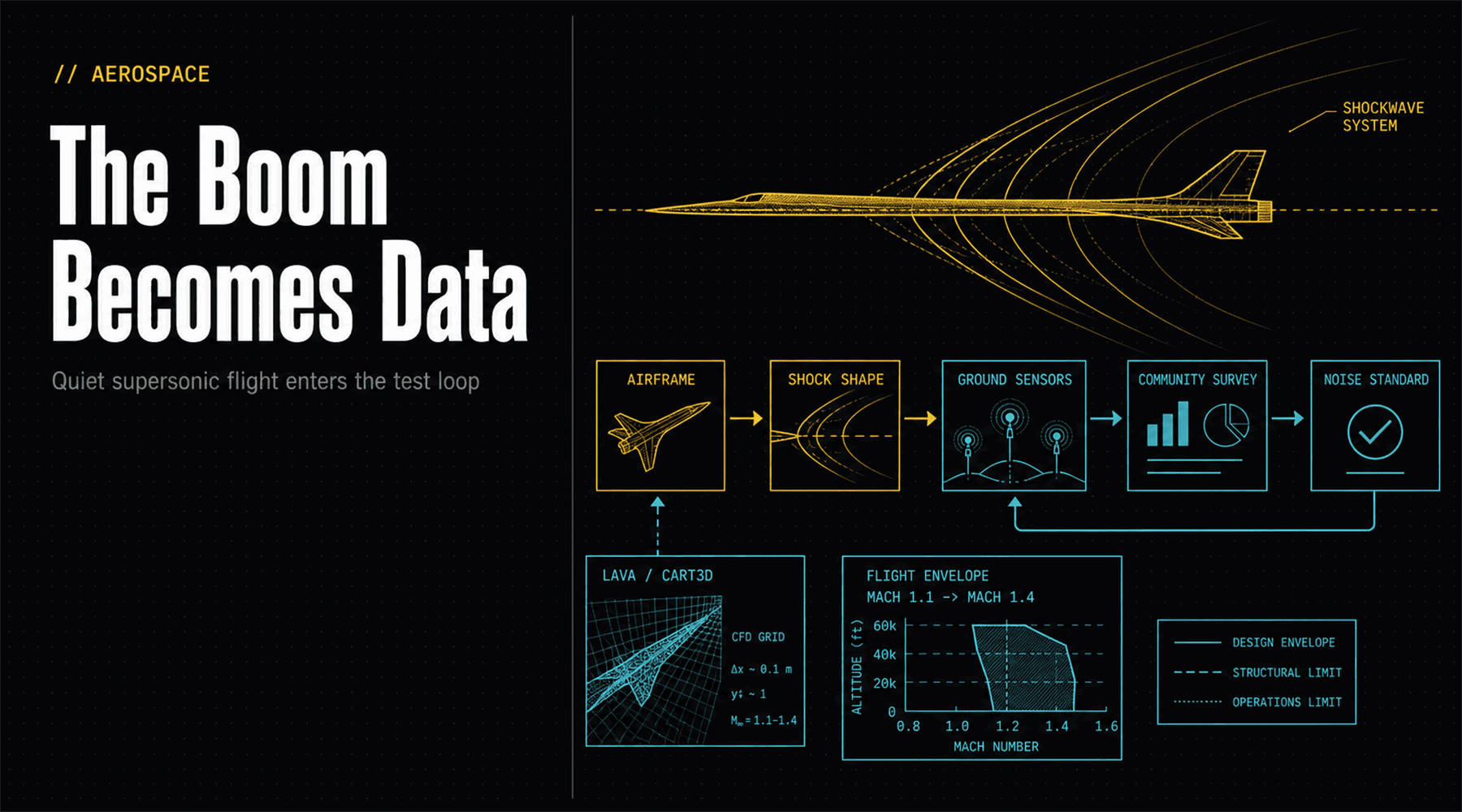
NASA's X-59 finally crossed the sound barrier on June 5, and the important part is not that an experimental airplane went fast. Aviation already knows how to do that. The important part is that NASA is trying to turn one of aviation's bluntest public nuisances into an engineered signal: measurable, repeatable, quieter, and useful enough for regulators to judge.
The X-59 reached about Mach 1.1, roughly 713 mph, during an 81-minute flight from Edwards Air Force Base. NASA says the aircraft climbed to 43,400 feet, then worked through subsonic and supersonic handling checks. A louder F-15 chase plane flew nearby, so this first run was not the public quiet-boom demonstration. It was a gate opening. The aircraft has now entered the part of its test envelope where the whole Quesst mission starts becoming real.
That distinction matters. The X-59 is not a passenger prototype. It is a standards instrument with wings.
airframe shape -> shock pattern -> ground sound -> community survey -> noise standard
+ CFD database + flight data + sensors + regulatorsThe speed is the easy headline
Supersonic flight over land has been boxed in for decades because sonic booms are not just loud. They are distributed. A boom is not a single airport-adjacent noise event. It follows the aircraft's path, crossing homes, schools, farms, suburbs, and cities that receive no benefit from the flight overhead.
That is why the X-59's first supersonic flight should be read as a public-infrastructure test, not a nostalgia act for Concorde. NASA's target is not merely to prove that a long, narrow jet can fly past Mach 1. The target is to produce a lower-intensity sonic thump, gather human response data from communities, and hand that evidence to U.S. and international regulators. If the data is convincing, the old blanket logic around overland supersonic flight can be replaced by thresholds that describe what is actually acceptable on the ground.
The aircraft's next major target is closer to mission conditions: Mach 1.4 at roughly 55,000 feet. NASA describes those as the base conditions for later community overflights. That is where the story changes from envelope expansion to acoustics, perception, and policy.
The X-59 is not trying to make the sound barrier disappear. It is trying to make the sound barrier governable.
A plane designed around shock waves
The X-59 looks strange because the physics is strange. When an aircraft flies faster than sound, pressure waves stack into shock waves. Traditional shapes can concentrate those shocks into a boom that reaches the ground as a sharp blast. X-59's long nose, slender body, swept wing, top-mounted engine, and carefully shaped outer mold line are all meant to spread and soften the shock pattern before it becomes ground noise.
That shape creates its own engineering tradeoffs. The nose is so long and skinny that the pilot cannot rely on a conventional forward window. NASA uses an eXternal Vision System, or XVS, that combines sensors, computers, and high-definition displays to provide the forward view. The aircraft is therefore a test bed for quiet supersonic aerodynamics and also for the practical cockpit systems needed when the airframe itself is shaped around acoustics rather than pilot sightlines.
The top-mounted engine is part of the same logic. Put the engine above the fuselage and more of its noise is directed away from people below. Stretch the vehicle to nearly 100 feet while keeping it narrow and the aircraft begins to look less like a familiar jet and more like a shock-wave management device.
The software behind the thump
The most Tundrabit part of the X-59 is that the airplane is inseparable from its computation. NASA's Advanced Supercomputing division has used agency-developed tools, including LAVA and Cart3D, to simulate design iterations and build a large supersonic performance database. Those simulations are not just pretty flow visualizations. They feed planning tools that help pilots fly profiles expected to hit target noise levels during tests.
That makes the X-59 a modern aerospace stack: high-performance computing, computational fluid dynamics, flight instrumentation, chase-plane validation, acoustic sensors, public surveys, and regulatory evidence. The aircraft is the visible object. The system around it is what could change aviation.
This is also why one successful Mach 1.1 flight is not enough. Low-boom claims have to survive the boring parts: repeated test points, varied atmospheric conditions, instrumentation errors, pilot procedure, maintenance, and the messy reality that people experience sound differently. A technically elegant thump still has to be acceptable to the people under the flight path.
Regulation needs measurements, not vibes
There is a clean reason NASA is doing this rather than leaving it entirely to aircraft startups. A new overland supersonic market cannot be created by sales decks. It needs standards. Standards need data. Data needs a repeatable source. The X-59 is built to be that source.
NASA says it will share community-response data with U.S. and international regulators to help establish new acceptable noise thresholds. The Federal Aviation Administration and the International Civil Aviation Organization are the kinds of bodies that need this evidence before the rules can move. That does not guarantee a commercial boom in quiet supersonic travel. It does mean the argument can shift from whether supersonic aircraft are categorically too disruptive to what measurable sound profile should be allowed.
That is a healthier fight. It invites engineering constraints instead of slogans. How loud is the thump? How often can it occur? At what altitude? Under what weather? Over what routes? With what certification tests? Those are questions a serious industry can build toward.
Fast travel still has to earn its footprint
Quieting the boom does not solve every supersonic problem. Fuel burn, airport operations, emissions, ticket economics, maintenance costs, and route networks still matter. A quieter aircraft can still be an expensive and inefficient aircraft if the rest of the design misses. The X-59 should not be treated as proof that supersonic airliners are automatically back.
But it does attack the problem that made overland supersonic flight politically and socially dead on arrival. If the boom can be softened enough, and if the data can prove it in public, designers get room to work on the remaining constraints. That is how dormant categories come back: not through one magic vehicle, but through a set of constraints that become solvable again.
The first supersonic X-59 flight is a milestone because it moves the project from design promise into measured flight behavior. The coming flights matter more. Mach 1.4. Sound-profile validation. Community overflights. Survey data. Regulator packets. That is the path from experimental aircraft to possible rule change.
The takeaway is simple: NASA did not just push a needle past Mach 1. It started converting the sonic boom from a public complaint into an engineering variable. If Quesst works, the future of supersonic travel over land will be decided less by romance about speed and more by whether the thump can pass the data test.
// Discussion
Comments
No comments yet. Start the thread.