The modern development environment is becoming part of the product.
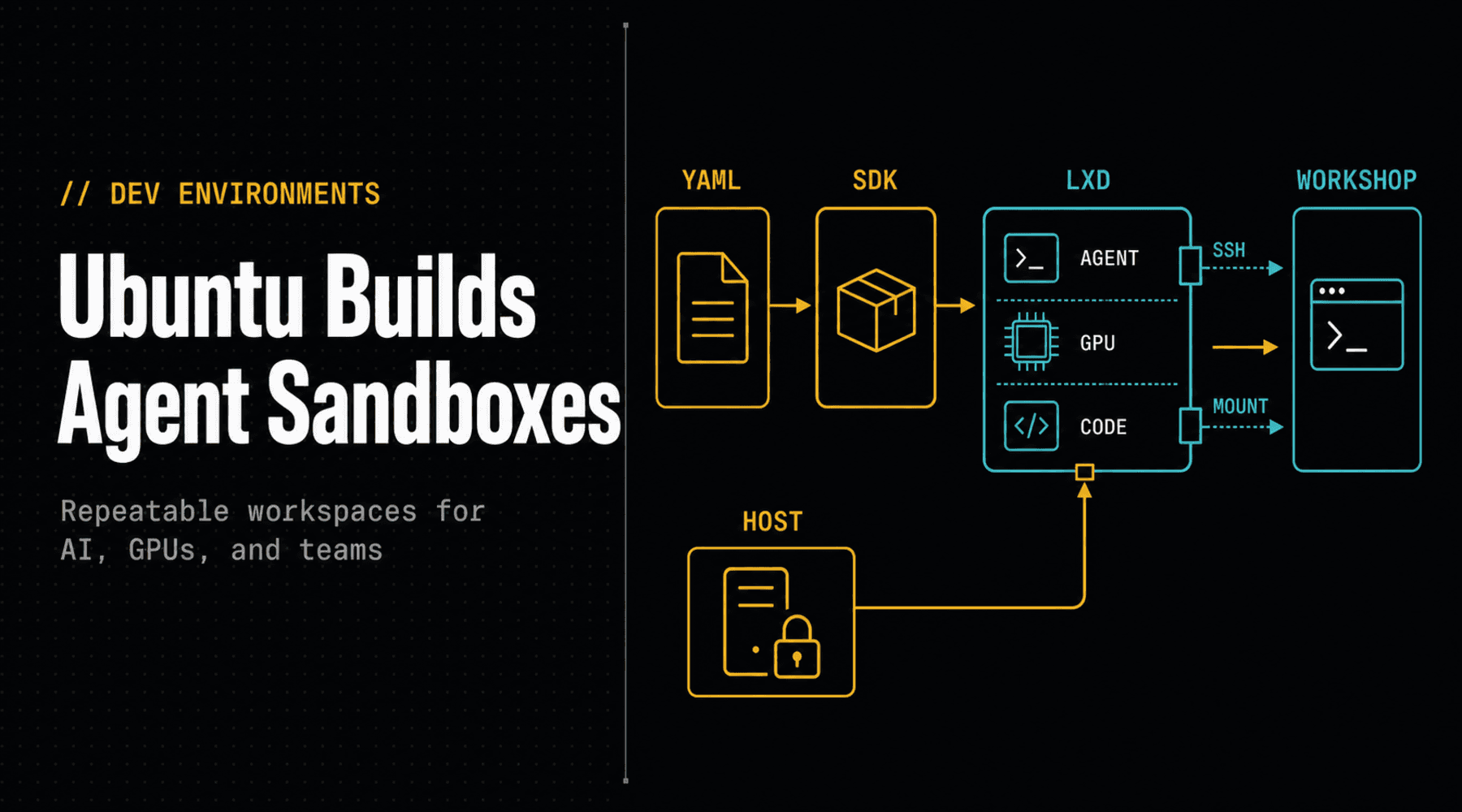
Canonical's new Workshop tool makes that point directly. Announced on May 27 and surfaced through Phoronix, Workshop is a Snap-packaged system for launching repeatable Ubuntu development environments from YAML definitions. The pitch is simple: describe the environment once, share it with the project, and recreate it on another machine or in a pipeline without rebuilding a fragile workstation by hand.
That sounds like familiar developer convenience until you look at the workloads Canonical is aiming at. Workshop is built for agentic AI, AI and ML, robotics, IoT, education, GPU software, and other areas where the environment is rarely just a language runtime plus a package manager. It is often a pile of Ubuntu versions, SDKs, drivers, container images, IDE integrations, hardware access, SSH forwarding, mounts, notebooks, and local automation. The painful part is not writing code. The painful part is getting the same code to run in the same shape twice.
YAML becomes the workbench
Workshop environments are defined by YAML files. Those definitions can be version controlled, copied across machines, and shared by teams. Canonical says the core building blocks are SDKs: composable units of functionality that can come from the SDK Store or live inside a repository. The examples Canonical gives are telling: Ollama, OpenCode, NVIDIA CUDA, and AMD ROCm.
That is the right level of abstraction. A developer should not have to remember a page of installation steps for every machine, and a team should not have to debug one person's local CUDA stack for the fourth time this month. If the environment is important to the work, it belongs in source control beside the work.
Workshop is not just a templating wrapper. It builds on LXD and runs workloads inside unprivileged system containers. The environment is meant to be fast to create, easy to tear down, and reproducible after updates. That matters because experimentation is messy. Developers need a place where they can try new toolchains, model runners, SDK versions, and hardware interfaces without slowly poisoning the host system.
Agent-ready is the interesting phrase
Canonical's documentation calls Workshops secure, fast, composable development environments that come agent-ready. That phrase deserves attention. AI coding agents are no longer a sidecar that writes snippets into an editor. They run commands, inspect projects, start services, edit files, and sometimes operate inside CI. The environment they inhabit becomes a security boundary and a collaboration boundary.
Workshop gives that boundary a more explicit shape. Canonical describes an interface system inspired by snapd for allocating host resources. Instead of letting every SDK invent its own way to reach the desktop, GPU, SSH agent, mounts, camera, network tunnel, or other host capability, Workshop pushes those requests through a common model. That is exactly where agent tooling needs to go.
The lesson from recent agent security work is that prompts are not enough. A human approving a command, or a team trusting a repo, does not make an environment safe. The agent needs a contained workspace with limited default privileges, visible resource grants, and a clean teardown path. Workshop is one more sign that the industry is moving from clever assistants toward managed agent infrastructure.
This is not just Docker again
Containers already exist, and many teams use Dockerfiles or devcontainers for repeatable environments. Workshop is interesting because Canonical is trying to make Ubuntu-native system-container environments feel like a product surface: SDKs, interfaces, project movement, IDE connections, JupyterLab, GitHub Actions, AI-agent usage, and host resource controls are all documented as first-class pieces.
That is useful in the domains Canonical names. Robotics and embedded work often need real device access. ML work needs GPUs and large native libraries. Education needs setups students can reproduce without becoming sysadmins. Agentic engineering needs sandboxes that a tool can enter without getting broad access to the host. A plain container recipe can handle some of that, but the operational details get sharp quickly.
Workshop's bet is that the development environment should be assembled from shareable capabilities, not tribal setup notes. A GPU SDK, an agent runner, a project checkout, and a mounted dataset can become a defined composition. That composition can be launched, upgraded, inspected, and destroyed.
The security tradeoff is the product
The most important sentence in Canonical's announcement is not about speed. It is Dmitry Lyfar's line that ease of use for developers should not mean ease of access for AI agents. That is the tension every serious agentic-development tool now has to solve.
Developers want low friction. Agents need limits. Hardware work needs access to the real machine. Security teams need repeatable policy. Workshop's interface model is an attempt to make those requirements compatible instead of pretending one side wins. Host resources are not invisible magic. They are explicit capabilities.
There will be hard details. Teams will need to decide who publishes SDKs, how SDKs are reviewed, what host interfaces are allowed, how CI environments differ from laptops, and how secrets are kept out of agent reach. Canonical's first release will not make those decisions disappear. But it gives them a place to live.
Development environments are infrastructure now
The broader shift is clear. We used to treat the developer machine as personal territory and the build system as the official path. Agentic tooling makes that split awkward. If agents write code, run tests, launch services, and poke at dependencies, their workspace is part of the software supply chain.
Workshop is Canonical's answer to that pressure: make the workspace reproducible, make capabilities explicit, and make the sandbox normal enough that teams use it before something goes sideways. That is a healthy direction. The future of AI-assisted development will not be won by the agent that can run the most commands on the least protected laptop. It will be won by tools that make powerful automation feel boringly containable.
The takeaway is simple: Canonical is turning the Ubuntu dev box into a defined object. For AI agents, GPU software, robotics stacks, and distributed teams, that is more than convenience. It is the control plane for how work actually happens.
// Discussion
Comments
No comments yet. Start the thread.