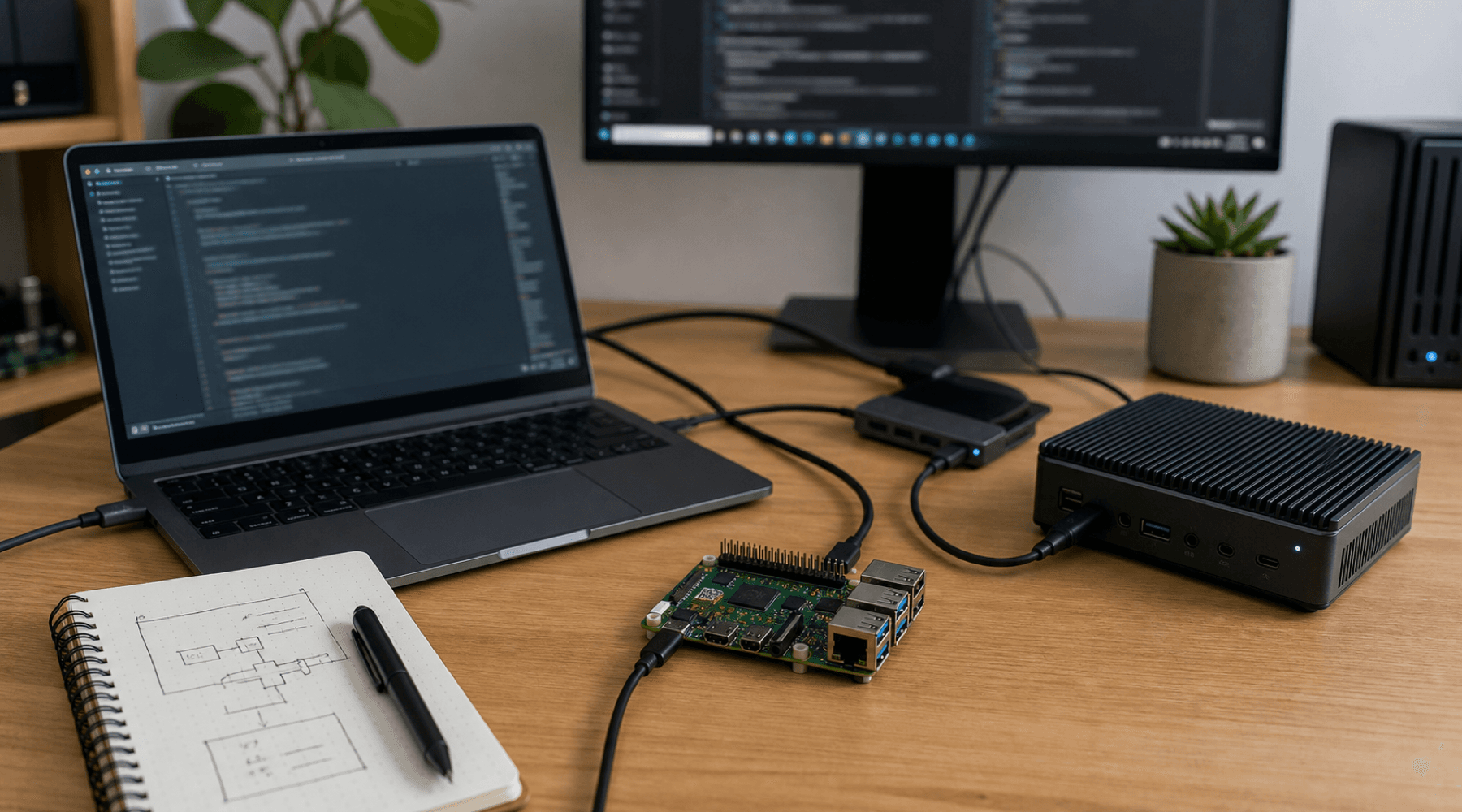
The useful milestone in Ubuntu's ARM64 work is not that another board boots Linux. That part has been true for years. The useful milestone is that Canonical is treating ARM64 less like a side lane and more like ordinary Ubuntu infrastructure.
Phoronix highlighted Canonical's latest Ubuntu-on-ARM update, and the upstream post from Ubuntu Foundations Engineering Manager Ravi Kant Sharma is worth reading as a systems checklist. The story is not one benchmark, one laptop, or one silicon vendor. It is package distribution, kernel servicing, boot trust, emulation, snaps, browser DRM, and hardware enablement all moving in the same direction.
Architecture support becomes real when the boring paths stop being special cases.
The Archive Move Is The Signal
The most important change is also the least glamorous. Starting with Ubuntu 26.04, ARM64 packages have moved from ports.ubuntu.com into the main archive.ubuntu.com infrastructure. Canonical says the migration is complete for 26.04 and is being backported to Ubuntu 24.04 LTS.
That sounds like mirror plumbing because it is mirror plumbing. It also changes the user experience. Packages served through the main archive inherit the same mirror network path as AMD64 packages, which should improve availability, reliability, and download performance for ARM64 users. More importantly, it removes a category boundary. ARM64 is no longer treated as a ports architecture for normal package delivery.
old path: arm64 package -> ports archive -> smaller mirror surface
new path: arm64 package -> main archive -> ordinary Ubuntu mirror flow
The Ubuntu post notes that this took coordinated changes across cloud-init, live-build, livecd-rootfs, ubuntu-release-upgrader, and release infrastructure. That is the important part. Architecture parity is rarely a single switch. It is a long trail of scripts, builders, installers, images, mirrors, and upgrade paths that all have to stop assuming the mainstream path means one CPU family.
Livepatch Moves ARM64 Into The Operations Loop
Canonical also announced Livepatch for ARM64 on June 23, 2026. Ubuntu ARM64 systems can now receive critical kernel security fixes without requiring a reboot, bringing ARM64 closer to the operational behavior administrators already expect from Ubuntu on AMD64.
For servers, edge systems, and developer workstations, that matters because uptime behavior is part of platform credibility. A machine can be technically supported and still feel second-class if every serious kernel fix forces a maintenance window that the primary architecture avoids.
The implementation details are the real story. Canonical says ARM64 Livepatch required upstream kernel and toolchain work, native ARM64 build-farm capacity, and architecture-specific regression testing. That is the difference between a feature checkbox and an operations contract. If kernel patches are going to land without reboots, the build and test machinery has to be as serious as the promise.
Laptops Need Boot Trust, Not Just Boot Logs
The desktop and laptop side has been moving too. Ubuntu 25.04 introduced support for Qualcomm Snapdragon X Elite laptops through the generic ARM64 desktop ISO. The next hard problem was Secure Boot, because these machines need device trees that the firmware does not provide to Linux.
Canonical's answer is stubble, an EFI stub that embeds the required device trees into the signed kernel image. Since that binary goes through Ubuntu's existing Launchpad signing pipeline, the boot path can work with Secure Boot without inventing a separate trust chain. Ubuntu 25.10 picks up that capability for Snapdragon X Elite laptops, and Ubuntu 26.04 LTS is the first LTS release to include it.
That is a good example of the kind of work ARM64 laptops need. The obstacle is not merely whether Linux can run. It is whether the generic installer, firmware expectations, signing pipeline, and long-term release model can line up well enough that users do not feel like they are carrying a science project.
The Ecosystem Gap Is Shrinking
Canonical's update also points to the less pure but very practical user-space work. The Steam snap for ARM64 reached stable in June 2026, bundling the x86-only Linux Steam client with FEX so AMD64 games can run on supported ARM hardware. The post is clear that this is Canonical enablement on top of Valve's and FEX's work, not a Valve-supported ARM Steam client.
That caveat matters, but so does the direction. Emulation is not a substitute for native software everywhere. It is, however, one way to make an emerging desktop architecture livable while native coverage improves.
Browser and media support are part of the same practical layer. Ubuntu's post notes that Google Chrome for Linux on ARM64 is planned for 2026 with built-in Widevine support. That should remove a recurring workaround class for protected browser playback and also help snaps such as Firefox and Spotify integrate ARM64 Widevine support. Meanwhile, more desktop snaps, including productivity and engineering applications, are publishing ARM64 builds.
- For server operators: main archive delivery and Livepatch make ARM64 look more like an ordinary fleet target.
- For laptop users: generic ISO support and Secure Boot work reduce the custom-image tax.
- For developers: better package mirrors, snaps, and browser support lower the daily friction of using ARM64 as a primary workstation.
- For hardware vendors: CIX P1 support shows the work is broadening beyond one ARM laptop vendor and one boot model.
The Takeaway
Ubuntu's ARM64 update is useful because it focuses on the unromantic parts of platform maturity. A first-class architecture is not proven by a launch demo. It is proven by archives, upgrade tooling, kernel patching, signed boot flows, application packaging, media support, and the absence of special-case instructions in ordinary workflows.
ARM64 is already important in cloud, edge, single-board computers, and laptops. The harder question is whether a general-purpose Linux distribution can make those machines feel boring to run. Canonical's latest work says the answer is moving from hardware enablement toward platform normalcy.
That is the right kind of progress. Not louder ARM hype. Fewer places where users have to remember they are on ARM at all.
// Discussion
Comments
No comments yet. Start the thread.