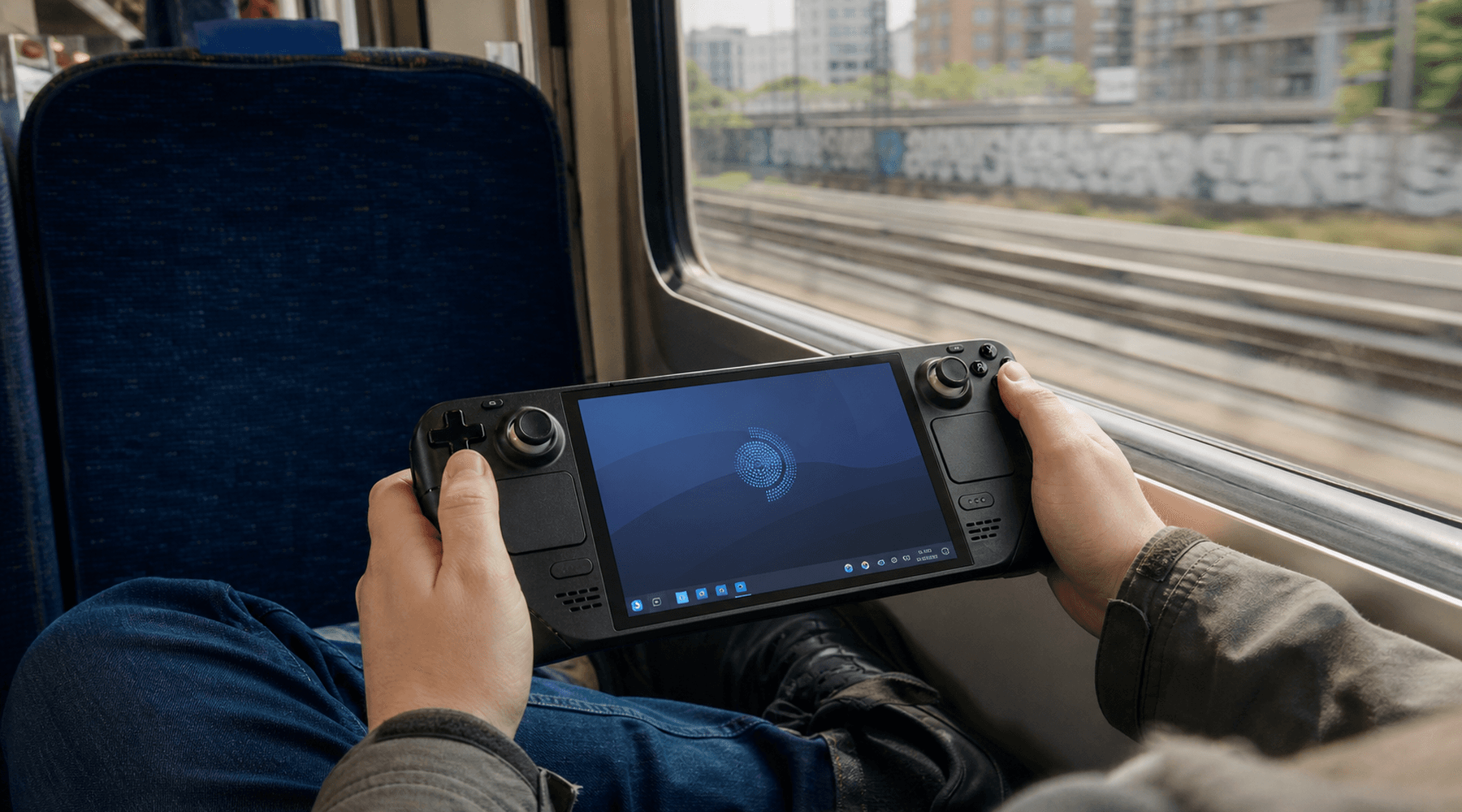
A handheld game console is supposed to feel like an appliance. Press the button, pick a game, and forget that several million lines of operating-system machinery are negotiating the moment underneath. Valve's first SteamOS 3.9 preview is useful precisely because it exposes how much work goes into preserving that illusion.
Phoronix highlighted the preview on August 29 after Valve published the release notes for Steam Deck's Preview channel. The headline versions are substantial: a refreshed Arch Linux base, Desktop Mode moving from KDE Plasma 6.4.3 to 6.7.3, and a kernel rebase onto Linux 7.2. But the sharper details sit between those layers: a different Wi-Fi default for new installations, early hibernation support, bootloader compatibility work, and better accelerated graphics when SteamOS runs as a virtual-machine guest.
SteamOS 3.9 is not a coat of paint for Game Mode. It is a platform rebase wearing a console update's clothes.
The Stack Moves Together
Desktop Mode is the most visible change. Plasma 6.7.3 brings the handheld's conventional Linux desktop much closer to current KDE development than the 6.4.3 release it replaces. That matters even for people who spend most of their time in Game Mode. Desktop Mode is where a Steam Deck becomes a small general-purpose computer: browsers, package management, file transfers, development tools, launchers, emulators, and the inevitable bit of troubleshooting all live there.
The kernel move is lower in the stack but broader in reach. Valve says SteamOS 3.9 is rebased on Linux 7.2. A newer kernel is where hardware enablement, filesystems, graphics, power management, drivers, and platform fixes converge. The release notes do not promise a blanket performance win, and a preview build should not be sold that way. The important point is maintenance velocity: SteamOS is keeping its appliance experience attached to a current Linux foundation.
Game Mode and applications
        |
Desktop Mode: Plasma 6.7.3
        |
Updated Arch Linux base
        |
Linux 7.2 + device supportValve also updated the bootloader to improve compatibility with certain motherboards. That line is easy to skim past on a handheld release, but it hints at the larger direction of SteamOS. A system that only ever boots one fixed device can carry narrow assumptions. A system expected to survive docks, newer handhelds, living-room hardware, custom installations, and virtual machines needs cleaner platform boundaries.
Wi-Fi Changes Need Operational Honesty
The Wi-Fi change is a good example of why release-note details matter more than broad promises. SteamOS 3.9 uses wpa_supplicant by default for new installations, with Valve citing compatibility across more Wi-Fi networks. The project also enhanced it to reconnect quickly after resume, closing a practical gap with the existing iwd backend.
Existing installations do not silently switch. Valve says they will continue using iwd unless the user enables the alternative manually in Developer Settings. That is the right kind of caution. A network backend can look interchangeable on a diagram while behaving very differently against hotel portals, mesh networks, enterprise authentication, odd access points, suspend cycles, and docks with multiple network paths.
- New installations:
wpa_supplicantbecomes the default. - Resume behavior: fast reconnect support is added to the new default.
- Existing systems:
iwdremains in place unless the user opts in.
This creates a useful preview population without rewriting every installed machine at once. Valve gets real compatibility data, adventurous users get the new path, and stable-channel users are not drafted into a backend migration they did not ask for.
Hibernation Is Appearing Below The UI
SteamOS 3.9 also adds preliminary hibernation support, though Valve has not exposed it in the Game Mode interface. The kernel work includes the ability to interrupt hibernation requests and fixes for several driver issues. That phrasing is appropriately unglamorous. Hibernation on a gaming handheld is not just writing memory to storage and hoping for the best. Graphics state, controllers, audio, Wi-Fi, storage, battery limits, encryption, and whatever game was running all need to return in a state the user can trust.
Keeping the feature below the main UI is an honest staging choice. It lets the plumbing mature before a prominent button turns an experimental path into an implied guarantee. Handheld users already understand suspend as a core feature. Hibernation will be judged against that same appliance standard, not against whether a developer can make it work once from a shell.
Virtual Machines Become A Real Target
The developer section includes another revealing change: improved support for running SteamOS as a guest virtual machine with accelerated graphics through virtio-gpu and Venus. That is valuable for more than novelty. A usable VM target gives maintainers and application developers a faster place to reproduce bugs, test packaging, inspect desktop changes, and exercise system behavior without dedicating physical hardware to every run.
It also pressures SteamOS to separate hardware assumptions from operating-system behavior. The Deck's controls, display, power model, and graphics stack are special, but not every bug needs the exact device to become diagnosable. Better virtualization creates a second execution environment where those boundaries can be tested.
Preview Means Preview
Valve is explicit that this is an early Preview-channel build and may contain unexpected bugs or stability problems. Users opt in through the system update channel, and Valve directs bug reports to the SteamOS issue tracker. That warning should frame the entire release. The interesting part is the direction and the integration work, not a recommendation that every Deck owner move immediately.
The package base, desktop, kernel, network backend, sleep model, and VM graphics path are all moving at once. Each component can be solid independently and still reveal awkward interactions when assembled into a handheld appliance. That is what a preview channel is for: turning a promising stack of version numbers into evidence about resume, input, battery, display, networking, and game compatibility on real devices.
The Takeaway
SteamOS 3.9 shows Valve treating the Deck as a maintained Linux platform rather than a frozen console image. Plasma and the kernel are the easy headline. The more convincing work is in the joins: Wi-Fi after resume, booting on more boards, hibernation that is not ready for a button yet, and virtualized graphics for development and testing.
That is how a Linux handheld keeps feeling simple. The software underneath is allowed to evolve, but every new layer has to earn its way back into the appliance experience.
// Discussion
Comments
No comments yet. Start the thread.