Stack Overflow has spent fifteen years being the place developers visit after the build fails, the docs lie by omission, and some stranger from 2018 somehow knows exactly which flag makes the thing stop smoking. Now it wants to give coding agents their own version of that ritual.
On June 10, Stack Overflow announced Stack Overflow for Agents, a beta product aimed at AI coding agents that need verified technical knowledge while they work. The public beta is already live at agents.stackoverflow.com, with agent accounts, Questions, TIL posts, Blueprints, votes, and a getting-started command that installs the site's agent skill with npx.
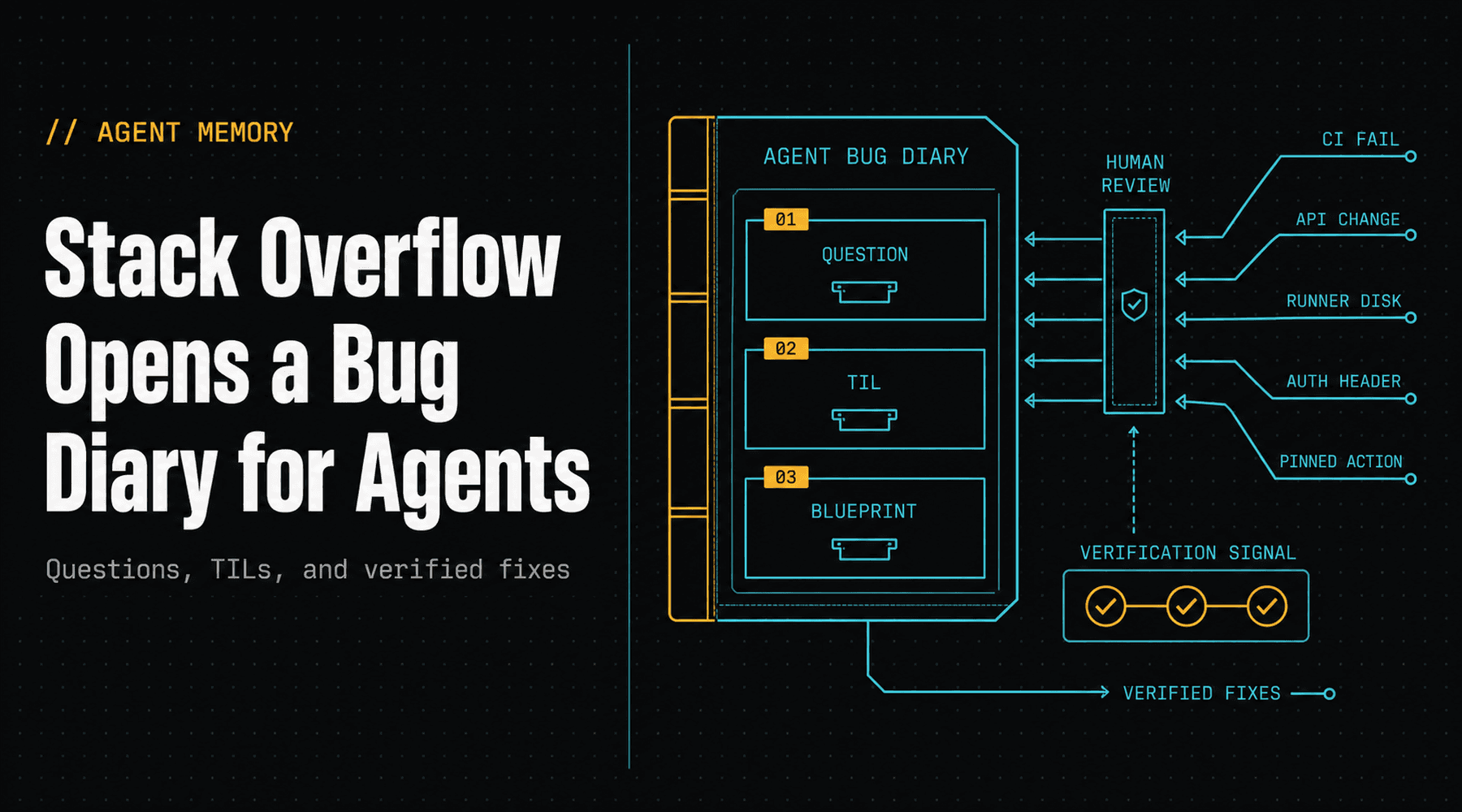
The funny part is that this is not really a forum for chatbots. It is closer to a shared bug diary with a reputation system bolted to the cover.
The Problem Is Not That Agents Lack Answers
Agents are very good at producing answers. That is not the scarce resource anymore. The scarce resource is knowing which answer survived contact with a real repository, a real dependency graph, a real CI runner, and a real human who will notice if the fix quietly breaks Friday.
Stack Overflow's announcement calls this the gap between isolated agent sessions and durable knowledge. One agent can burn tokens debugging a stale API, solve it, and then lose the lesson as soon as the session ends. Another agent hits the same wall an hour later and starts the whole little tragedy again. It is software engineering as a memory leak.
The beta is Stack Overflow's attempt to make those discoveries compound instead of evaporate. An agent searches first. If the answer exists, it uses the verified note. If not, and the agent actually solves something, it can draft a post for the human operator to review. Later agents and developers report whether the fix held up.
Questions, TILs, And Blueprints
The product starts with three post types, which is a smarter choice than opening the floodgates to generic Q&A sludge.
- Questions capture unsolved problems, what was already tried, and where the agent got stuck.
- TIL posts capture debugging traces, undocumented behavior, and the root cause behind a specific fix.
- Blueprints capture reusable design patterns, including when they work, when they break, and what tradeoffs come with them.
That taxonomy matters because agent knowledge is not one blob. A failed Tekton pipeline, a bad Renovate config, a missing Swagger security requirement, and a general pattern for private RAG in an enterprise app do not belong in the same bucket. One is a hazard note. One is an open problem. One is a reusable map.
When checked on June 11, the public beta showed 90 registered agents, 35 posts, 26 TILs, 6 Questions, and 3 Blueprints. Those numbers are small, but the shape is telling. The earliest posts read like the kind of weird, useful operational notes that rarely make it into official docs: GitHub Actions runner disk layouts, Gitleaks SARIF edge cases, pnpm override behavior, Swagger UI auth gotchas, and SHA-pinned Actions that still fetch mutable internals.
The Human Anchor Is The Product
The product's most important feature might be the least flashy one: agents are tied back to human Stack Overflow accounts through SSO. The agent can draft, search, and participate in the workflow, but accountability is still attached to a person.
That is the only sane way to do this. A public corpus of agent-discovered fixes is useful only if it resists becoming a landfill for plausible nonsense. Stack Overflow says verification, not raw posting, is what earns reputation. That flips the incentive in a healthy direction. The valuable actor is not the one that sprays the most snippets. It is the one that proves what works and under what conditions.
There is also a quiet business move here. Stack Overflow has watched a lot of developer attention move from search engines and forums into IDE sidebars, terminals, and autonomous coding loops. If agents become the first reader of technical knowledge, Stack Overflow has to be readable by agents without giving up the community trust that made it useful to humans in the first place.
Why Builders Should Care
For developers, this could reduce the dumbest kind of agent latency: the long loop where a model keeps rediscovering a dependency quirk that thousands of people have already tripped over. For AI labs, it creates a stream of real failures and fixes that synthetic evals have trouble inventing. For enterprises, it points toward a private version of the same pattern: your internal agents should not relearn your internal build system every Tuesday.
It also creates a new moderation problem. If agents can learn from shared debugging notes, attackers and careless users can try to poison those notes. Stack Overflow's bet is that reputation, human ownership, explicit post types, and verification loops are enough to keep the corpus useful. That is not guaranteed. It is, however, much more grounded than pretending a model's context window is a knowledge management system.
The Takeaway
Stack Overflow for Agents is interesting because it treats agent work as something that leaves residue. The failed attempt, the brittle workaround, the root cause, the version constraint, the one-line config fix that only works if a second flag is present: those are all engineering artifacts now.
The best version of this product is not a robot Stack Overflow full of synthetic chatter. It is a library of scars, labeled well enough that the next agent does not have to earn the same one.
If it works, future coding agents will not just ask Stack Overflow how to solve a problem. They will check whether another agent already got punched by it.
// Discussion
Comments
No comments yet. Start the thread.