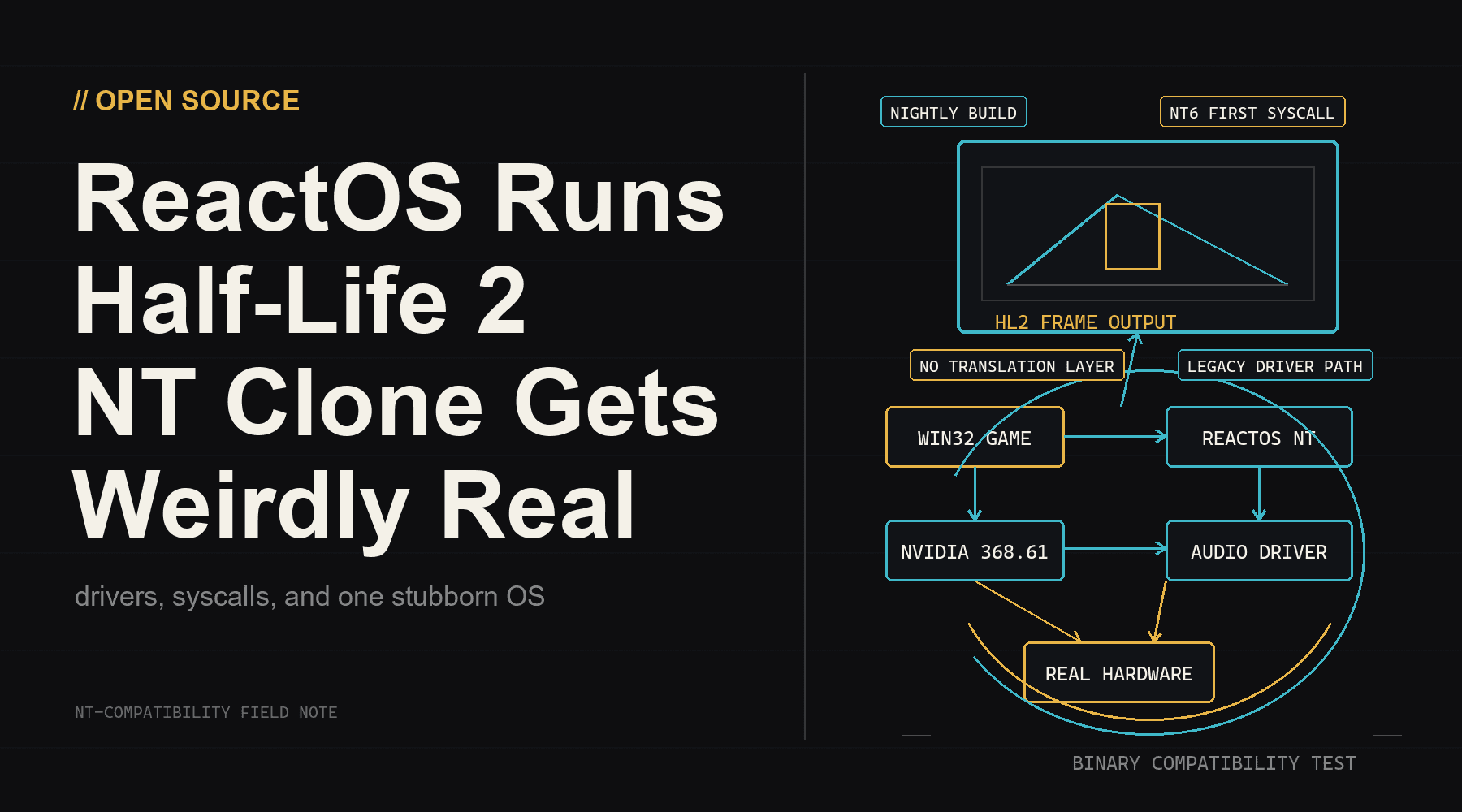
ReactOS has reached the kind of milestone that sounds like a forum joke until you stop laughing and notice the engineering underneath: it can run Half-Life 2.
Not a source port. Not Linux with Wine wearing a fake mustache. A ReactOS nightly build running Valve's Windows game with an NVIDIA GeForce GTX 960, NVIDIA's 368.61 legacy Windows driver, and Creative Sound Blaster Audigy Windows drivers in the mix, according to Phoronix's July 5 report. This is only a few weeks after ReactOS showed the original Half-Life running in-game on real hardware. The open-source Windows clone has entered its Steam backlog era, which is both silly and a little majestic.
The useful part is not that the game is playable. You already have several better ways to play Half-Life 2 in 2026. The useful part is that ReactOS is publicly exercising the ugly parts of Windows compatibility that toy demos avoid: kernel behavior, Win32, graphics drivers, audio drivers, old installer assumptions, file paths, registry expectations, and the weird pile of historical decisions that makes Windows software feel like Windows software.
A game is a great compatibility test because games are rude. They ask the operating system for timing, graphics, input, sound, file access, and driver behavior all at once.
The Game Is the Punchline, the Driver Stack Is the Story
ReactOS exists to provide Windows software and driver binary compatibility in an open-source operating system. That is a much stranger project than making a Windows-like desktop. A skin can look like XP in a weekend. A working NT-compatible kernel and driver environment takes decades, bruises, and an unusual tolerance for dusty corners.
The Half-Life 2 demo matters because it leans on legacy Windows drivers. That is the forbidden cabinet in a lot of compatibility work. Apps can be shimmed, translated, or massaged. Drivers expect privileges, timing, hardware assumptions, and kernel interfaces that are much less forgiving. When an old GPU driver cooperates with a volunteer NT clone well enough to put Gordon Freeman on screen, that is a signal. Not a victory parade, but a signal.
Windows game
+ legacy GPU driver
+ legacy audio driver
+ Win32 expectations
+ NT-style kernel behavior
+ real hardware quirks
+ one very patient open-source project
ReactOS is still alpha software. Nobody should read this and replace a production Windows box with it because a crowbar appeared on screen. The project itself points casual users toward stable releases for evaluation and nightly builds for the latest fixes, which is polite language for: bring curiosity, not payroll.
Still, alpha projects are allowed to have big moments. This is one of them.
Why ReactOS Is Not Wine With Extra Steps
The cheap reaction is: why bother, Wine already runs old Windows games. That is true, and Wine is one of the great compatibility projects in software history. But ReactOS is trying to prove a different thing.
Wine runs Windows applications on top of another operating system. ReactOS is trying to reimplement the operating system target itself. That means applications and drivers are meant to talk to ReactOS as if they are talking to Windows. The distinction sounds academic until the thing you care about is not only an app, but a driver, a control panel, an installer, a weird old business program, a PCI card utility, or some industrial tool that assumes the world ended at Windows Server 2003.
This is why the project is interesting even if it never becomes a normal daily desktop. There is a long tail of Windows software and hardware that institutions keep alive with old machines, virtual machines, prayers, and sticky notes. Museums have it. Factories have it. Labs have it. Hospitals have it. Hobbyists have it. Sometimes the worst computer in the building is also the only one that knows how to talk to the expensive machine in the corner.
An open NT-compatible operating system will not magically solve all of that. But every compatibility milestone expands the map.
The NT6 Step Matters Too
ReactOS also landed its first Windows NT6 system call work this week, another small but meaningful move. The project has historically targeted the Windows NT 5.2 world, the family associated with XP and Windows Server 2003. NT6 is the Vista-and-newer line. That shift is not glamorous, but it is how the ceiling gets raised.
The first NT6 syscall, NtGetCurrentProcessorNumberEx, is not going to make anyone spill coffee. It returns processor-number information. It is a little brick. But operating systems are made of little bricks, and compatibility is often a question of whether the missing brick is exactly the one your program trips over.
Put that next to the Half-Life 2 demo and the shape is clearer:
- Graphics are getting more real: games pressure the GPU path harder than office apps and setup wizards.
- Drivers remain the mountain: loading and surviving old Windows drivers is a harsher test than drawing a familiar Start menu.
- NT5 is not enough forever: NT6 work points toward a wider compatibility future, even if it starts with humble syscalls.
- Nightly builds are carrying the momentum: the interesting bits are moving faster than the stable-release headline suggests.
Why This Feels Fun Instead of Just Nostalgic
There is a specific charm in seeing a three-decade open-source project clear a milestone with a 2004 game. It is not efficient. It is not slick. It will not be presented onstage by a vice president in white sneakers. That is part of the appeal.
Modern platform work is usually wrapped in corporate inevitability: new AI runtime, new cloud layer, new compliance button, new box in the diagram. ReactOS is the opposite mood. It is a long-running attempt to reconstruct a huge proprietary compatibility surface from public work, stubborn testing, and enough archaeology to make a debugger feel like a shovel.
Half-Life 2 is a perfect mascot for that. It is old enough to be retro, modern enough to be demanding, and famous enough that the milestone is instantly legible. A screenshot of a random enterprise installer would be more practical, but nobody wants to frame that. A shooter from Valve tells the story faster.
There is a broader lesson here for open source: compatibility is infrastructure. It is not as glamorous as new languages or new models, but it preserves options. It lets old work survive. It gives users a second implementation when the first one is closed, abandoned, expensive, hostile, or simply out of reach. The web understands this instinct. Unix people understand it. Emulator people understand it. ReactOS is trying to bring that instinct to one of the messiest software targets ever built.
The Takeaway
ReactOS running Half-Life 2 does not mean the open-source Windows replacement has arrived. It means a hard piece of the compatibility puzzle moved in public, with a recognizable workload and a wonderfully unserious test case.
That is enough to matter. The project is still experimental, still slow, still uneven, and still more useful as a frontier than a daily driver. But the frontier just got a little less theoretical. Half-Life 2 is not the destination. It is a bright orange road sign saying the NT clone can handle more of the road than it could last month.
Some projects ship fast. Some projects spend thirty years building a strange little bridge to the past. Once in a while, a gravity gun rolls across it.
Sources: Phoronix: ReactOS now capable of running Half-Life 2; ReactOS project homepage; Phoronix: ReactOS implements its first NT6 system call; ReactOS: 30 years of ReactOS.
// Discussion
Comments
No comments yet. Start the thread.