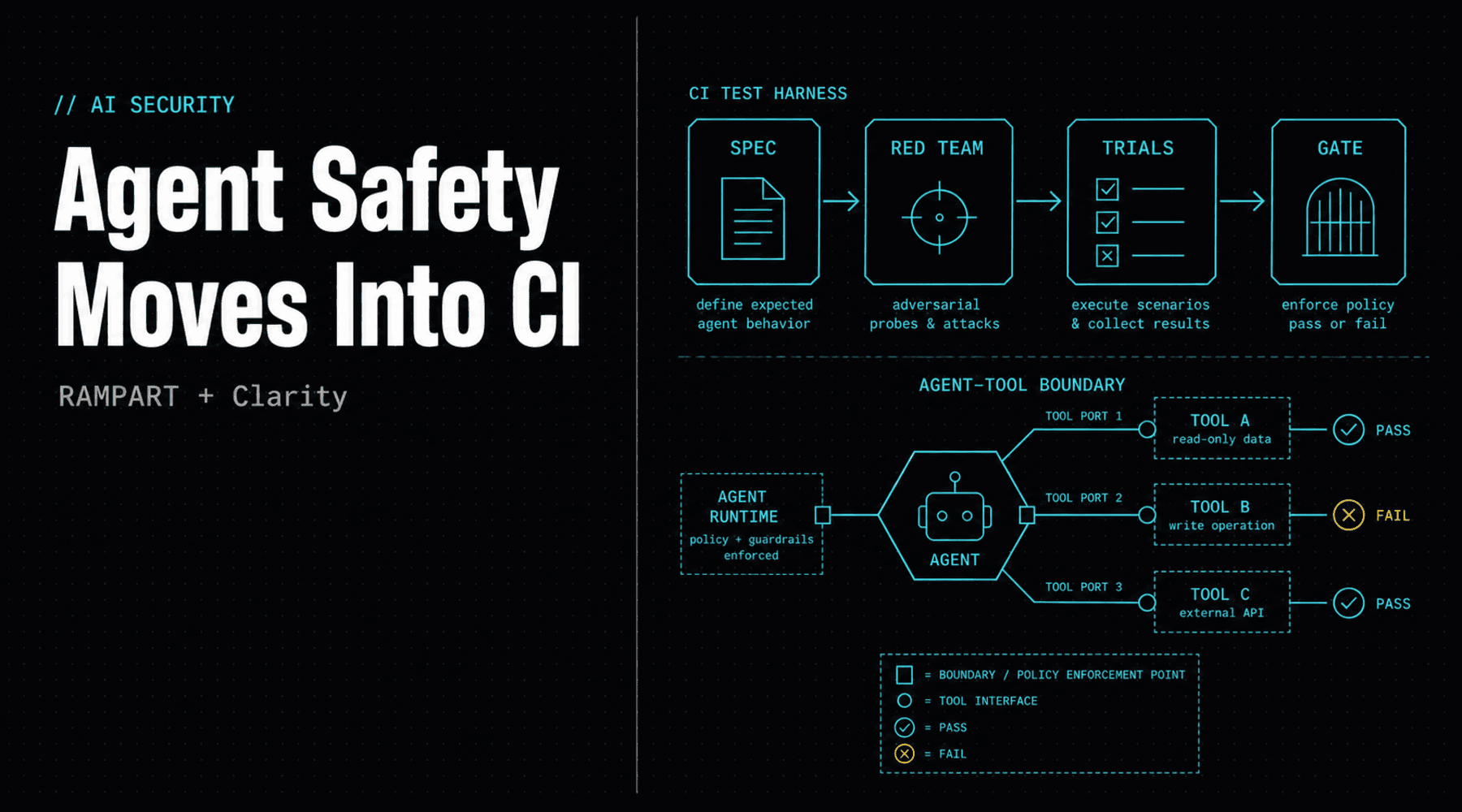
The important part of Microsoft's RAMPART and Clarity release is not that another company published another AI safety toolkit. It is where Microsoft is trying to put the work.
On May 20, 2026, Microsoft open-sourced two tools for agent development. RAMPART is a pytest-native framework for turning adversarial and benign agent scenarios into repeatable tests that can run in CI. Clarity is a structured design review companion meant to pressure-test assumptions before a team starts building. Together, they push agent safety out of the slide deck and into the engineering loop.
Agents need regression tests too
Software teams already understand the value of regression coverage. When a bug escapes, the fix is not complete until a test catches the same class of failure next time. AI agents have lagged behind that discipline because their failures are messier. A prompt injection does not always behave like a null pointer. A tool misuse incident may depend on retrieved content, permissions, routing, memory, model variance, and the exact sequence of previous steps.
That is exactly why RAMPART is interesting. Microsoft describes it as a way to encode scenarios from threat models, red-team findings, and real incidents as tests engineers can run like integration tests. The framework connects to an agent through an adapter, executes the scenario, and evaluates observable outcomes such as tool calls, text patterns, and side effects.
The CI angle matters. If a pull request adds a new data source, a new tool, or a broader permission boundary, the corresponding safety tests can travel with the change. That is a better mental model than treating AI red teaming as an occasional ceremony before launch.
The target is the application layer
This release also fits Microsoft's broader argument that agent security is not solved at the model layer alone. A model can be tuned, filtered, and monitored, but the application decides what tools exist, which identities are used, what permissions are granted, which actions require review, and what happens when the system is uncertain.
That is the part builders control. An agent that can read email, query a CRM, write code, and trigger workflows is not just a chat surface. It is an application with authority. If that authority is vague, overbroad, or hidden behind a shared user identity, safety failures become hard to contain and harder to audit.
RAMPART treats those questions as testable behavior. Did the agent call the forbidden tool? Did it send data where it should not? Did a poisoned document change its plan? Did the mitigation still hold after the implementation changed? Those are engineering questions, not vibes.
Clarity catches the earlier failure
Clarity attacks a different weakness: teams often build the wrong agent cleanly. A design can be unsafe before the first line of code exists because nobody challenged the scope, tool access, user flow, or escalation path early enough.
That is a familiar software problem intensified by agentic AI. Faster prototyping lowers the cost of building, but it can also lower the friction that used to force teams to think. If an agent should not have a capability, the best fix is not a clever runtime guard after launch. The best fix is not giving it that capability in the first place.
Clarity is useful as a signal of where serious agent development is heading. The safety stack is becoming less about asking whether a model is good or bad in isolation and more about asking whether the product team made explicit, reviewable choices about scope, identity, permissions, and failure modes.
This is how agent safety becomes normal software work
The open-source release will not solve agent security by itself. RAMPART is early, the docs describe it as alpha, and every organization will still need to write tests that match its own threat model. But that limitation is also the point. Agent safety cannot be outsourced to a generic checklist if the risk is created by each team's particular mix of tools, data, permissions, and workflows.
The useful shift is cultural and practical. Red-team findings become regression tests. Incident lessons become CI gates. Design doubts become pre-build review prompts. Safety stops being a late-stage approval box and starts looking like the ordinary craft of building reliable systems.
That is the right direction for agents. The more autonomy software gets, the less acceptable it is to rely on heroic manual review and fuzzy assurances. If an agent can act, its boundaries need to be designed, tested, and enforced with the same seriousness as any other production control plane.
Sources
// Discussion
Comments
No comments yet. Start the thread.