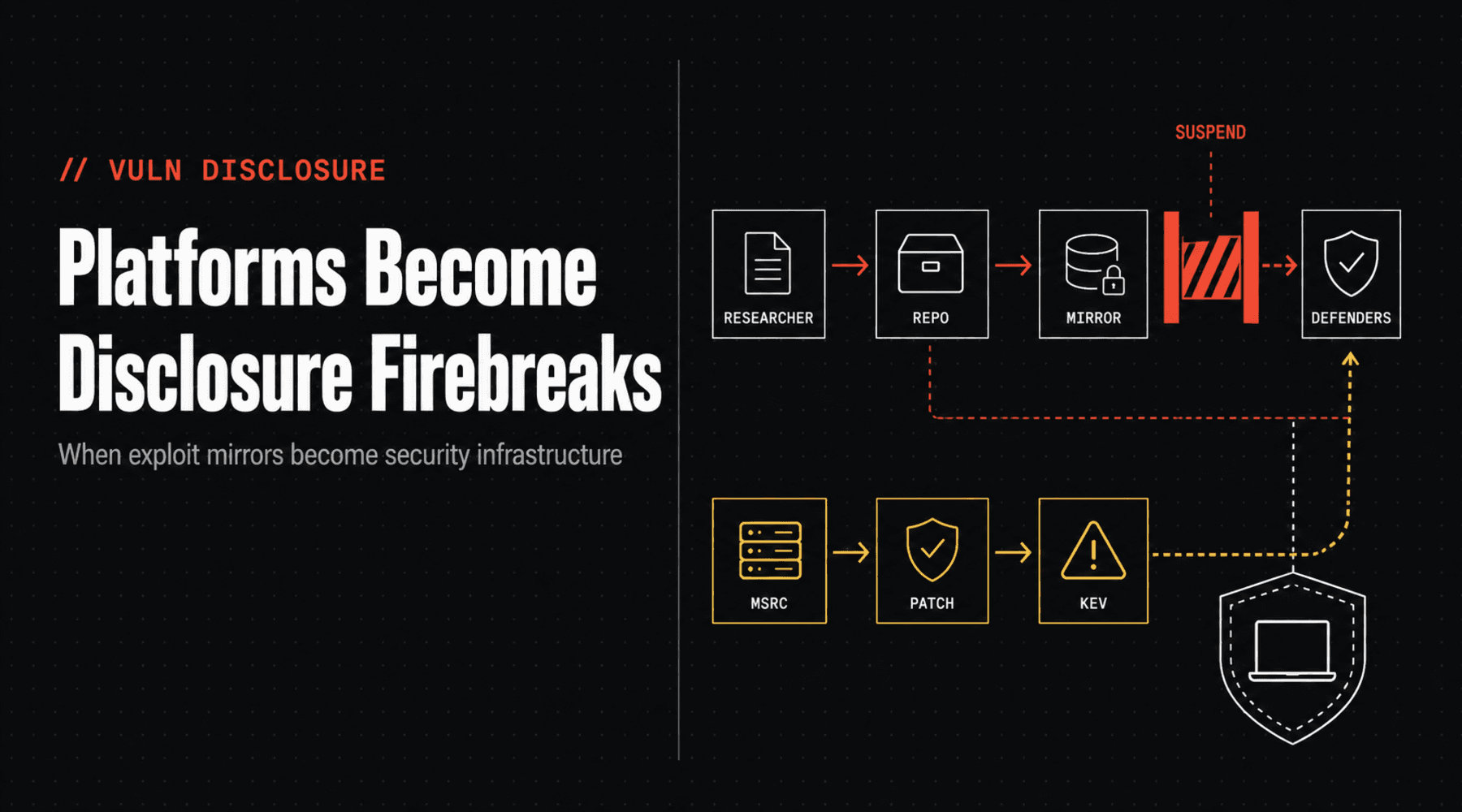
Exploit publication used to be a fight between researchers, vendors, defenders, and attackers. Now the platforms are in the middle too.
Cybersecurity News reported that accounts tied to the researcher Nightmare-Eclipse were suspended on GitHub and GitLab after publishing and mirroring Windows exploit research associated with BlueHammer, RedSun, and UnDefend. The article frames the move as a dispute over public proof-of-concept code, but the more durable story is about infrastructure: code hosts are becoming disclosure firebreaks.
That matters because the surrounding vulnerability context is real. CISA's Known Exploited Vulnerabilities catalog lists CVE-2026-33825, a Microsoft Defender access-control flaw, as exploited in the wild. Microsoft describes it as a local privilege escalation issue in Defender. Public reporting from BleepingComputer said the flaw was used in zero-day attacks and that CISA ordered federal agencies to apply mitigations by May 6.
Once a working exploit lands in public infrastructure, the line between research artifact and operational weapon gets thin. A repo can help defenders reproduce behavior, validate patches, build detections, and understand risk. The same repo can help attackers compress their development cycle. That tension is not new. What is new is how much of the disclosure pipeline now depends on commercial collaboration platforms that were not originally designed to be vulnerability triage institutions.
The platform is part of the blast radius
A public exploit mirror is not just a web page. It is searchable. It can be forked, starred, watched, cloned, indexed, scraped, packaged into automated tooling, and copied into private repositories. It has an API surface and an abuse-reporting surface. It can disappear from one place and reappear in another before defenders or vendors have finished coordinating.
That makes platform policy operationally relevant. If GitHub, GitLab, package registries, paste sites, and archive services allow everything by default, they can accelerate attacker access. If they remove too much too quickly, they can suppress legitimate research, frustrate defenders, and push disclosure into darker, less accountable channels. Either failure mode is bad.
The right question is not whether exploit research should exist in public. Serious security work needs reproducibility. The better question is which artifacts belong in which channel at which time. A crash reproducer, a minimized trigger, a detection rule, a patch test, a behavioral write-up, and a turnkey exploit are not the same thing. Platform policy that treats them as identical will keep producing messy outcomes.
Defenders need signal, not spectacle
The most useful public research usually gives defenders enough information to act without handing attackers the shortest path to reuse. That can mean describing the affected component, privilege boundary, preconditions, indicators, detection ideas, mitigation status, and patch behavior before releasing weaponized details. It can also mean coordinating with vendors, CERTs, platform trust teams, and downstream maintainers when exploitation is already active.
For a vulnerability like CVE-2026-33825, the defender's urgent questions are practical. Is this being exploited? Which systems are exposed? What patch or mitigation is available? How quickly must it be applied? What telemetry would show abuse? CISA's KEV entry answers the urgency question by putting the bug on a federal remediation clock. Microsoft's advisory gives the vendor-side reference. Reporting fills in what happened around exploitation.
A public PoC can support that process, but only when it is timed and scoped with the threat environment in mind. Dumping a polished chain into the open while defenders are still racing the clock does not make the ecosystem more transparent. It makes the race faster for everyone, including people who do not care about patching.
Suspension is a blunt tool
Account suspension is the least nuanced mechanism in this stack. It may stop immediate distribution through one channel, but it rarely resolves the underlying disclosure problem. Researchers lose trust. Mirrors multiply. Defenders lose context. Platforms get accused of censorship, favoritism, or inconsistent enforcement. Vendors still need to patch. Attackers still have private copies if the code was already public.
That does not mean platforms should do nothing. It means they need a richer playbook than binary allow-or-ban decisions. A mature platform response could support temporary quarantine, restricted access for vetted defensive teams, clear appeal paths, machine-readable takedown reasons, coordination hooks for vendors and CERTs, and preservation of non-weaponized technical context. Those controls are boring, which is exactly why they are useful.
The ecosystem also needs better norms around exploit packaging. Publishing research is one thing. Publishing turnkey chains, persistence helpers, evasion tricks, or copy-paste offensive workflows during active exploitation is another. Researchers should not have to choose between silence and a repository that looks like attacker enablement. Platforms can help by giving disclosure artifacts more shapes than public or deleted.
Disclosure is becoming infrastructure
The old disclosure model assumed the main control points were the researcher, the vendor, and the advisory. That model is no longer enough. Code hosts, package registries, CI systems, social networks, exploit indexes, search engines, and chat platforms all affect how quickly technical knowledge moves.
This is not a reason to panic about public research. It is a reason to treat disclosure like infrastructure. Good infrastructure has policy, audit trails, escalation paths, reliability, and purpose-built controls. It does not depend on improvised platform bans after a repo is already mirrored across the internet.
The practical takeaway is simple: exploit publication now needs a delivery model as serious as the exploit itself. Researchers need channels that preserve credibility. Vendors need fast coordination without hiding defects. Defenders need actionable detail before code becomes commodity tooling. Platforms need policies that can slow dangerous distribution without burying legitimate work.
If code hosts are going to act as firebreaks, they need to become better firebreaks: transparent, proportional, technically literate, and built for the reality that vulnerability disclosure is no longer just a PDF and a patch Tuesday entry. It is a live supply chain for security knowledge.
// Discussion
Comments
No comments yet. Start the thread.