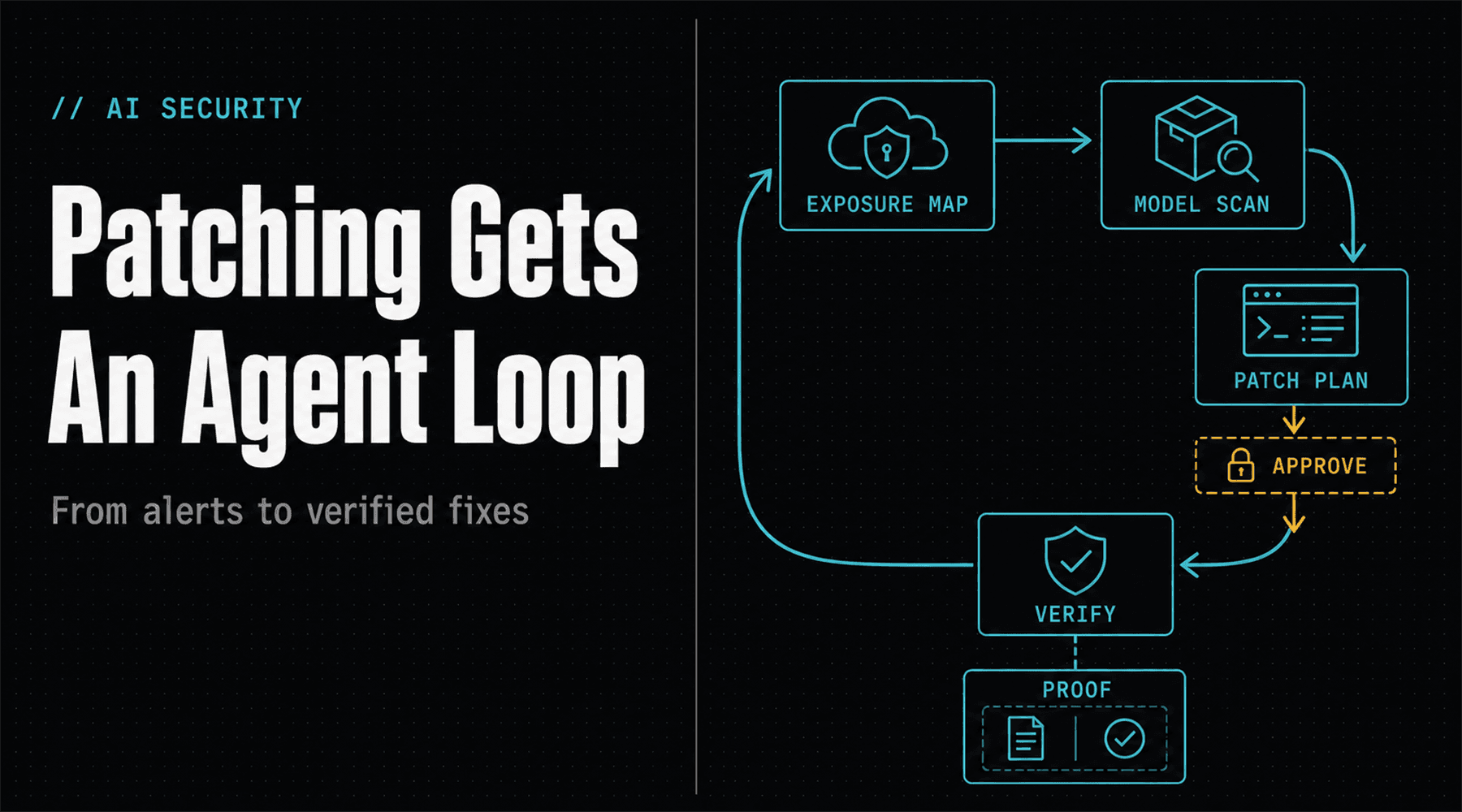
The important part of Google's new AI security launch is not that another large vendor put AI into a security product. Everyone is doing that.
The important part is the loop. Google AI Threat Defense, announced May 27, combines Gemini, Wiz, CodeMender, and Mandiant into a platform meant to move from exposure mapping to vulnerability analysis to remediation to monitoring. That is a different shape from the traditional scanner dashboard. It is not just a bigger list of findings. It is a bid to turn vulnerability management into a closed operating cycle.
That distinction matters because the bottleneck in security has shifted. Finding more possible problems is no longer the scarce capability. Organizations already drown in CVEs, misconfigurations, exposed services, dependency alerts, identity risks, and scanner output. The scarce capability is deciding which problem actually matters in a live environment, routing it to the right owner, producing a fix that does not break production, proving that the fix worked, and repeating the process before the next exploit window closes.
Google is framing AI Threat Defense as an answer to AI-accelerated attacks, where adversaries can discover and exploit flaws in hours or days. The pitch is that defenders need comparable speed, but the interesting engineering problem is more specific: speed without evidence is just automated noise. A security agent that can produce patches is useful only if it can also carry context, ownership, tests, and proof through the workflow.
From findings to fixes
Google's announcement describes a four-step framework: prepare, scan and prioritize, remediate, and monitor. The prepare step uses Wiz to map exposure across applications, APIs, identities, infrastructure, code repositories, CI/CD pipelines, clouds, and runtime environments. The scan step uses AI-driven analysis to focus deeper work on the systems where exposure and business impact justify it. The remediation step brings in Gemini, CodeMender, Wiz Green Agent, and engineering workflows to generate or accelerate fixes. The monitor step keeps watching software delivery and live environments after the patch lands.
That is the right abstraction. A vulnerability is not equally urgent everywhere. A bug buried in an internal tool with no sensitive data and no reachable attack path is different from the same class of bug sitting in a customer-facing service with privileged identity paths. Legacy scanning often flattens those distinctions into severity labels. The next generation of vulnerability management has to reason over reachability, exploitability, ownership, data sensitivity, dependency context, and production reality.
Wiz gives Google a cloud and exposure graph. Mandiant gives it response experience and attacker context. Gemini gives it the model layer. CodeMender is the part that changes the workflow from advisory to action, because it is designed to create security patches rather than merely identify vulnerable code.
CodeMender is the pressure point
DeepMind introduced CodeMender in October 2025 as an AI agent for code security. The early claim was not modest: CodeMender had already upstreamed 72 security fixes across open-source projects, including projects with millions of lines of code. The technical details are the useful part. CodeMender uses program-analysis tools, static and dynamic analysis, differential testing, fuzzing, SMT solvers, and specialized agents to reason about root causes and validate changes.
That is the difference between an autocomplete patch and a repair workflow. Security fixes often fail because the visible crash is not the real bug, the minimal diff does not address the root cause, or the fix creates a regression that shows up somewhere else. A useful patching agent needs to navigate code, understand the failure mode, modify the right layer, run tests, critique its own diff, and produce something a maintainer can review without starting from scratch.
Google still describes human review as part of the process. That should stay true for serious systems. The promise of agentic remediation is not that enterprises can remove engineers from security decisions. The promise is that engineers get a smaller, better packet of work: the exposed system, the affected path, the likely root cause, the proposed change, the validation evidence, and the rollback or rollout context.
The new control plane is change management
If AI finds vulnerabilities faster than people can patch them, the winning product will not be the one that finds the most bugs. It will be the one that turns discovery into safe change. That makes change management the new security control plane.
Teams will need policies for when an AI-generated fix can open a pull request, when it can be auto-merged into a low-risk component, when it needs a human security reviewer, when it needs product owner approval, and when it should be blocked because the runtime context is too sensitive. They will also need receipts: which model or agent found the issue, which evidence supported prioritization, which tests ran, which owner approved the change, and which production signal proved the exposure was closed.
This is where closed-loop platforms can become valuable. The loop is not just technical automation. It is an audit trail. Prepare establishes what exists and what is exposed. Scan explains why the issue matters. Remediate records what changed. Monitor confirms whether the risk actually disappeared. Without that evidence chain, agentic security becomes another opaque box that teams are asked to trust.
Alert volume is not the enemy, weak routing is
Security vendors often talk about alert fatigue as if the problem is volume alone. Volume matters, but weak routing is the deeper failure. A thousand findings are manageable if they are accurately deduplicated, prioritized, owned, and connected to fix paths. Ten findings are too many if nobody knows whether they are reachable, who owns the service, which dependency introduced the risk, or whether the patch is safe.
AI Threat Defense is interesting because it puts the live environment and the code workflow in the same story. That is where most security work breaks down. Cloud posture tools understand exposure but not always code ownership. Code scanners understand source but not always runtime reachability. Incident responders understand attacker behavior but often arrive after the architecture has already made a flaw dangerous. A real remediation loop has to pull those views together.
The risk is vendor gravity. A tightly integrated loop can produce better context, but it can also make security decisions depend on one platform's graph, agents, models, and workflow assumptions. Enterprises should demand portable evidence and clear interfaces. If a patching agent says a fix is safe, teams should be able to inspect why. If a cloud graph says a path is exploitable, teams should be able to trace the path. If a monitor says risk is gone, teams should be able to see the signal.
The takeaway
Google AI Threat Defense is another move in the defender-side AI race, alongside work from Microsoft, OpenAI, Anthropic, Mozilla, and others. The market will argue over benchmarks, pricing, model quality, and which vendor's graph sees the most risk. Those details matter.
But the bigger shift is already visible. Security is moving from periodic scanning toward continuous repair loops. The useful AI security system will not be the loudest vulnerability finder. It will be the one that can connect exposure, prioritization, patch generation, review, deployment, and proof without losing the thread.
That is the bar now. In a world where attackers can compress discovery and exploitation, defenders need more than machine-speed alerts. They need machine-speed patching with human-grade receipts.
// Discussion
Comments
No comments yet. Start the thread.