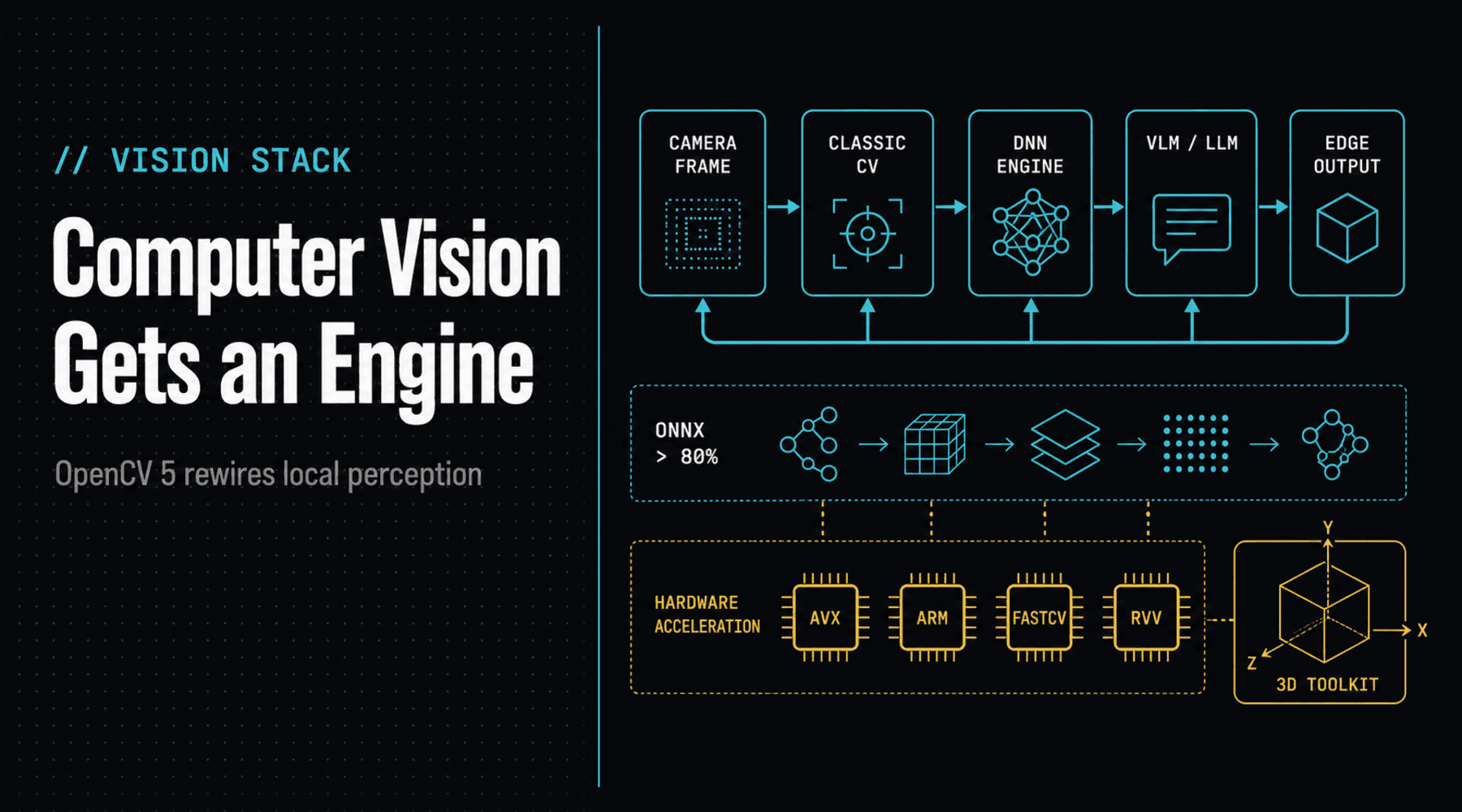
OpenCV 5 matters because computer vision stopped being one thing. A modern vision app might start with old-school image processing, pass through a neural network, call a transformer, track objects in 3D, and then run on a phone, robot, ARM server, laptop, or RISC-V board. The hard part is no longer only writing the algorithm. It is keeping the perception stack coherent across all of that hardware and model churn.
The OpenCV team describes version 5 as one of the biggest releases in the library's history, and the claim is not just release-note theater. OpenCV has been the default toolbox for computer vision for more than two decades. It sits inside research prototypes, factory inspection systems, robotics labs, medical imaging tools, AR pipelines, hobby projects, and production AI systems. When that library changes its core assumptions, a lot of downstream software quietly changes with it.
The headline feature is a rebuilt foundation: a new DNN engine, stronger ONNX support, a redesigned hardware acceleration layer, better Python integration, richer tensor support, updated 3D vision tooling, and a cleaner architecture for the 5.x line. Put differently, OpenCV is trying to become the place where classical computer vision and local AI inference stop feeling like separate toolchains.
camera frame
  -> classic CV
  -> DNN engine
  -> ONNX model
  -> VLM or LLM assist
  -> edge output

same app, different silicon:
x86 | ARM | Snapdragon | RISC-VThe old split is collapsing
For years, computer vision developers had a useful split. OpenCV handled the image operations: filtering, resizing, calibration, feature matching, contours, tracking, geometry. Deep learning frameworks handled the models. That split worked when neural nets were an extra layer bolted onto a vision pipeline.
That is not the normal case anymore. A camera frame may be preprocessed by OpenCV, passed into an ONNX model, fused with a language or vision-language model, and then fed back into classic geometry or tracking. Edge devices need the same pipeline to run under tight memory, power, and latency budgets. Python users expect easier bindings. C++ users expect cleaner types. Hardware vendors expect a way to add optimized kernels without forking the whole library.
OpenCV 5 is aimed at that reality. The new DNN engine is graph-oriented, with support for fusion and broader ONNX coverage. The project says the release is built for transformers, large vision models, VLMs, and LLM workflows, not only the older convolutional-network era. That does not mean OpenCV becomes a general-purpose model lab. It means the library has to understand enough of modern inference to keep vision pipelines local, portable, and fast.
The interesting part of OpenCV 5 is not that it noticed AI. It is that it treats AI inference as another part of the vision pipeline instead of an external ceremony.
Hardware acceleration becomes boring on purpose
The redesigned hardware acceleration layer may be the most practical change for builders. OpenCV has always chased performance, but modern hardware makes that problem messier. There are x86 vector paths, ARM NEON and SVE paths, Qualcomm FastCV routes through Snapdragon hardware, RISC-V vector work, and vendor-specific kernels that need to be plugged in without turning the codebase into conditional spaghetti.
OpenCV 5's answer is a cleaner HAL contract. The user writes normal OpenCV code. When the right acceleration path exists, the library can dispatch to it. The OpenCV team calls out Intel IPP and SSE or AVX paths, Arm KleidiCV, Qualcomm FastCV, RISC-V Vector, and Universal Intrinsics 2.0 as pieces of the new performance story.
That is not glamorous, but it is how perception software survives real deployment. A robot company, inspection vendor, or medical device team does not want five different pipelines for five chips. It wants one vision stack that can take advantage of the silicon under it.
- For embedded teams: less hand-tuning when moving between ARM, Snapdragon, and RISC-V targets.
- For AI teams: a tighter path from ONNX models into camera-driven applications.
- For Python users: cleaner bindings, NumPy 2.x support, and named arguments that reduce daily friction.
- For C++ users: a more modern baseline, with C++17 now the recommended minimum.
3D and calibration still matter
The release also reinforces something easy to forget in the AI rush: vision is not only classification and chat-with-image demos. Real systems need calibration, geometry, pose, depth, reconstruction, and tracking. OpenCV 5 expands 3D vision tooling and splits older monolithic pieces into a cleaner structure.
That matters because VLMs do not remove the need for measurement. A warehouse robot needs to know where an object is. An AR app needs stable geometry. A factory camera needs calibration and repeatability. A medical imaging tool needs deterministic transforms and traceable processing. Language can help explain or orchestrate, but the pipeline still needs math that behaves the same way every time.
OpenCV 5 looks strongest where those worlds meet: classical geometry on one side, model inference on the other, and enough hardware dispatch underneath to make the whole thing viable outside a demo machine.
The local AI angle
The timing is useful. Developers are pushing more AI work back to local devices because latency, privacy, bandwidth, and cost all matter. A cloud model can be powerful, but a camera application often needs an answer now, near the sensor, under a power budget, with no guarantee that a network round trip is acceptable.
OpenCV has always been near the sensor. That is why this release is important. If OpenCV 5 makes local vision pipelines easier to assemble, optimize, and move across hardware, it becomes part of the broader shift from AI as a remote chat service to AI as a runtime layer inside ordinary software and machines.
The takeaway is simple: OpenCV 5 is not trying to make every builder a model researcher. It is trying to make perception software feel less fragmented. Camera frame in, local computation across classic CV and neural inference, hardware-specific speed without hardware-specific application code, output back to the edge. That is the engine modern computer vision needed.
// Discussion
Comments
No comments yet. Start the thread.