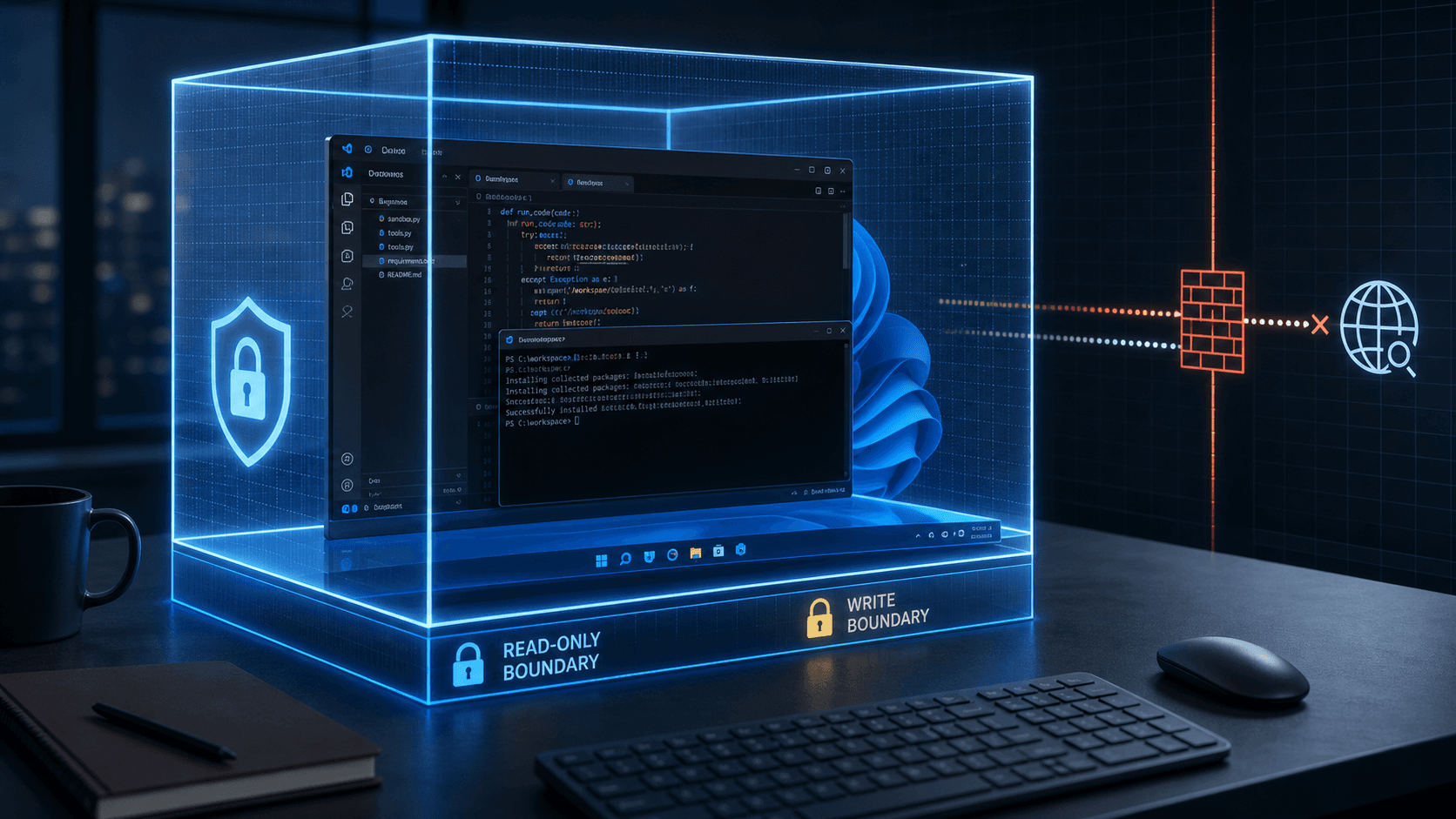
The most revealing AI engineering post of the week is not about a bigger model or a faster benchmark. It is about the awkward fact that coding agents stop being toys the moment they can run real commands on a real machine.
That is why OpenAI's new writeup on bringing Codex sandboxing to Windows matters. The company is describing a problem every serious agent platform is going to face: once an AI agent can edit files, invoke package managers, run tests, and touch Git, safety is no longer a policy slide. It becomes an operating-system problem.
OpenAI's May 13 engineering post lays out the design pressure clearly. Before this work, Windows users were pushed toward two bad choices: approve nearly every action, or remove the friction and let the agent run with broad local power. Neither scales. Constant approvals kill the point of an autonomous coding tool. Full access kills the point of having guardrails.
Windows Was Missing The Obvious Primitive
On macOS and Linux, agent sandboxes can lean on native isolation tools that are already shaped for constrained process execution. Windows is trickier. OpenAI says the platform does not offer a built-in primitive that maps cleanly to an agent that needs to behave like a developer while still being boxed in.
The engineering post walks through three candidates that did not fit. AppContainer was too narrow because it assumes an application knows in advance exactly what it needs. Windows Sandbox was stronger in isolation terms, but it is a disposable virtual machine that sits too far away from the user's actual checkout and tooling, and it is not even available on Windows Home. Mandatory Integrity Control looked elegant in theory, but it would have changed the trust semantics of the user's real workspace in a way that was too broad to justify.
That list is useful because it shows the actual constraint. Coding agents need a strange middle ground. They have to feel local enough to work on the files and tools developers already use, while being constrained enough that they cannot quietly write outside approved paths or talk to the network whenever they want.
The First Attempt Solved Writes, Not Trust
OpenAI's first prototype is the kind of detail more AI companies should publish. It used synthetic Windows SIDs, ACLs, and write-restricted tokens to define exactly where Codex could modify the filesystem. That let the agent write inside the working directory and configured writable roots while explicitly denying writes to places like .git, .codex, and .agents.
That is a serious design, not a hand-wave. But the same post admits the network story was weaker. The unelevated version tried to fail closed by poisoning proxy variables, redirecting Git transport to dead endpoints, and shadowing SSH helpers with stub binaries. That catches normal tool behavior. It does not stop adversarial code or any binary that simply ignores the environment and opens sockets directly.
This is the key turning point in the story. Filesystem limits without trustworthy network suppression are not enough for an agent that can execute arbitrary development workflows. If a model can read something sensitive and any subprocess can exfiltrate it, the sandbox is cosmetic.
Why The Final Design Got More Serious
OpenAI's answer was to move to an elevated setup path and run sandboxed commands under dedicated local Windows users such as CodexSandboxOffline and CodexSandboxOnline. That sounds like an implementation detail. It is actually the architectural shift that makes the rest of the safety model work.
By separating the sandboxed process tree from the real user principal, OpenAI could use Windows Firewall rules in a way the first prototype could not. The result is closer to what enterprise security teams and cautious developers actually need: a coding agent that can still act on the host workspace, but from a principal the operating system can meaningfully constrain.
That lines up with OpenAI's separate May 8 security post about how Codex is governed internally. In that writeup, the company says it does not run Codex with open-ended outbound access, uses approval policies for actions that cross sandbox boundaries, and layers agent-native telemetry on top so security teams can understand not just what happened, but why the agent tried to do it. That is the shape of a real control plane, not a vibe-based trust model.
This Is Bigger Than One Product
The broader significance is easy to miss if you read this as a niche Windows compatibility story. It is not. It is an early blueprint for the next phase of local AI tooling.
Most of the public conversation around coding agents still fixates on benchmark scores, code quality, or whether the model can finish a ticket without supervision. Those are important, but they are downstream of a more basic question: what operating-system boundary contains the agent while it does useful work?
Microsoft's own Windows Sandbox documentation helps explain why OpenAI could not just reuse the stock feature and call it done. Microsoft describes Windows Sandbox as a disposable isolated environment built from the host's existing Windows image, with dynamic memory and shared immutable system files for density and performance. That is excellent for testing untrusted software. It is much less suited to an agent that must act directly inside the developer's existing workspace, preserve local context, and participate in ordinary command-line workflows without shuttling everything through a separate desktop session.
In other words, agent safety is now colliding with old operating-system assumptions. Traditional application sandboxes were built either for tightly scoped apps or for fully isolated guest environments. Coding agents fit neither category. They are open-ended operators that still need precise local boundaries.
What Changes Now
The practical lesson is that every serious agent vendor will end up in this territory. Once you want real autonomy on user machines, you need enforcement at the OS level, not just warnings, prompt rules, or polite approval dialogs.
Expect the next wave of competition in coding agents to include more discussion of principals, firewalls, filesystem labels, subprocess inheritance, credential handling, and telemetry. That may sound less glamorous than model demos, but it is where trustworthy product design actually lives. The winner is not the system that can run the most commands. It is the one that can run enough commands to be useful while making the failure boundary legible and hard to bypass.
The Takeaway
OpenAI's Windows sandbox work is a sign that coding agents are growing up. The industry is moving past the phase where an agent could be treated like a chat interface with shell access sprinkled on top.
If agents are going to become normal development infrastructure, they need operating-system boundaries designed for real work rather than idealized demos. OpenAI's Windows design is interesting not because it is perfect, but because it takes that problem seriously enough to engineer around the platform instead of pretending the platform already solved it.
Sources: OpenAI's May 13, 2026 engineering post on the Windows Codex sandbox, OpenAI's May 8, 2026 security post on running Codex safely, and Microsoft Learn's Windows Sandbox architecture documentation.
// Discussion
Comments
No comments yet. Start the thread.