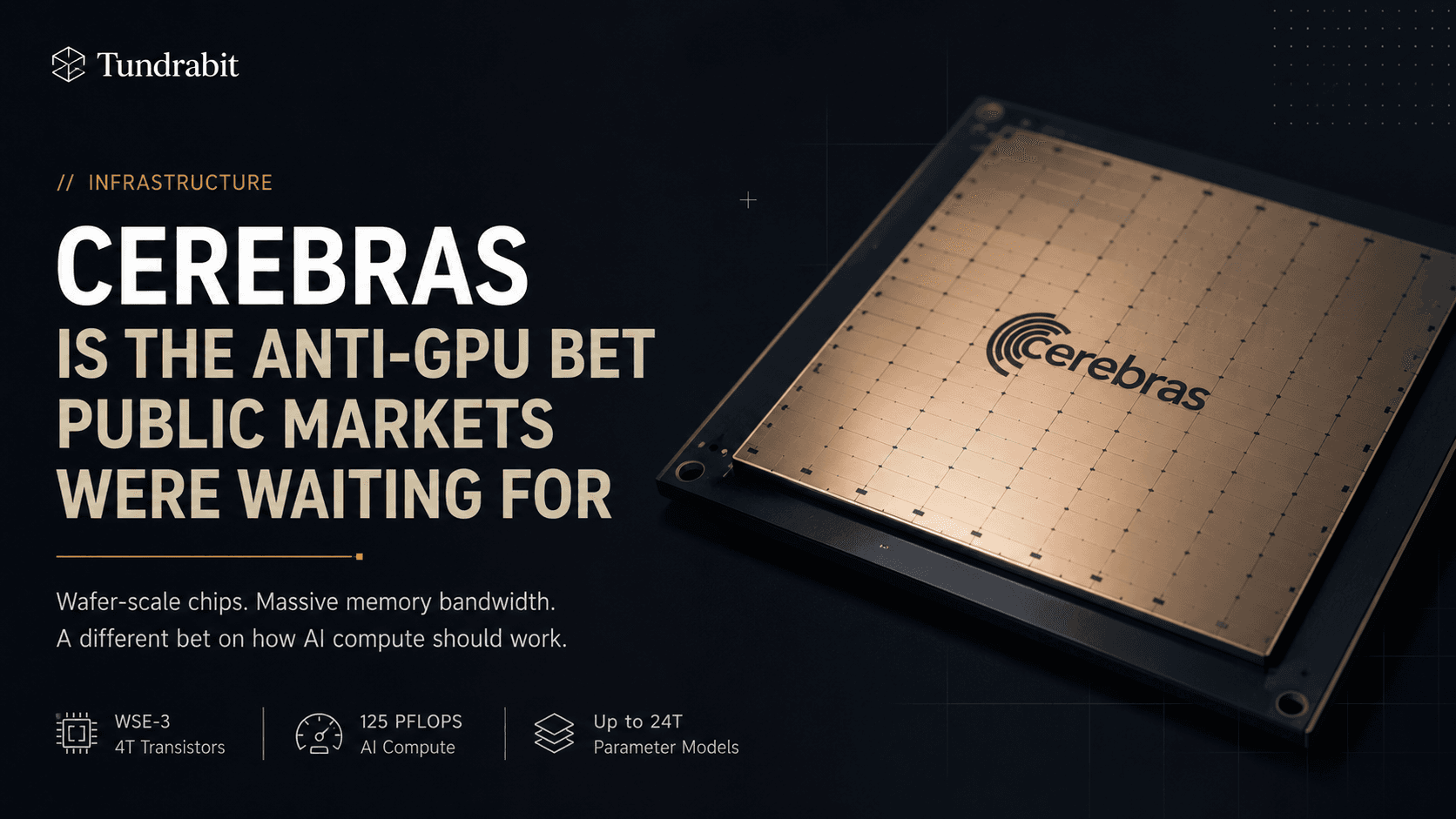
Cerebras is not interesting because it is another AI chip company.
It is interesting because it is one of the few companies trying to make AI compute look physically different.
Most of the AI infrastructure market is built around clusters of GPUs. That model works, and Nvidia has turned it into one of the most important businesses in the world. But it also creates a familiar set of problems: memory bandwidth, interconnect complexity, power draw, networking, scheduling, latency, and the operational mess of making thousands of chips behave like one machine.
Cerebras comes at the problem from the opposite direction. Instead of slicing a wafer into many separate chips and wiring them together later, it builds one giant wafer-scale processor.
That is the whole bet.
If AI workloads are increasingly limited by how fast data can move, then maybe the answer is not just more chips. Maybe the answer is a radically larger chip with more compute and memory bandwidth kept close together.
The wafer-scale idea
Cerebras’ core product is the Wafer-Scale Engine. Its current WSE-3 chip is enormous by normal semiconductor standards. Cerebras says it measures 46,225 square millimeters, contains 4 trillion transistors, includes 900,000 AI-optimized cores, and delivers 125 petaflops of AI compute.
The point is not just size for size’s sake. The point is architecture.
Modern AI workloads are often bottlenecked by moving data between processors and memory. Traditional GPU clusters solve that by scaling outward: more accelerators, more networking, more racks, more orchestration. Cerebras tries to collapse more of that work onto a single giant processor with huge on-chip memory bandwidth.
Its CS-3 system packages that wafer-scale processor into a machine Cerebras says can scale up to 24 trillion parameter models on a single logical device. The company positions the system as a way to get supercomputer-scale AI performance without the same cluster-management burden.
That is why Cerebras is not just selling a chip. It is selling a different theory of AI infrastructure.
The public-market moment matters
Cerebras’ IPO turned that technical theory into a public-market object.
Reuters reported that Cerebras priced its IPO at $185 per share, raising $5.55 billion by offering 30 million shares. The deal valued the company at about $56.43 billion on a fully diluted basis, making it the largest IPO of 2026 at the time of pricing.
The debut was explosive. Reuters also reported that shares opened 89 percent above the IPO price in the company’s U.S. market debut. Investor’s Business Daily reported that Cerebras later traded around a market capitalization near $69 billion while investors watched for possible index inclusion.
That kind of reaction says something about the market’s appetite.
Investors already know the Nvidia story. They know GPUs, data centers, cloud capex, AI training, inference, networking, and the hyperscaler buildout. Cerebras gives them a different kind of AI infrastructure bet: not a cloud application, not a model lab, and not another software wrapper, but a company built around a hardware architecture that challenges the assumptions underneath the current stack.
This is not the next Nvidia story
The easy headline is to ask whether Cerebras is the next Nvidia.
That is the wrong frame.
Nvidia is not just a chip company. It is a platform company with hardware, software, networking, developer adoption, CUDA, OEM relationships, hyperscaler demand, and years of ecosystem lock-in. Cerebras is not replacing that overnight.
The better question is narrower and more useful: where does wafer-scale compute make the current GPU-cluster model look overbuilt, inefficient, or slow?
That is where Cerebras has room.
If a workload benefits from extreme memory bandwidth, lower latency, fast inference, simpler scaling, or reduced cluster complexity, Cerebras has a real argument. Its public materials emphasize fast inference, large-model training, privacy, control, and deployment options ranging from cloud API access to on-prem systems.
That matters because AI infrastructure is becoming less one-size-fits-all. Training a frontier model, serving an open-weight model, running agentic coding workloads, supporting enterprise inference, and doing high-performance research are not identical compute problems.
The market may not need one Nvidia replacement. It may need specialized alternatives in places where the GPU model is not the cleanest answer.
Inference is where the story sharpens
Cerebras has leaned hard into inference speed.
The company says its platform serves open models through API access and dedicated capacity, and it has recently highlighted enterprise trials for Kimi K2.6, a trillion-parameter open-weight model. Cerebras says it has set benchmarks across open-weight models including GLM, GPT-OSS, Qwen, and others, while delivering speedups for customers working on agentic coding models.
That is the right battlefield.
The AI market is moving from training shock to deployment grind. Training still matters, but inference is where models become products. Every assistant response, code-agent step, enterprise query, search result, customer-support action, and workflow automation call has to run somewhere.
When AI usage grows, inference becomes infrastructure.
That makes speed, cost, latency, power, and capacity harder to ignore. If Cerebras can make certain inference workloads meaningfully faster or simpler, it does not need to win every chip market. It needs to win valuable slices of the AI workload map.
The risks are real
Cerebras still has to prove that a radical architecture can become a durable business.
Wafer-scale chips are technically impressive, but technical impressiveness is not enough. Customers need reliability, software maturity, pricing clarity, supply stability, model support, integrations, and confidence that the platform will keep improving. Nvidia’s advantage is not only silicon. It is the surrounding machine.
There is also the risk of investor overreach. A huge IPO and a fast first-day move can make the market treat any AI infrastructure company like a guaranteed winner. That is dangerous. Cerebras is competing in a brutal space against companies with enormous capital, customer relationships, and software ecosystems.
The company may be right about architecture and still face hard commercial constraints.
That does not make the story weaker. It makes it more interesting.
The useful takeaway
Cerebras matters because it gives the AI compute market another shape.
The AI boom has made GPUs feel inevitable. Cerebras is a reminder that the current stack is not the final form. AI workloads are still changing. Model sizes are changing. Inference patterns are changing. Agentic workflows are changing. Power and data-center constraints are getting tighter.
That kind of environment rewards architectural experiments.
Some will fail. Some will become narrow tools. A few may become real platforms.
Cerebras is now public, highly visible, and forced to prove which one it is.
The company’s wager is simple: AI compute does not have to be a pile of GPUs stitched together by networking and software. It can be something bigger, denser, and stranger.
That is why Cerebras is worth watching.
Not because it is the next Nvidia.
Because it is one of the clearest public bets that the AI infrastructure race still has room for a different machine.
// Discussion
Comments
No comments yet. Start the thread.