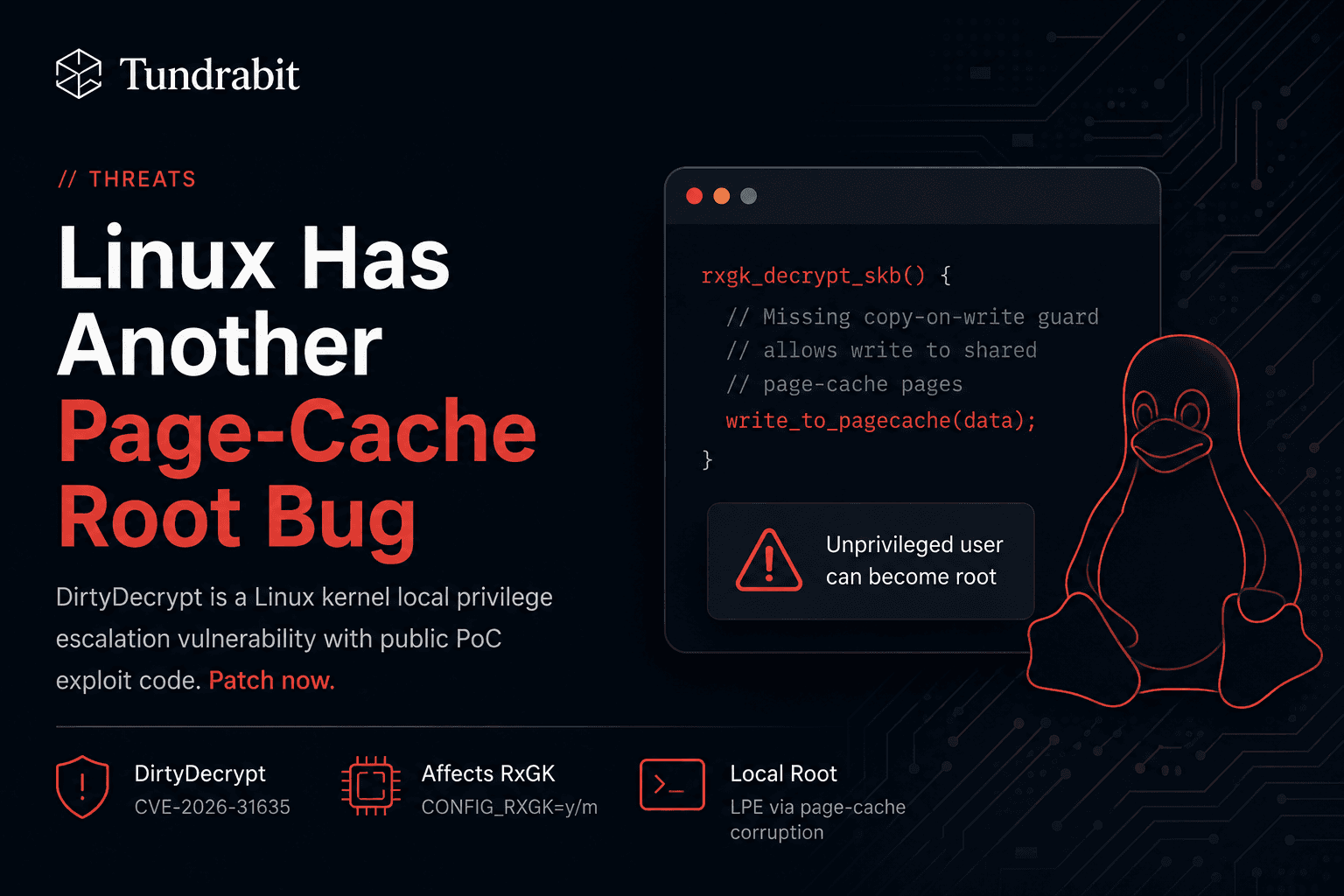
Linux has another dirty bug.
A proof-of-concept exploit is now public for DirtyDecrypt, also called DirtyCBC, a Linux kernel local privilege escalation vulnerability that can give an unprivileged local user root access on affected systems.
The bug is being tied to CVE-2026-31635, though the public record around it is messy. NVD describes CVE-2026-31635 as an RxRPC issue involving an oversized RESPONSE authenticator length check, while public DirtyDecrypt reporting focuses on a missing copy-on-write guard in the RxGK decrypt path. Either way, the operational concern is clear: vulnerable Linux systems with the relevant kernel configuration should be patched immediately.
This is not a remote internet-wide worm story. It is a local privilege escalation story. But local root bugs matter because attackers rarely stop at initial access. Once a user, container, service account, or developer session is compromised, privilege escalation is how a foothold becomes control.
What DirtyDecrypt does
DirtyDecrypt is reported to live in rxgk_decrypt_skb(), part of the Linux kernel’s RxGK subsystem. RxGK is the GSS-API security layer for RxRPC, the transport used by the Andrew File System client.
The reported root cause is a missing copy-on-write guard. When the kernel decrypts an incoming socket buffer, it may write directly into a shared page-cache-backed page instead of first creating a private copy. That matters because page-cache memory can back sensitive files or privileged process memory.
In the worst case, that kind of primitive can let a local attacker corrupt privileged files such as /etc/shadow, /etc/sudoers, or SUID binaries, then turn the corruption into root access.
The pattern should sound familiar. DirtyDecrypt sits near a recent cluster of Linux kernel local privilege escalation bugs involving page-cache writes, crypto or networking paths, and missing ownership checks before in-place modification.
The dirty-bug pattern is the story
DirtyDecrypt follows a run of similar Linux kernel issues: Copy Fail, Dirty Frag, and Fragnesia. Microsoft has warned that Dirty Frag abuse can expand post-compromise risk, and public reporting has described limited in-the-wild activity around related Linux local privilege escalation techniques.
The repeated pattern is what matters.
These bugs are not all identical, but they rhyme. They involve kernel paths that process data in place, often around networking, encryption, or fragmented buffers. The dangerous condition appears when the kernel writes to memory it should not be modifying directly.
That is why these bugs are so uncomfortable. They do not require exotic user interaction or a fragile race condition in the same way older local root bugs often did. Some of these modern page-cache corruption primitives can be more deterministic, more reliable, and easier to operationalize once code is public.
For defenders, that changes priority.
A local privilege escalation with public exploit code is not theoretical. It becomes a second-stage tool for any attacker who already has a low-privilege foothold.
Who is likely exposed
DirtyDecrypt reportedly requires a Linux kernel built with CONFIG_RXGK=y or CONFIG_RXGK=m. That narrows the affected population.
The highest-risk systems are rolling-release or near-mainline Linux environments that track upstream kernel development closely. Public reporting specifically points to Fedora, Arch Linux, openSUSE Tumbleweed, and systems using mainline kernel builds on RHEL or CentOS Stream style environments.
Stable enterprise distributions are likely less exposed by default if RxGK is disabled, but that should not be assumed. Administrators should verify configuration rather than rely on distribution reputation.
The basic check is:
zcat /proc/config.gz | grep RXGKIf the feature is enabled or built as a module, the system deserves closer attention.
Containers make this worse
The cloud and container angle is where a local bug can become a larger incident.
On a Kubernetes worker node, local root on the host is not just root on one machine. It can mean access to container runtime sockets, mounted secrets, pod data, workloads sharing the same node, and credentials available in the environment.
That does not mean every container automatically escapes. It means a kernel local privilege escalation changes the blast radius after an attacker gets code running inside a workload.
Developer workstations are another high-risk target. A Fedora or Arch laptop with active cloud credentials, kubectl contexts, SSH keys, production tokens, and local project secrets can be more valuable than a server. Root on that machine can become access to the organization.
That is why local kernel bugs keep mattering in 2026. The endpoint is no longer isolated. It is a control plane with a keyboard.
What to do now
The primary fix is to update to a kernel containing the upstream patch and reboot into the patched kernel. The patch was reportedly merged upstream on April 25, 2026.
For rolling-release systems, that means normal package upgrades followed by a reboot:
# Fedora
sudo dnf upgrade --refresh kernel kernel-core kernel-modules
sudo systemctl reboot

# Arch Linux
sudo pacman -Syu linux linux-headers
sudo systemctl reboot

# openSUSE Tumbleweed
sudo zypper dup
sudo systemctl reboot
If patching cannot happen immediately, some reports recommend blacklisting rxrpc, esp4, and esp6 modules as a temporary mitigation. That can break AFS and IPsec VPN use, so it should be treated as a risk tradeoff, not a clean fix.
Kubernetes operators should treat vulnerable worker nodes as high priority. Rebuild node images with patched kernels, rotate sensitive credentials where exposure is possible, and avoid assuming container boundaries are enough if the host kernel is vulnerable.
The broader lesson
The Linux kernel security story right now is not one bug. It is a class of bugs showing up repeatedly under pressure.
AI-assisted security research, public proof-of-concept culture, faster disclosure cycles, and more researchers digging through kernel paths all mean these issues surface faster. That is good for security in the long run, but it compresses the reaction window for defenders.
The answer is not panic. It is operational discipline.
Know which kernels you run. Know which kernel configs are enabled. Patch fast when public exploit code appears. Treat developer workstations and Kubernetes nodes as high-value systems. Do not let local privilege escalation sit in the “less urgent than remote” bucket when attackers already have plenty of ways to get initial access.
DirtyDecrypt is another reminder that root is often one kernel path away.
Sources
- Cyber Security News: DirtyDecrypt Linux Kernel Vulnerability PoC Exploit Code Released
- NVD: CVE-2026-31635
- The Hacker News: DirtyDecrypt PoC Released for Linux Kernel CVE-2026-31635 LPE Vulnerability
- BleepingComputer: Exploit available for new DirtyDecrypt Linux root escalation flaw
- Microsoft Security: Dirty Frag expands post-compromise risk
// Discussion
Comments
No comments yet. Start the thread.