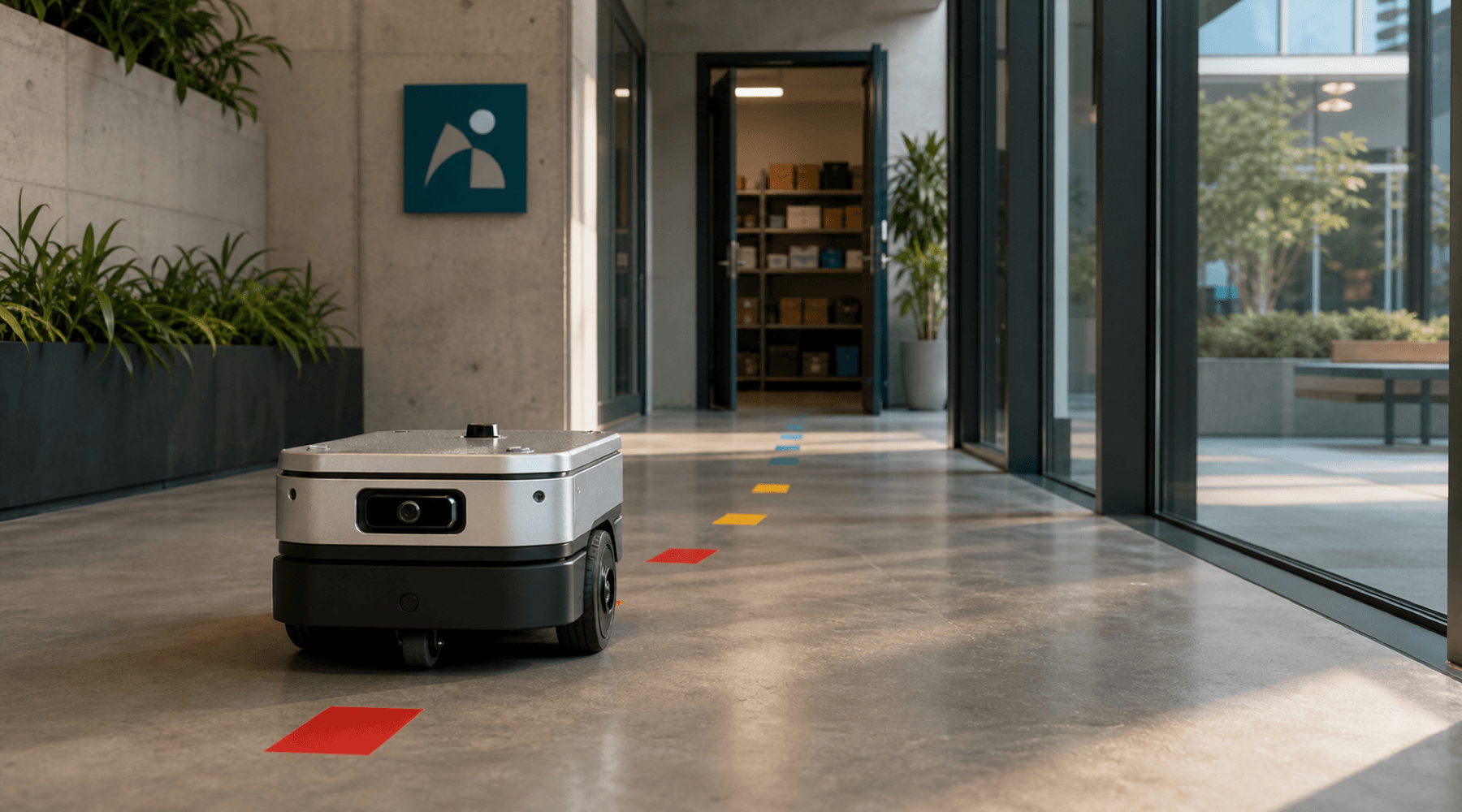
The interesting thing about Mistral's Robostral Navigate is not that another AI company wants a piece of robotics. That part is predictable. The interesting thing is the sensor budget. Mistral says the 8B model can take a plain-language instruction and ordinary RGB camera images, then move a robot through a real environment without LiDAR, depth sensors, or a bundle of synchronized camera feeds.
InfoWorld's July 10 write-up frames Robostral Navigate as part of the rush to bring modern AI into robots. Mistral's own announcement gives the sharper technical claim: the model reaches 76.6% success on the unseen R2R-CE navigation benchmark, beats the best single-camera approach by 9.7 points, and still outperforms depth or multi-camera systems by 4.5 points on that metric.
The product signal is simple: if navigation can work from a single cheap camera, useful robots get easier to build, test, and deploy.
The Sensor Stack Is The Cost Stack
Robotics has always had a perception tax. If a machine needs depth sensors, LiDAR, several cameras, careful calibration, and a heavyweight mapping stack before it can follow an instruction, the robot becomes expensive before it does anything useful. That cost is not only hardware. It shows up in mounting, calibration, maintenance, power draw, data bandwidth, training complexity, and failure modes that only appear once the robot leaves the lab.
A single RGB camera does not make those problems disappear, but it changes the shape of them. Color cameras are cheap, small, common, and already part of many mobile robots. If a navigation model can infer enough about space and intent from that stream, the rest of the platform can be simpler. The robot still needs wheels, control loops, safety logic, and local compute. It just may not need a specialized perception rig for every deployment.
instruction: leave the lobby and stop by the second shelf\ninput: one RGB camera\nmodel: embodied navigation policy\noutput: where to move next, plus orientation\nfallback: local displacement when the target is outside viewPointing Is A Practical Interface
Mistral describes Robostral Navigate as using a pointing-based policy. Given an instruction and observation history, the model predicts image coordinates for where the robot should move next, along with the desired orientation when it gets there. That matters because image-space pointing can be less brittle than asking every robot to agree on exact metric displacement from the start.
Different robots have different camera heights, lenses, fields of view, wheels, legs, and body sizes. A policy that reasons in the current camera view can generalize across some of those differences more naturally than one that assumes a fixed platform geometry. Mistral says the model is robust to camera intrinsics and world scale, and can run across wheeled, legged, and flying robots.
There is still a fallback. When the destination is outside the current field of view, the model can use local coordinate displacements such as moving forward and turning by a given amount. That hybrid approach is a good sign. The world does not always fit into the current frame. A robot needs a way to act when the relevant target is around a corner, behind a doorway, or temporarily occluded by people and furniture.
Simulation Is Doing The Heavy Lift
Mistral says the model was built entirely in-house and trained entirely in simulation, using token-efficient methods including prefix-caching. That is a big claim because robotics data is expensive. Real-world robot runs are slow, hardware-limited, and often annoying to reset. Simulation lets teams manufacture far more routes, obstacles, layouts, and instruction variants, but it also creates the old sim-to-real problem: models can learn the simulator's shortcuts instead of the world's mess.
The company is arguing that Robostral Navigate can handle real offices, residential spaces, commercial buildings, and outdoor settings, including obstacles it was not shown during training. That is the standard robotics promise, and it deserves careful field testing. Benchmarks are useful, but a live hallway has reflections, clutter, half-open doors, moving people, bad lighting, shiny floors, and objects that were placed somewhere by someone who did not read the research paper.
Operational note: a robot navigation model becomes credible when it handles the boring weirdness of buildings, not only the benchmark route.
Why This Matters For Builders
The robotics market has plenty of demos. What it needs is lower deployment friction. A single-camera navigation stack could make that friction smaller for service robots, delivery carts, inspection platforms, hospitality robots, warehouse helpers, and research machines that need language-guided movement but cannot carry a luxury sensor package.
It also puts pressure on the software boundary. The model is not the whole robot. Builders still need safety envelopes, obstacle handling, fleet management, localization, remote monitoring, recovery behavior, and a way to explain why the robot chose a route. But a better navigation model can move more of the platform's intelligence into software that is portable across hardware.
- For robotics teams: fewer special sensors can mean cheaper prototypes and simpler maintenance.
- For AI teams: embodied models have to prove they can generalize outside static image tasks.
- For operators: success depends on repeatable behavior in ordinary buildings, not polished demos.
- For developers: language instructions become useful only when they compile down to safe movement.
The Takeaway
Robostral Navigate is worth watching because it points at a less theatrical version of embodied AI. Not a humanoid robot with a personality. Not a glowing control room. A small machine, one camera, a destination, and a model that can decide where to go next.
If Mistral's numbers hold up in real deployments, the important shift is practical. Robot navigation starts to look less like a custom sensor-integration project for each machine and more like a portable perception-and-control layer. That would make robotics less precious, which is exactly what the field needs.
The road from benchmark to building is still long. But lowering the sensor burden is a real move. A robot that can navigate from the same kind of camera we already know how to ship is a robot that has a better chance of leaving the demo floor.
// Discussion
Comments
No comments yet. Start the thread.