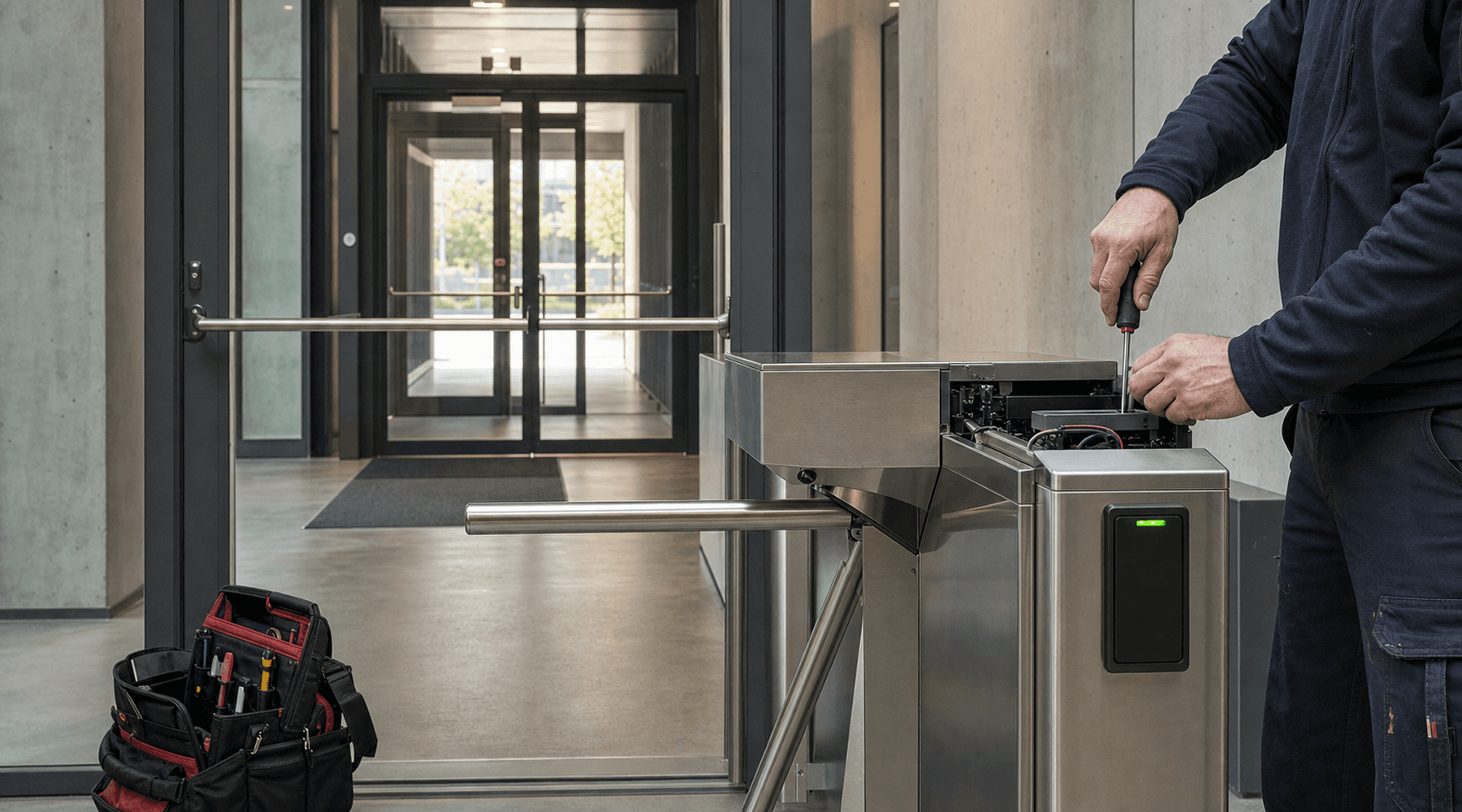
Every useful operating system has a doorway that most people never look at. User-space programs run on one side. The kernel runs on the other. A system call is the controlled crossing between them: open a file, allocate memory, talk to a socket, wait for a process, ask the kernel to do something privileged on your behalf.
That doorway is hot code. It is also security-sensitive code. It has to establish kernel state, respect tracing and seccomp hooks, handle ptrace and audit work, dispatch the right syscall number, and return cleanly without turning a fast path into a maintenance trap. That is why a cleanup can matter even when it does not introduce a shiny feature.
Phoronix reported on July 13 that Thomas Gleixner's reworked syscall entry handling is expected to land for Linux 7.3. The upstream tip/core/entry branch shows the shape of the work: consolidate where kernel stack randomization happens, move more architectures onto the generic entry helpers, remove an older helper once it is no longer used, and simplify x86 syscall-number handling.
The practical win is not that syscalls suddenly become exciting. It is that the most ordinary crossing in the system becomes a little more regular, a little smaller, and easier to reason about.
The Doorway Got A Cleaner Sequence
The key addition is a pair of entry helpers named enter_from_user_mode_randomize_stack() and syscall_enter_from_user_mode_randomize_stack(). Their purpose is direct: establish user-to-kernel entry state, then apply randomized kernel stack offset handling early enough to cover the rest of the entry function.
That ordering detail matters. Stack randomization is a hardening feature, but it is only useful over the code scope where the randomized offset actually applies. Gleixner's patch notes explain why the helpers are macros rather than inline functions: an inline function would limit the randomization scope to the inline function itself. The macro keeps the effect in the caller's entry path.
The x86 patches then switch syscall entry code to those helpers. Other architecture patches in the same branch do similar alignment for RISC-V, powerpc, s390, LoongArch, and related paths. The result is less architecture-specific boilerplate around the same idea: enter from user mode, set up the right state, apply stack randomization, then run the syscall-entry work that handles tracing, seccomp, audit, and friends.
user program
    -> syscall instruction
    -> enter from user mode
    -> randomize kernel stack offset
    -> run tracing / seccomp / audit work
    -> dispatch syscall number
-> return to user modeLess Magic Around Syscall Numbers
The x86 side also gets a cleanup that is easier to appreciate if you have ever had to debug type conversions in low-level code. One commit removes a confusing sequence where syscall numbers moved from int to long, back to int, and then to unsigned int. The new version keeps the signedness story simpler and relies on the low-level assembly path to do the sign extension it already performs on 64-bit kernels.
That is not a cosmetic detail. Syscall dispatch has to treat negative syscall numbers, out-of-range values, and tracer-modified values correctly. This path sits close to ptrace, seccomp, audit, and architecture dispatch tables. Dense, clever conversions may work, but they make the boundary harder to audit. The patch series makes the rule more explicit: compare against the maximum syscall number in the right type, then dispatch with a narrow unsigned argument where that produces smaller code.
Phoronix noted that syscall-heavy benchmarks and microbenchmarks showed a small performance gain, while one readability-oriented patch had no measurable impact. That is the right scale for this kind of work. Nobody should expect an application-level speedup headline from an entry cleanup. The value is that the code path every process uses is smaller, more consistent, and less surprising.
Why Builders Should Care
Syscall entry code is one of those places where maintainability and security are the same conversation. If each architecture does the same boundary work in its own slightly different order, reviewers have more room to miss the one path that handles state differently. If tracing assumptions are implicit, a later cleanup can accidentally change what a debugger or security tool observes. If dispatch logic is dense, performance tuning and hardening both get more fragile.
A boring syscall path is a feature. It means architecture maintainers can share helpers instead of repeating ceremony. It means hardening code runs early enough and in the intended scope. It means future ptrace, seccomp, audit, and tracing work starts from a clearer contract. It also means the hot path can shed a little text without losing the checks that make the boundary safe.
- For kernel maintainers: generic entry helpers reduce the number of architecture-specific places where the same policy can drift.
- For performance engineers: smaller hot code and fewer avoidable operations matter most when the workload crosses the kernel boundary constantly.
- For security tooling: syscall entry is where tracing, filtering, auditing, and task state all meet, so implicit behavior is expensive.
- For system builders: stable boundary code is infrastructure. Most applications depend on it without knowing its name.
The Takeaway
This is not a release-note feature that users will toggle. It is a piece of kernel housekeeping in a place where housekeeping has leverage. Linux is full of paths that have to be fast, instrumentable, hardened, and portable across architectures at the same time. The syscall doorway is one of the most important.
The useful part of this patch series is that it makes that doorway less ad hoc. Stack randomization moves into a clearer entry sequence. Architectures converge on common helpers. x86 loses some confusing syscall-number handling. The path remains ordinary, which is exactly the point.
Good systems engineering often looks like that: take the part everyone crosses, remove a little ambiguity, and make the next person less likely to get it wrong.
// Discussion
Comments
No comments yet. Start the thread.