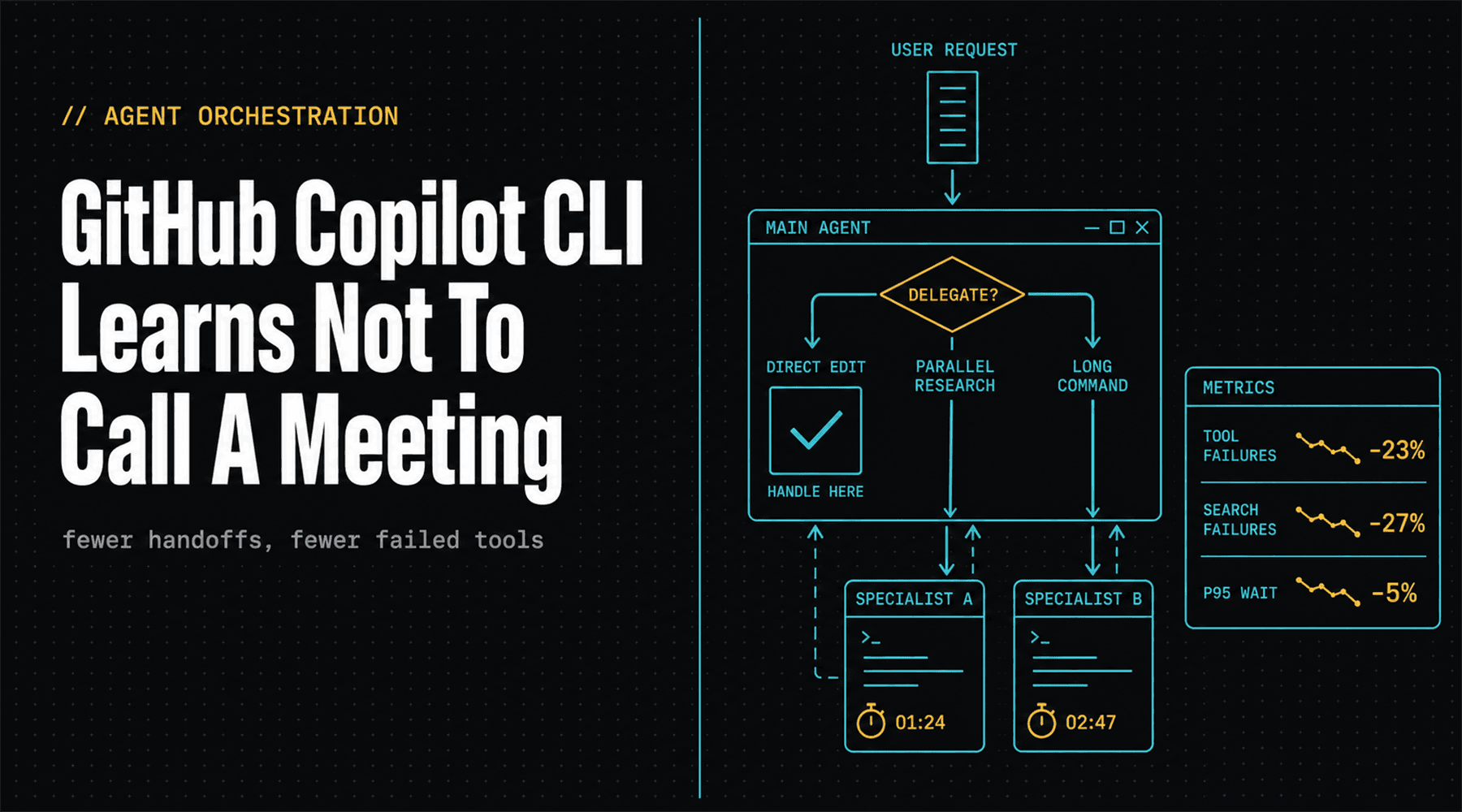
GitHub Copilot CLI just learned a deeply useful workplace skill: do the small thing yourself.
On June 12, GitHub said it had rolled out smarter subagent delegation to 100 percent of Copilot CLI production traffic. The change is available in Copilot CLI version 1.0.42 or later, and the mechanics are wonderfully unglamorous. The main agent is now more selective about when it hands work to specialist subagents, more willing to handle narrow tasks directly, and less likely to sit around while a helper rediscovers a file it already knew about.
This is not a bigger brain story. It is a better traffic-control story.
That distinction matters. Coding agents are no longer just autocomplete with a trench coat. They read files, run tools, edit code, launch searches, ask subagents to inspect separate areas, and try to stitch the results into one coherent change. The orchestration layer decides whether that looks like a good engineer with a terminal or a standup meeting accidentally held inside your repository.
The Problem Was Not Laziness. It Was Overhelp.
Subagents are useful. A helper can inspect an unfamiliar subsystem while the main agent edits the obvious file. It can run a long command while other work continues. It can explore a separate path without dumping every detail into the main context window. For broad tasks, parallelism is the whole point.
But GitHub's post is blunt about the failure mode. Delegation costs tool calls, coordination, waiting, and sometimes fresh confusion. A helper may search the same repo again, follow a stale path, misread a relative location, or report back after the main agent has already moved on. In the worst version, the main agent delegates, waits, receives a muddy answer, and then does the work itself anyway. Congratulations, the bug fix has been promoted to committee.
The new policy pushes Copilot CLI toward a narrower first move:
- Handle focused discovery and edits directly when the path is obvious.
- Delegate when independent context or parallel work creates real leverage.
- Keep the handoff specific: what the user asked, what is already known, what the helper owns, and what result is needed.
- Treat subagents as a parallelism tool, not a pause button.
That last line is the one to tape to the server rack. A subagent that makes the main agent idle is not parallel execution. It is a very expensive loading spinner.
GitHub Used Agents to Debug the Agents
The funniest part is also the most practical. GitHub says it used LLMs to analyze full agent trajectories and identify where orchestration helped versus where it added overhead. In other words, the agents left enough exhaust in their session history that another model could point at the waste heat and say, roughly, why did you call a meeting for this?
From there, the team turned the diagnosis into policy, tested it with generated regression cases and existing benchmarks, then moved through staff and public A/B tests before shipping. This is the pattern that will probably separate serious agent products from toy demos: not one heroic prompt, but telemetry, trajectory review, offline evals, production experiments, and a willingness to tune the harness itself.
The result was measurable. GitHub reported a 23 percent reduction in tool failures per session, including a 27 percent drop in search tool failures and an 18 percent drop in edit tool failures. It also reported lower total user wait time: 5 percent at P95 and 3 percent at P75, with no quality regression.
Those are not cinematic numbers. They are better than that. They are the kind of numbers people feel after a week of daily use: fewer weird stalls, fewer repeated searches, fewer moments where the agent acts like the repository was moved while it was blinking.
The CLI Is Becoming a Little Operating System for Work
This update also fits a larger Copilot CLI arc. Earlier in June, GitHub described language-server support for real code intelligence, so the agent can use symbol-aware navigation instead of treating code as a bag of text. It also showed custom agents as a way to turn one-off prompts into repeatable workflows.
Put those pieces together and the CLI starts to look less like a chatbot strapped to a shell and more like a small operating system for software work:
- Language servers provide structured code knowledge.
- Custom agents encode repeatable responsibilities.
- Subagent delegation controls when work becomes parallel.
- Telemetry and evals tune the routing policy after real use.
The hard part is not adding more knobs. Developers already have knobs. Some of them are still stuck behind the monitor from the last toolchain migration. The hard part is making the default path calm, quick, and hard to derail. GitHub's change is interesting because it removes noise without asking the user to become an agent dispatcher.
Why This Matters Outside GitHub
Every agent builder is going to face this problem. More tools do not automatically mean more capability. More subagents do not automatically mean more throughput. Past a certain point, every extra helper increases the chance that someone has the wrong file, the wrong abstraction, or the wrong job.
The best agent systems will learn when to stay boring. Read the file. Edit the file. Run the test. Then, when the task really is wide enough, split the work with clean ownership. That sounds like basic engineering because it is basic engineering. The novelty is that the same discipline now belongs in the agent harness, not just in the human team.
There is also a security angle hiding in the productivity story. A narrower delegation policy means fewer tool paths, fewer broad searches, fewer accidental exposures to stale workspace assumptions, and fewer chances for a helper to act on bad context. It is not a sandbox, and it is not a permission model. Still, in agent land, reducing unnecessary motion is a form of safety. The bug you do not create is the best kind of clever.
The Takeaway
GitHub Copilot CLI's smarter delegation rollout is a small product change with a large lesson: agentic software gets faster when it becomes less dramatic. The winning move is not always more agents, longer chains, bigger plans, and louder confidence. Sometimes the winning move is one main agent looking at a narrow task and saying: I have this.
That is good news for developers. It is also good news for the whole category. The future of coding agents should not be a conference room full of tiny consultants. It should be a sharp tool that knows when to work alone, when to split the job, and when to stop calling meetings with itself.
// Discussion
Comments
No comments yet. Start the thread.