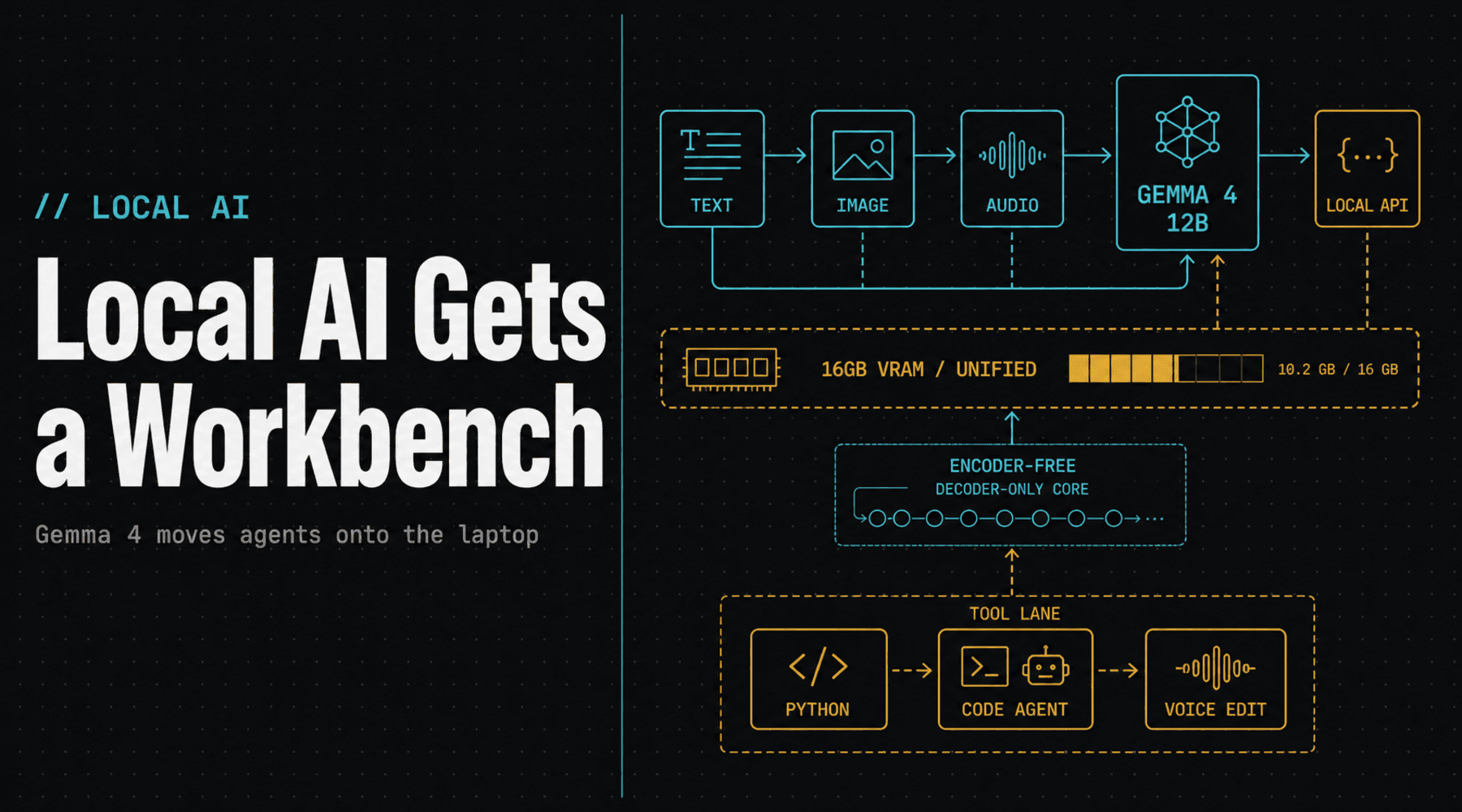
The most interesting part of Google's Gemma 4 12B release is not that it is another open model. The model world has plenty of those. The interesting part is the target: a dense, multimodal AI system meant to run on laptop-class hardware, wired into local tools, voice editing, Python execution, and local API endpoints instead of living only behind a cloud chat box.
That changes the shape of AI software. A cloud model is a destination. You send data to it, wait for an answer, and pay for the privilege. A local model is infrastructure. It sits next to the files, shell, microphone, notebook, browser, IDE, and app state. It can run close to private data, respond without a network round trip, and become part of a normal developer or knowledge-worker toolchain.
Google says Gemma 4 12B is a dense multimodal model with a unified, encoder-free architecture. In practical terms, the release is designed to handle text, image, and audio inputs without bolting separate heavy encoders onto the side of the model. Raw visual and audio signals are projected into the same decoder-only backbone, which reduces some of the latency and memory fragmentation that can make local multimodal systems feel awkward.
local workstation
  text input
  image input
  audio input
      -> Gemma 4 12B
      -> local API endpoint
      -> Python tool, code agent, voice editor

privacy, latency, and cost move closer to the userWhy 12B matters
The 12 billion parameter size is important because it sits in the middle of the local AI argument. Tiny models are useful, but often brittle. Giant models are impressive, but usually need server-class hardware. A strong 12B multimodal model is closer to the point where ordinary laptop hardware becomes an AI workbench instead of a thin client for someone else's data center.
Google's developer guide says Gemma 4 12B is small enough to run locally on dedicated GPU laptops with 16GB VRAM or unified memory. That does not mean every budget machine turns into a frontier lab. It means the useful middle is getting crowded: enough capacity for meaningful coding, visual analysis, audio input, and tool use, with a memory target that many prosumer and enterprise laptops can actually meet.
The real shift is not offline chat. It is local agency: a model that can inspect, generate, execute, revise, and explain without every action leaving the machine.
The encoder-free bet
Most multimodal systems have a familiar architecture. A vision encoder turns an image into embeddings. An audio encoder does something similar for sound. The language model then reasons over the transformed inputs. That works, but it spreads the system across multiple components that may have different memory needs, latency profiles, and fine-tuning behavior.
Gemma 4 12B takes a more direct path. Google describes a lightweight vision embedder that projects image patches into the model's hidden dimension, plus an audio wave projection that slices 16 kHz audio into 40 millisecond frames and projects them into the input space. The point is not that encoders are obsolete everywhere. The point is that local multimodal AI benefits when the pipeline is less fragmented.
That matters for builders because local AI is already hard enough. If an app needs a separate stack for images, a separate stack for voice, another service for text, and a remote tool executor, the promise of local intelligence collapses into glue code. A unified model is easier to reason about, package, tune, and serve.
The workbench layer
The second part of the release is the Google AI Edge tooling around the model. Google is pushing Gemma 4 12B through local experiences such as AI Edge Gallery on macOS, voice-driven editing in AI Edge Eloquent, and LiteRT-LM serving local API endpoints from the terminal. Those details are more important than they sound.
- For developers: a local model can generate Python, execute scripts, inspect outputs, and revise work while keeping the loop on the machine.
- For analysts: visual and tabular tasks can happen near private files instead of through a remote upload workflow.
- For app builders: an industry-compatible local endpoint turns the laptop into a testbed for agent tools and harnesses.
- For enterprises: local inference reduces some privacy, latency, and metering pressure before a cloud model is even considered.
This is why the workbench metaphor fits. A local model with a terminal-facing server is not merely answering prompts. It becomes another process on the machine, reachable by scripts, IDEs, UI prototypes, and workflow tools. That is a different product surface than a browser tab.
Cloud AI is not going away
None of this makes cloud models irrelevant. The largest hosted systems will keep winning on peak reasoning, enormous context, fleet-scale retrieval, and managed reliability. Many companies will still prefer a hosted service because it is easier to operate and audit centrally.
But the center of gravity is no longer only up and out. Some AI work wants to move down and in: onto the laptop, the edge box, the workstation, the robot, the clinic machine, the factory PC, the field device. That shift is partly about cost and latency, but it is also about control. The closer the model is to the user and the data, the more it can feel like a native capability instead of a rented interface.
Gemma 4 12B is one release, not the finish line. Its importance is the direction of travel. Local AI is becoming multimodal, tool-aware, and practical enough to design around. The next wave of useful AI software may look less like a single omniscient website and more like a collection of capable local workbenches, each close to the files and sensors it needs to understand.
// Discussion
Comments
No comments yet. Start the thread.