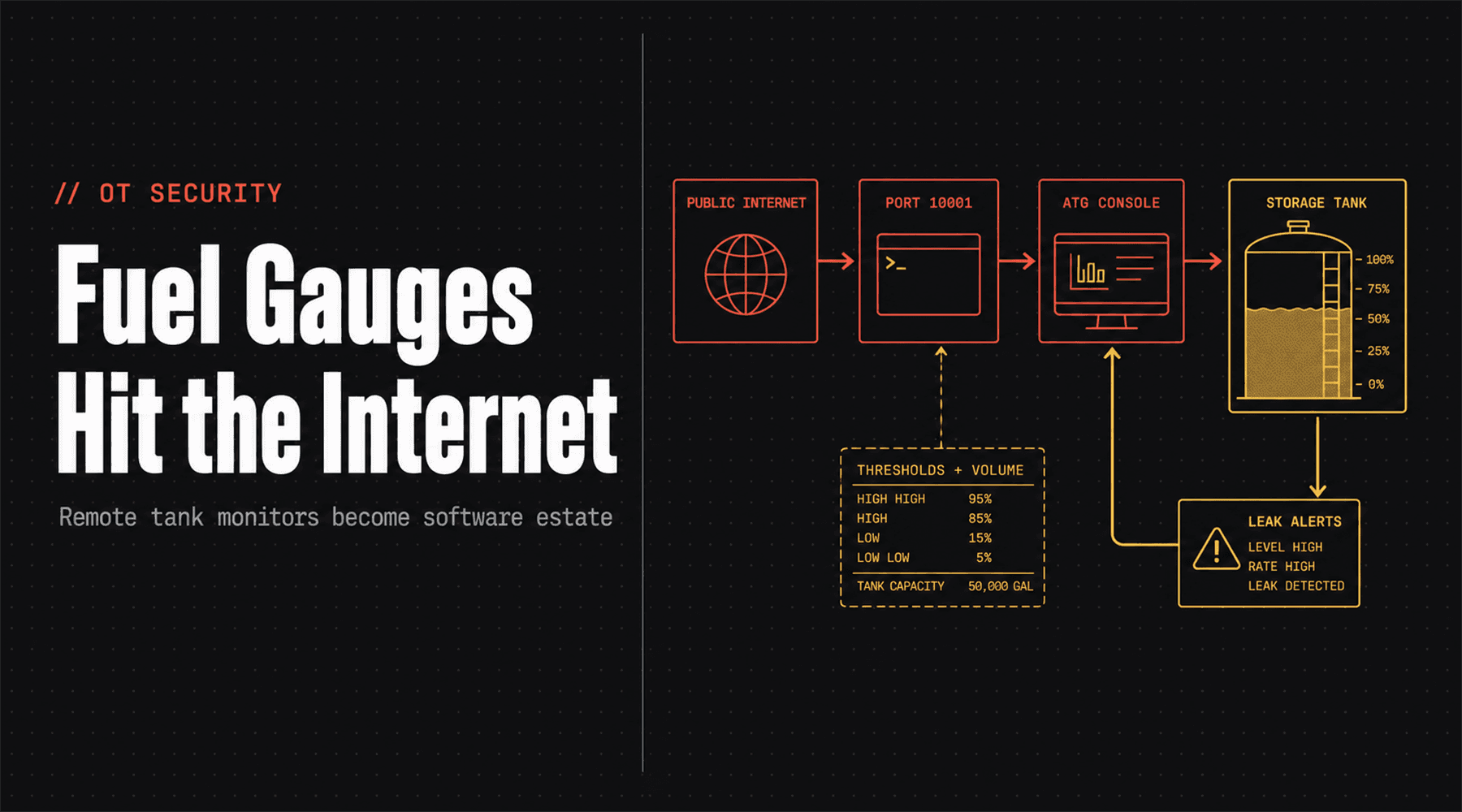
The scariest industrial computer is not always a turbine controller or a giant factory robot. Sometimes it is a fuel tank gauge with a serial port, a default password, and a route to the public internet.
That is the small but useful shock inside the June 2026 warning from CISA, the FBI, NSA, DOE, EPA, TSA, DOT, and USDA. The agencies say U.S.-based automatic tank gauge systems, or ATGs, are being targeted by cyber actors. These devices are common in energy, chemical, food and agriculture, and transportation environments. They track tank levels, temperatures, inventory, and leak signals. In plain English: they help operators know what is sitting in a tank and whether something is going wrong.
The advisory is not a cinematic critical-infrastructure story. It is better than that. It is the kind of practical warning that explains how modern risk really spreads. A quiet monitoring box becomes remote management. Remote management becomes internet exposure. Internet exposure becomes a command shell for anyone patient enough to scan.
public internet
      |
port 10001 / web UI
      |
ATG console -> tank labels -> volume readings -> alert thresholds
      |                                |
+--------- operator trust <------+What happened
The federal fact sheet says the observed activity involves unattributed cyber actors compromising internet-exposed ATG systems and modifying them through command execution. The agencies list several probable paths in: authentication bypass, hardcoded credentials, operating-system command execution, SQL injection, and privilege escalation.
Once inside, an attacker may be able to change network settings, product identifiers, tank volumes, pump controls, and alarm behavior. That last part is the piece to notice. A tank gauge is not just a display. It is part of the operator's sense-making loop. If readings or alerts become unreliable, the physical system can drift away from the picture on the screen.
BleepingComputer reported on June 5 that Shadowserver had added ATG scanning to its accessible ICS reporting and saw 1,061 exposed IPs on 2026-06-05 after filtering out likely honeypots, with 909 in the United States. Treat that number as a moving measurement, not a permanent census. The point is that exposure is visible enough to measure from the outside.
Old operational technology did not become safe because it was boring. It became risky because boring systems were networked without being treated like software.
Why this matters
ATGs are mundane by design. That is why the story matters. They sit near the boundary between digital administration and physical consequence. A bad web app can leak data. A bad tank gauge can mislead a human about fuel, chemicals, leak detection, or equipment health.
This does not require Hollywood sabotage. A small change to a label, threshold, network setting, or alarm state can create expensive uncertainty. Operators may waste time inspecting false problems. Worse, they may miss a real problem because the system that should have raised its hand was muted or manipulated.
The agencies recommend exactly the kind of controls that should already be normal for exposed industrial devices: remove public internet access, restrict remote access through firewalls or VPNs, replace default passwords, use strong unique credentials, patch with certified service providers where possible, enable logging, watch for unauthorized changes, and report suspicious activity.
The checklist is the architecture
For software teams, this may sound basic. That is the lesson. Critical infrastructure keeps rediscovering that identity, patching, inventory, logs, and network boundaries are not paperwork. They are the architecture. If an operator does not know which field devices are reachable, who can administer them, what firmware they run, and what a normal configuration looks like, the expensive physical plant inherits the cheap mistakes of the cheap network edge.
- Exposure: find ATG serial ports, web interfaces, and vendor remote-access paths before scanners do.
- Access: remove default passwords and tie remote maintenance to controlled networks, not the open internet.
- State: keep known-good snapshots of tank labels, volumes, alarm thresholds, and network settings.
- Telemetry: log changes that affect readings or alerts, then route those logs somewhere someone will actually inspect.
- Vendor pressure: make secure update paths and credential handling part of service contracts, not an optional support conversation.
That is not glamorous security. It is the work that keeps boring machines boring.
What changes now
The ATG warning should push more operators to inventory the quiet edge of operational technology. Gas stations, chemical storage sites, farms, warehouses, and transport depots often rely on specialist equipment installed years before today's threat model. Those systems may be maintained by vendors, local contractors, or overworked generalists who inherited a network diagram that is really a collection of assumptions.
The fix is not to panic about every sensor. It is to stop treating remote access as a convenience layer floating above the plant. Remote access is part of the plant. If it can change what operators see, it belongs inside the same risk model as valves, pumps, inventory systems, and emergency procedures.
This is also where public reporting helps. CISA's fact sheet is short, specific, and usable. It names the systems, names the sectors, names the likely access patterns, and tells owners what to do. That beats vague cyber-awareness language. The next step is making sure smaller operators can turn that guidance into actual configuration changes without waiting for an incident.
The takeaway
Automatic tank gauges are a useful reminder that infrastructure security is not only about rare zero-days and elite malware. It is often about whether a measurement device was put online with weak credentials, whether anyone noticed, and whether the operator can still trust the panel when the alarm does not fire.
The internet is very good at finding forgotten computers. The physical world is full of them. Every serious infrastructure operator should assume that small field devices are now part of the software estate, because attackers already do.
// Discussion
Comments
No comments yet. Start the thread.