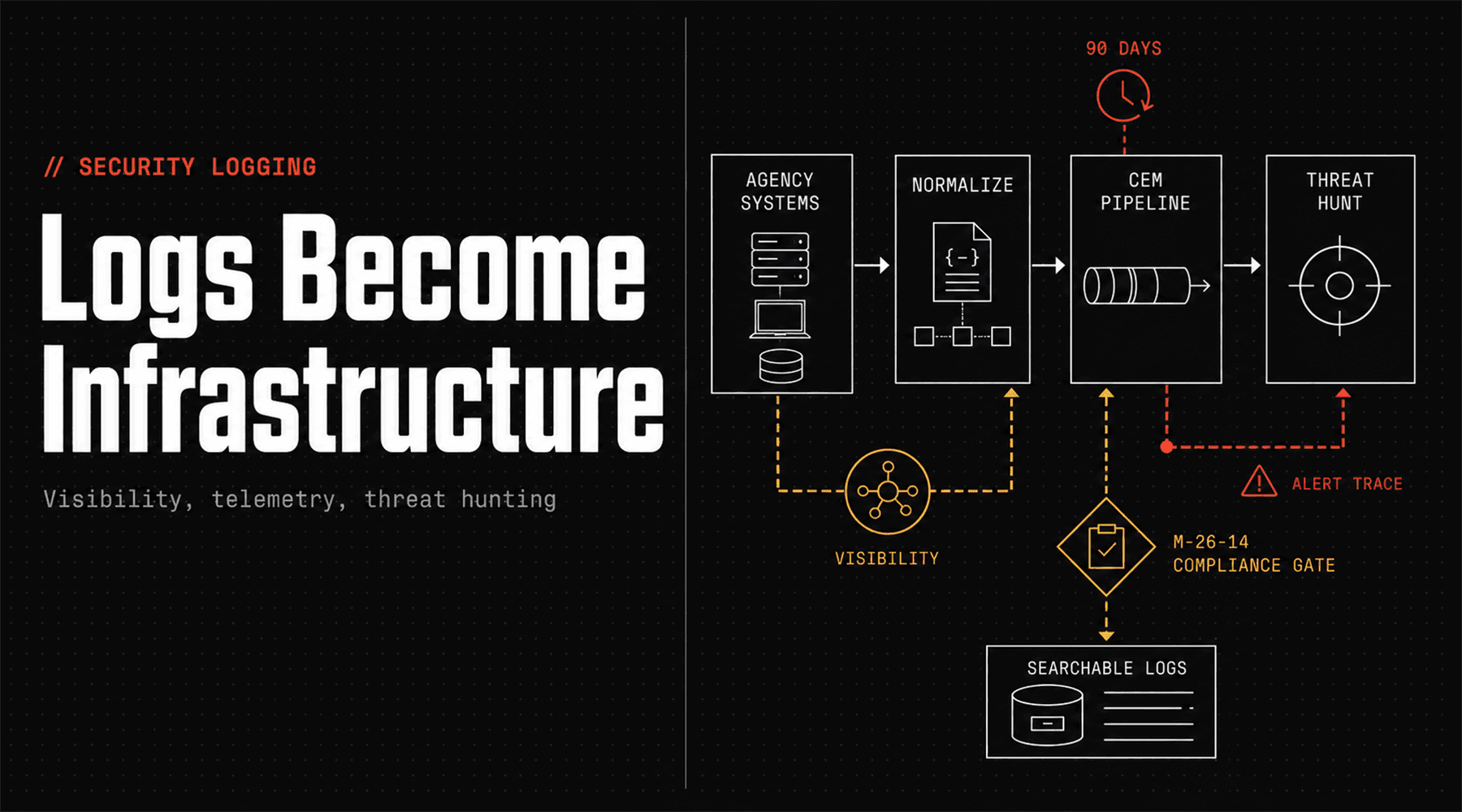
Logs are usually treated like exhaust. Systems emit them, vendors store them, auditors ask whether they exist, and security teams try to find the useful pieces after something has already gone wrong. The federal government is trying to make that posture less casual.
On May 26, CISA published a new page for a Logging Reference Architecture tied to OMB memorandum M-26-14, Ensuring Effective and Efficient Agency Logging and Network Visibility to Defend Against Evolving Cyber Threats. The page is not the architecture itself yet. It says CISA, working with OMB and the CISO Council, has been tasked with developing the reference architecture within 90 days. That future document is supposed to guide agencies as they implement continuous event monitoring and threat-hunting capabilities.
The interesting part is the framing. This is not just a new retention rule or a reminder to collect more telemetry. OMB is asking for an architecture: a way to make logs useful across agencies, missions, platforms, and incident workflows. That is a bigger shift than it sounds, because the hard problem in logging has never been whether computers can generate enough records. They generate more than enough. The hard problem is whether those records arrive in the right shape, can be searched under pressure, and support a real investigation when the attacker is still moving.
Visibility is a system design problem
Modern environments produce a messy spread of evidence: identity events, endpoint alerts, DNS logs, cloud control-plane records, SaaS audit trails, network flow data, application traces, privileged-access logs, email events, and more. In a healthy security program, those streams do not merely pile up in storage. They become a map of what the organization knows about itself.
That map is often incomplete. Some systems log too little. Some log too much, but in formats that require special handling. Some logs are retained for short periods because storage is expensive or because nobody has fought through the operational details. Some are technically present but unavailable to responders without a ticket, a vendor console, or a privileged administrator who happens to be awake.
A reference architecture cannot solve every organizational problem, but it can name the shape of the system agencies should be building. It can define which events matter, how they should be normalized, how long they should remain available, which systems need network visibility, and how logs should feed detection, hunting, and response. That turns logging from a procurement category into a security dependency.
The 90-day clock matters
CISA's page quotes the OMB memo directly: within 90 days, CISA will develop the logging reference architecture, and agencies must adhere to it by the timelines in the memo. The architecture is meant to build on earlier federal logging work under M-21-31 while giving agencies more flexibility for different mission requirements and risk profiles.
That balance is important. Federal agencies do not all look alike. A benefits portal, a research lab, an industrial-control environment, a classified-adjacent network, and a public-facing information site do not have identical logging needs. A rigid checklist can create compliance theater, where teams produce records that satisfy a table but do not help an incident commander understand what happened. Too much flexibility creates the opposite problem, where every agency has its own island of formats, tools, and retention assumptions.
The value of a reference architecture is that it can set a common floor without pretending every environment is the same. Agencies need local choices, but they also need shared expectations: which signals should exist, how quickly they should be accessible, what evidence a threat hunt can assume is available, and what gets preserved when an incident becomes a cross-agency problem.
Threat hunting needs historical depth
Threat hunting is not the same thing as alert review. An alert says a tool noticed something. A hunt asks a broader question: if this attacker, technique, credential, infrastructure, or suspicious pattern is present somewhere else, where would the evidence appear?
That question requires history. If an agency only keeps a thin slice of high-value logs, it may miss the slow part of a compromise: account discovery, quiet persistence, low-volume command traffic, cloud permission changes, or a service principal used in a way nobody expected. If records are retained but not searchable across relevant systems, responders can still lose the race. They know the data might exist, but they cannot get answers fast enough.
This is why logging belongs beside network visibility in the OMB memo. Logs explain what systems thought they were doing. Network visibility shows how systems actually communicated. Either one alone can be misleading. Together, they make it much harder for an intrusion to stay abstract.
More logs are not the goal
The obvious failure mode is volume worship. Agencies could read the memo as an instruction to ingest everything, keep everything, and call the storage bill a security program. That would be expensive and only partly useful.
The better reading is that logs need product discipline. A useful logging pipeline has schemas, ownership, durability, access controls, cost management, health checks, and search paths that responders trust. It should be clear which team owns a data source, what fields are expected, how parsing failures are detected, when retention changes, and what happens when a source goes silent. Logging should have service-level expectations because the incident response process depends on it.
There is also a privacy and governance side. Collecting more telemetry can expose sensitive behavior, administrative activity, and mission details. A serious architecture should make access auditable and purposeful. The goal is not to create a giant pile of surveillance data. The goal is to preserve the evidence needed to defend systems, recover faster, and understand attacks without handing every operator unlimited visibility into everything.
Security maturity looks boring from the outside
The most useful security infrastructure rarely looks dramatic. It looks like reliable timestamps, normalized identity fields, working parsers, documented retention, tested queries, durable archives, and a response team that can answer basic questions quickly. Which account logged in? From where? What changed? What did that host talk to? Was this seen anywhere else? How far back can we check?
CISA's pending reference architecture will be judged by whether it helps agencies answer those questions under stress. If it becomes another PDF that maps old controls to new acronyms, it will not change much. If it forces a cleaner design conversation around telemetry, searchability, retention, and response workflows, it can raise the floor for federal cyber defense.
The takeaway is simple: logs are no longer back-office residue. They are part of the defensive control plane. Agencies that treat them as infrastructure will be able to hunt, respond, and recover with more confidence. Agencies that treat them as compliance exhaust will keep discovering, during incidents, that they saved the wrong evidence in the wrong place for the wrong amount of time.
// Discussion
Comments
No comments yet. Start the thread.