Game studios have been living with a strange split brain for decades. Code gets Git, pull requests, cheap branches, and all the little rituals software people now treat as oxygen. Art gets giant binary files, file locks, special servers, expensive workflows, and a polite warning not to sneeze near the production depot.
Epic Games just put a serious marker down on that divide. At Unreal Fest Chicago, the company open-sourced Lore, a new revision-control system for games and entertainment projects. It is pre-1.0, still under active development, and not a drop-in replacement for every production pipeline tomorrow morning. But it is also not a toy. Lore is the technology line behind Unreal Revision Control in Unreal Editor for Fortnite, now being pulled into the open as a broader system for teams that treat code, meshes, textures, audio, video, and other binary assets as first-class project material.
The pitch is not that Git is bad. The pitch is that Git was not born inside a 300 GB game project full of artists, locks, branches, and binary blobs with feelings.
Why Epic Is Not Just Using Git LFS
Git is brilliant at a specific job: content-addressed source history for mostly text-heavy projects. It won the software world because it made branching cheap, history local, and collaboration fast. For normal software, that bargain is still excellent.
Game production bends the bargain out of shape. A serious Unreal project is not just C++ and scripts. It is large textures, animation data, cinematics, environment art, audio, generated files, and binary editor assets that do not merge like text. Git LFS helps Git carry big files, but it is still an add-on. Centralized systems handle large assets better, but they often trade away Git-style freedom, open protocols, local experimentation, or third-party implementation.
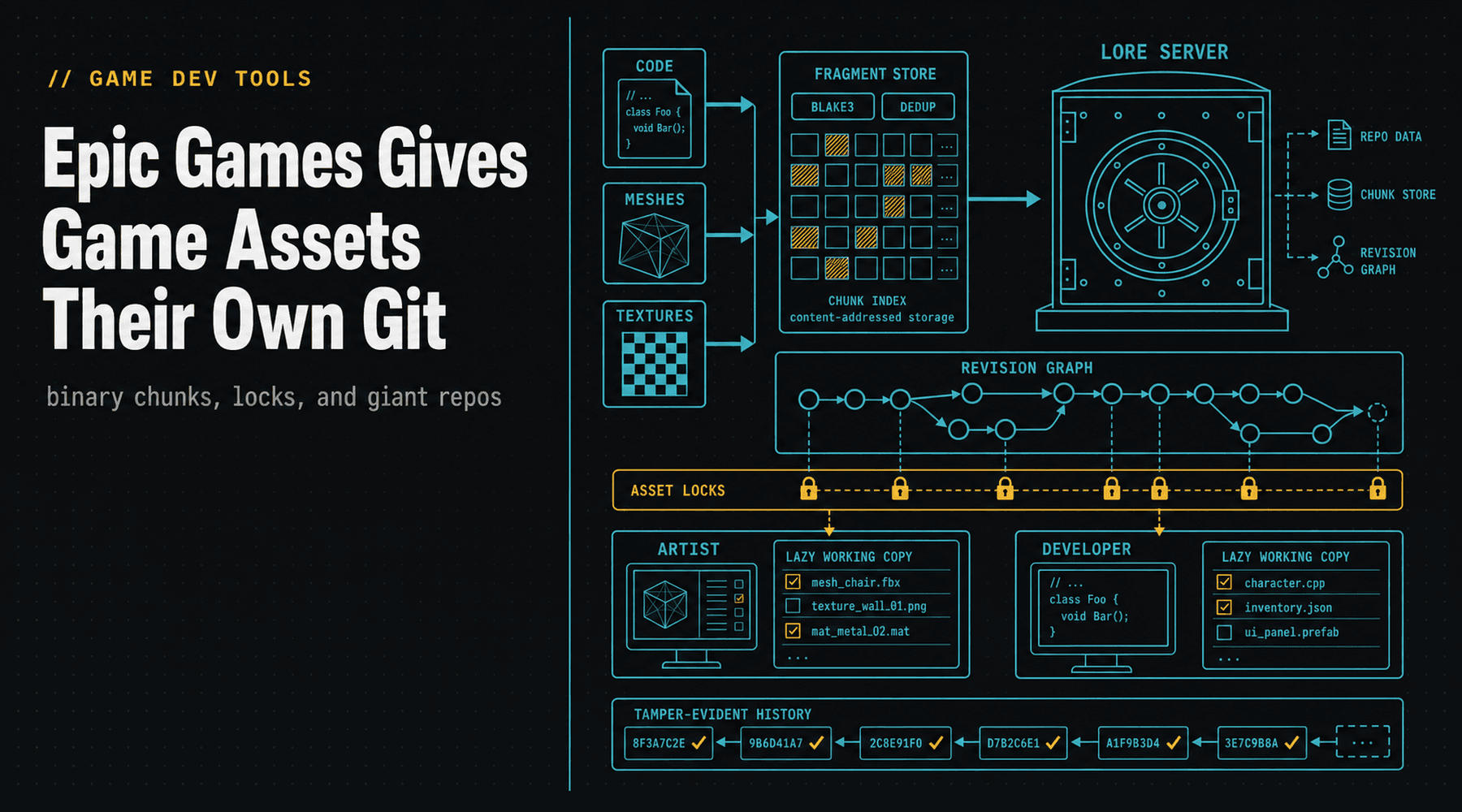
Lore is Epic's attempt to stop treating that problem as an awkward plugin category. Its README describes an open-source version-control system optimized for projects that combine code with large binary assets, built for both developers and artists. The docs go deeper: centralized server-of-record where that helps durability, access control, and conflict resolution; content-addressed storage where that helps trust and reuse; sparse and lazy working copies where that keeps giant repositories from crushing machines that only need a slice.
The Fun Part Is the Storage Model
Lore's design centers on two big pieces: an immutable content store and a mutable key-value store. The immutable side is where file contents and revision structures live. The mutable side is where names, branch heads, locks, and other moving pointers live. That separation is not academic. It is how a system can make big project data durable and verifiable while still letting a team move fast.
asset bytes
  -> fragment/chunk storage
  -> content addresses
  -> deduplication across revisions
  -> revision graph
  -> sparse working copy
The docs call out BLAKE3 as the address function and describe content addressing, fragmentation, sparse reads, packfiles, and lazy fetch. Translation for non-storage people: Lore wants to avoid downloading, copying, and storing the same enormous asset bytes over and over just because a project moved forward by one revision. If two versions share chunks, the system should know that and reuse them.
That is the right place to get ambitious. In game production, a single file can be too large to treat as a little blob in a nice text-world history graph. Chunking, deduplication, sparse views, and partial materialization are not garnish. They are the difference between version control being an asset pipeline and version control being the office printer everyone hates.
Locks Are Not a Moral Failure
Software engineers sometimes talk about file locks like they are evidence of a primitive civilization. Then they meet a binary scene file, two artists, and a deadline.
Text files can often be merged. Some art assets cannot be merged in a sane way, or cannot be merged by the people doing the work without turning a production day into archaeology. Lore's roadmap includes scalable locking, and Anchorpoint says it is contributing support around the new system. That matters because a version-control tool for artists has to respect the boring reality of asset ownership. Sometimes the correct collaboration primitive is not a heroic three-way merge. Sometimes it is: this file is mine until lunch, please do not silently turn the dragon into confetti.
This is where Lore's audience is clearer than the average open-source developer-tool launch. It is not aimed only at terminal-heavy programmers. Epic says Lore is for developers and artists alike, with an intuitive CLI, full-surface APIs, and a roadmap that includes an open-source desktop client. If the artist cannot use it without learning a private religion, the system loses.
Open Spec, Open Source, Real Stakes
The open-source part is not cosmetic. Lore is MIT licensed, publicly documented, and API-first. The project lists bindings across C/C++, C#, Rust, Go, Python, and JavaScript. That is exactly the kind of boring openness pipeline teams need before they bet years of asset history on a tool.
For studios, version control is not a cute productivity app. It is the memory of the company. It decides who can ship, who can roll back, who can recover from a bad merge, who can inspect history, and whether a vendor can build tooling without begging for permission. Proprietary wire protocols and black-box servers are tolerable until a studio needs to automate around them, migrate away from them, or prove what happened during a costly production mistake.
Lore is still early, and Epic is clear about that. Interfaces, APIs, and on-disk formats may change. The open-source tooling also cannot yet talk directly to the UEFN backend, even though Lore is the built-in version-control system for Unreal Editor for Fortnite. That is a big practical caveat. This is a launchpad, not a finished migration memo.
What Changes If This Works
If Lore matures, the interesting outcome is not simply "Perforce has competition" or "Git has competition." The more useful outcome is that game studios get a shared technical language for modern asset history: chunked storage, tamper-evident revision graphs, sparse workspaces, locks, branch freedom, open APIs, and artist-friendly clients living in one coherent system.
- Artists get less weird tooling debt: version control can understand large binary assets without treating them as suspicious luggage.
- Engineers keep modern workflows: branching and local experimentation do not have to vanish just because the project has enormous files.
- Tool vendors get an open target: documented APIs and an MIT license invite integrations instead of forcing every studio into private glue code.
- Studios get a bargaining chip: an open system changes procurement conversations even before it replaces an incumbent.
The cultural shift might be just as important. Game development is one of the most technically demanding forms of software production, but its tooling is often discussed as if it lives in a separate barn behind the real engineering house. Lore says the asset pipeline is the engineering house. The meshes count. The texture files count. The binary stuff counts. The people who make them count.
The Takeaway
Epic Games did not open-source a Git killer in the cartoon sense. Git is still Git, and most software projects should keep using it with a smile. Lore is more specific and more interesting: a bet that large creative production needs version control designed around the files studios actually ship.
That makes the announcement worth watching even if you never touch Unreal. Modern software is getting more media-heavy, model-heavy, generated-asset-heavy, and multi-discipline. The old code-versus-content wall is looking tired. Epic is trying to put a real door in it, with locks, chunks, branches, and a vault big enough for the dragon.
// Discussion
Comments
No comments yet. Start the thread.