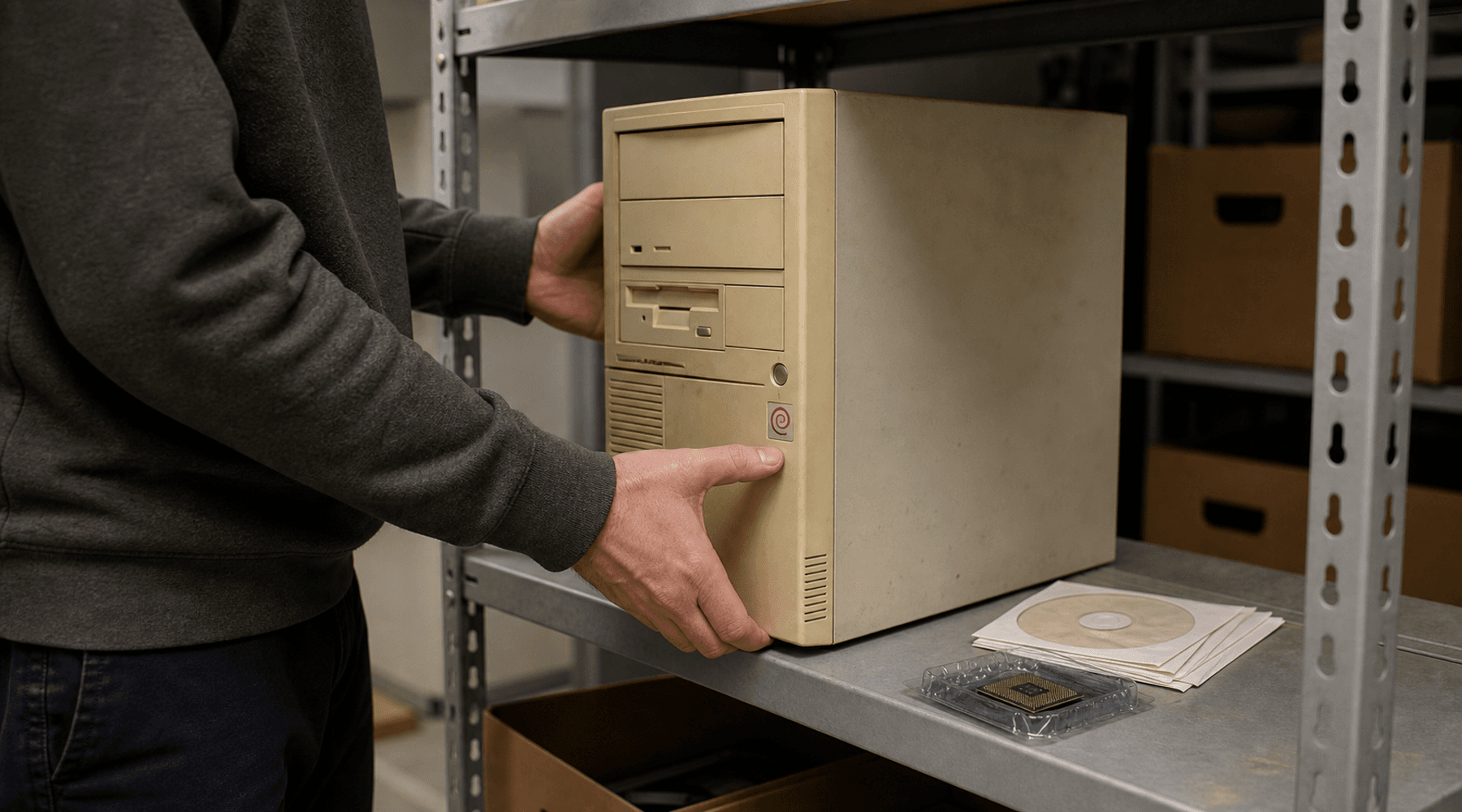
There is a difference between keeping old software runnable and keeping old machines on the main road. Debian's latest point releases put that difference in plain view.
The Register covered the moment this week as Debian 13.6 and Debian 12.15 arrived together. The headline angle is x86-32: Debian 12.15 is the last normal Bookworm point release before Debian 12 moves to long-term support, while Debian 13 has already narrowed what i386 means. The architecture is not gone, but its job has changed.
That distinction matters. Debian has been one of the last big general-purpose Linux distributions where old x86 hardware could feel less abandoned. For many users, that was not nostalgia. It was a repair bench, a lab controller, a kiosk, an old laptop, a print station, a ham-radio box, or a piece of industrial software that still did useful work. But a distribution has to decide where the maintainer time goes, and x86-32 has been losing the argument for years.
The practical story is not that Debian hates old hardware. It is that old hardware has crossed from normal platform into compatibility problem.
What Changed
Debian's own release notes for Trixie are careful and specific. From Debian 13, i386 is no longer supported as a regular architecture. There is no official Debian kernel and no Debian installer for i386 systems. Fewer packages are available because many upstream projects no longer support the architecture. Debian says the remaining purpose is legacy code, typically through multiarch or a chroot on a 64-bit amd64 system.
The point-release timing makes that concrete. Debian 13.6 is the current stable update for Trixie. Debian 12.15 is the oldstable update for Bookworm and marks the end of regular Debian support for that release. Debian says future Bookworm updates will be handled by the Long Term Support team, supported by the Debian LTS team and other contributors. In other words: the last regular Debian line that still had a normal 32-bit PC install story is now leaving the normal release track.
This is not the same as every 32-bit binary disappearing. Debian 13 can still run legacy i386 userland in supported configurations on amd64. That is a very different promise from shipping an official installer and kernel for the old machines themselves. The center of gravity moved from booting the platform to preserving compatibility.
Debian 12 bookworm\n+ i386 installer path\n+ regular oldstable support until 12.15\n+ LTS handoff after normal support ends\n\nDebian 13 trixie\n+ amd64 install path for x86 PCs\n+ reduced i386 support\n+ legacy 32-bit code through multiarch or chrootWhy It Was Inevitable
Architecture support is not just a compiler switch. It means build machines, installer images, kernel coverage, security testing, package fixes, bootstrap work, porters, bug triage, and enough upstream support that maintainers are not constantly patching around abandonment. The harder part is security. Old architectures can keep building long after they stop being a good place to carry browser engines, JITs, cryptography libraries, virtualization stacks, and language runtimes that assume more memory, more registers, newer instructions, and active upstream testing.
Debian's notes point at the real constraint: many projects no longer support i386. When upstreams leave, distributions inherit the sharp edges. A package can be technically buildable and still be an expensive liability if nobody upstream runs tests there or takes breakage seriously. At Debian's scale, that expense repeats across thousands of packages.
The irony is that Debian is handling the transition in a very Debian way. It is not cutting off the use case entirely. It is demoting it into the layer where it can be maintained with less platform-wide risk. If your real need is an old 32-bit binary, multiarch on amd64 is often the cleaner answer. If your real need is to keep a 32-bit-only physical machine alive forever, that has become a preservation project, not a mainstream operating-system target.
What Builders Should Take From It
The obvious lesson is about hardware refreshes, but the deeper one is about dependency shape. A fleet can be old in several different ways. Some machines are old because the hardware is slow. Some are old because firmware is frozen. Some are old because a vendor application requires a 32-bit userspace. Some are old because nobody knows what breaks if they are moved.
Those are different problems. Debian's shift forces teams to sort them out. A 32-bit app may be a compatibility problem that can be moved to amd64 with multiarch, a container, a chroot, or a small virtual machine. A 32-bit physical box may be a hardware lifecycle problem. An appliance with no migration path may be a vendor-risk problem. Treating all of those as the old Debian machine hides the real decision.
- For maintainers: reduced i386 support is a way to preserve useful compatibility without pretending the full platform cost is still normal.
- For operators: Debian 12.15 is a good trigger to inventory every remaining x86-32 install and classify why it exists.
- For software teams: if a product still requires 32-bit x86, document whether that is a real technical need or just an old build assumption.
- For preservation work: old hardware deserves care, but care is not the same as expecting the mainline distro release process to carry it forever.
The Takeaway
Debian's x86-32 transition is not dramatic because something exploded. It is dramatic because something ordinary stopped being ordinary. A platform that helped define commodity Linux now sits mostly as a compatibility layer for old code and a preservation path for people who know exactly why they need it.
That is how infrastructure ages. First it is the default. Then it is a supported option. Then it is a special case. Eventually the valuable part is no longer the machine itself, but the software and knowledge that still need a safe place to run.
Debian is not closing that place. It is putting a smaller, more explicit door on it.
// Discussion
Comments
No comments yet. Start the thread.