Cloudflare wants the web to install a cover charge.
On July 1, Cloudflare opened the waitlist for Monetization Gateway, a new edge service that lets a site charge for a web page, dataset, API, or MCP tool behind Cloudflare. The interesting bit is not the dashboard checkbox. It is the protocol choice: Cloudflare is using x402, a machine-readable payment flow built around HTTP's long-neglected 402 Payment Required status.
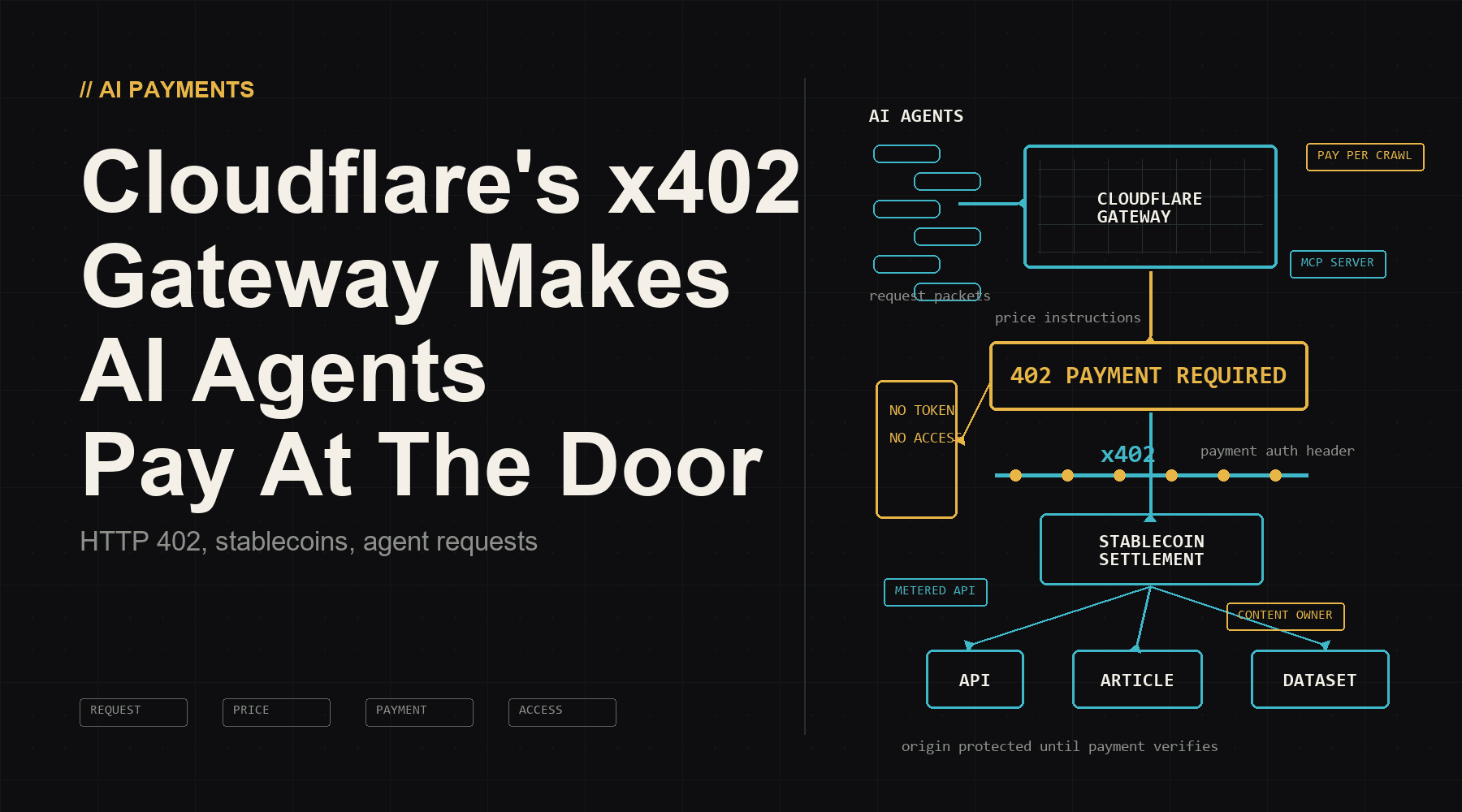
That turns a failed request into a negotiation. An agent asks for something. The server says what it costs. The agent comes back with payment authorization. The gateway checks the payment before the origin sees the request. If it works, the resource opens. If it does not, the agent can go sulk in the free tier like the rest of us.
This is not a normal paywall story. Normal paywalls assume a person, a browser, a login, a card form, and enough patience to click through three screens while a newsletter modal blocks the article. Cloudflare is aiming at software buyers: crawlers, agents, MCP clients, API callers, research workflows, and little autonomous programs that need one paid thing, right now, without a sales call.
The 402 Status Code Finally Gets A Job
HTTP 402 has always had a funny energy. The standard name, Payment Required, sounded obvious enough, then the web spent decades building payments somewhere else: app stores, ad networks, subscriptions, Stripe checkouts, licensing desks, platform stores, and bespoke API keys.
x402 tries to pull a slice of that back into the request itself.
GET /premium-dataset
402 Payment Required
payment: price, recipient, network
GET /premium-dataset + payment authorization
200 OK
Cloudflare says the Gateway will start with stablecoin settlement, with sellers able to keep those stablecoins for other transactions or redeem them for fiat. The plan includes pricing rules for specific REST verbs, variable charges for heavier work, and a trick that feels very Cloudflare: intercept an unauthenticated 401 Unauthorized from the origin and return a 402 Payment Required instead, complete with pricing instructions.
The upshot is that paid access becomes infrastructure config. A route, a method, a price, a rule, a payment check. Cloudflare says teams will be able to manage it from the dashboard, API, or Terraform. That matters because the web already has too many one-off commercial arrangements hiding behind email threads and PDF contracts.
The web has spent years teaching machines to read. Now it has to teach machines when the reading costs money.
Why Agents Make This Less Weird
The human web is bad at tiny payments because humans hate tiny decisions. Nobody wants to approve a three-cent page view or a one-cent API call in a modal. That is not commerce. That is a slot machine with worse lighting.
Agents change the shape of the problem. An AI coding assistant might need to call a paid debugging endpoint once. A research agent might need a licensed dataset for one task. A shopping agent might compare a few verified inventory feeds. A business process agent might pay for a premium MCP tool because the free one cannot do the job.
In those cases the buyer is not strolling around the web with a wallet. The buyer is a process trying to finish work. It needs identity, rules, limits, and a payment rail that does not require the vendor and the buyer to know each other ahead of time.
That last part is the big deal. Cloudflare is pitching a path where an agent can request a resource, receive the price, pay, and get the result without an API key, a subscription, or a pre-existing account relationship. That will not fit every business. Expensive compute, regulated data, and high-risk actions still need stronger identity and policy. But for low-friction digital goods, it is a cleaner primitive than pretending every agent is a human with a checkout tab.
Publishers Are The Obvious First Fight
The timing is not subtle. Cloudflare has been pushing its Content Independence Day campaign because AI crawlers have scrambled the old bargain: sites allowed crawling because search sent people back. Generative AI and agent systems often take the content, answer the user, and send much less attention home.
Cloudflare's related July 1 changes keep that pressure on mixed-use crawlers, especially bots that blur search indexing, AI training, and agent retrieval. TechCrunch reported that Cloudflare plans to block mixed-use crawlers by default on ad-supported pages starting September 15, 2026, unless site owners change settings. That is the policy side. Monetization Gateway is the toll lane.
Pay-per-crawl was the appetizer. Pay-per-use is the more interesting meal. A publisher may not only want to charge a crawler for fetching a page. It may want to charge when content is used inside an AI answer, when a premium archive is queried, when a dataset is pulled into a research workflow, or when a model-based service makes money from a structured source that used to get paid in traffic.
There are real devils in that machine:
- Bot identity: a payment flow only helps when the agent is honest enough, or constrained enough, to identify itself.
- Price discovery: a million pages do not all have the same value, and a flat toll can turn useful indexing into nonsense accounting.
- Budget controls: agents need spend limits before anyone lets them auto-pay their way across the internet.
- Attribution: getting paid for a direct request is easier than proving value inside a generated answer later.
- Bypass pressure: every toll creates an incentive to tunnel around it, especially when the thing being sold is text.
Still, the existence of messy edge cases is not an argument against the protocol. It is an argument for keeping the protocol boring, inspectable, and easy to automate.
MCP Tools Are Where This Gets Spicy
The sleeper detail is MCP.
Cloudflare's September 2025 x402 work with Coinbase already connected the protocol to Cloudflare's Agents SDK and MCP integrations. In its examples, an MCP server can expose free and paid tools, and an agent can attempt a paid tool call through an x402-aware client. The human can be prompted for confirmation, or the app can be designed for automatic payment within policy.
That is more interesting than a newspaper charging a bot. It points to a web where tools themselves can be metered.
Imagine a tiny company exposing a very good document parser as an MCP tool. No enterprise procurement. No full SaaS account. No sales demo. The agent sees the tool, gets the price, checks its budget, pays two cents, and moves on. The parser company gets paid for value delivered, not for forcing users into a monthly plan they do not want.
That could make the web more fun. Not everything needs to become a subscription slab. Some things should be vending machines: useful, specific, priced clearly, and available at the moment of need.
The Takeaway
Cloudflare's Monetization Gateway is early, and early payment infrastructure always attracts two kinds of people: builders who see the primitive and speculators who see a buzzword-shaped hat rack. Ignore the hat rack.
The primitive is real. If agents are going to browse, call tools, retrieve data, buy compute, and act across company boundaries, they need a way to pay for digital resources without dragging a human through checkout every time. HTTP 402 gives that idea a native-looking door. x402 gives the door a handle. Cloudflare gives it a very large edge network and a customer base that already sits in front of an alarming amount of the web.
The best version of this future is not a web where every sentence has a meter on it. That would be unbearable. The best version is a web where small valuable things can charge small honest prices without becoming enterprise software. APIs, datasets, MCP tools, premium archives, browser rendering sessions, model utilities, weird niche services with one perfect endpoint. That sounds healthier than a world where every agent scrapes first and negotiates never.
So yes, the old joke status code got promoted. HTTP 402 finally has a desk, a badge, and a surprisingly large stack of invoices.
Sources: Cloudflare: Announcing the Monetization Gateway; Cloudflare: Launching the x402 Foundation with Coinbase; Cloudflare: Your site, your rules; TechCrunch: Cloudflare's new policy pushes AI companies to pay for publishers' content.
// Discussion
Comments
No comments yet. Start the thread.