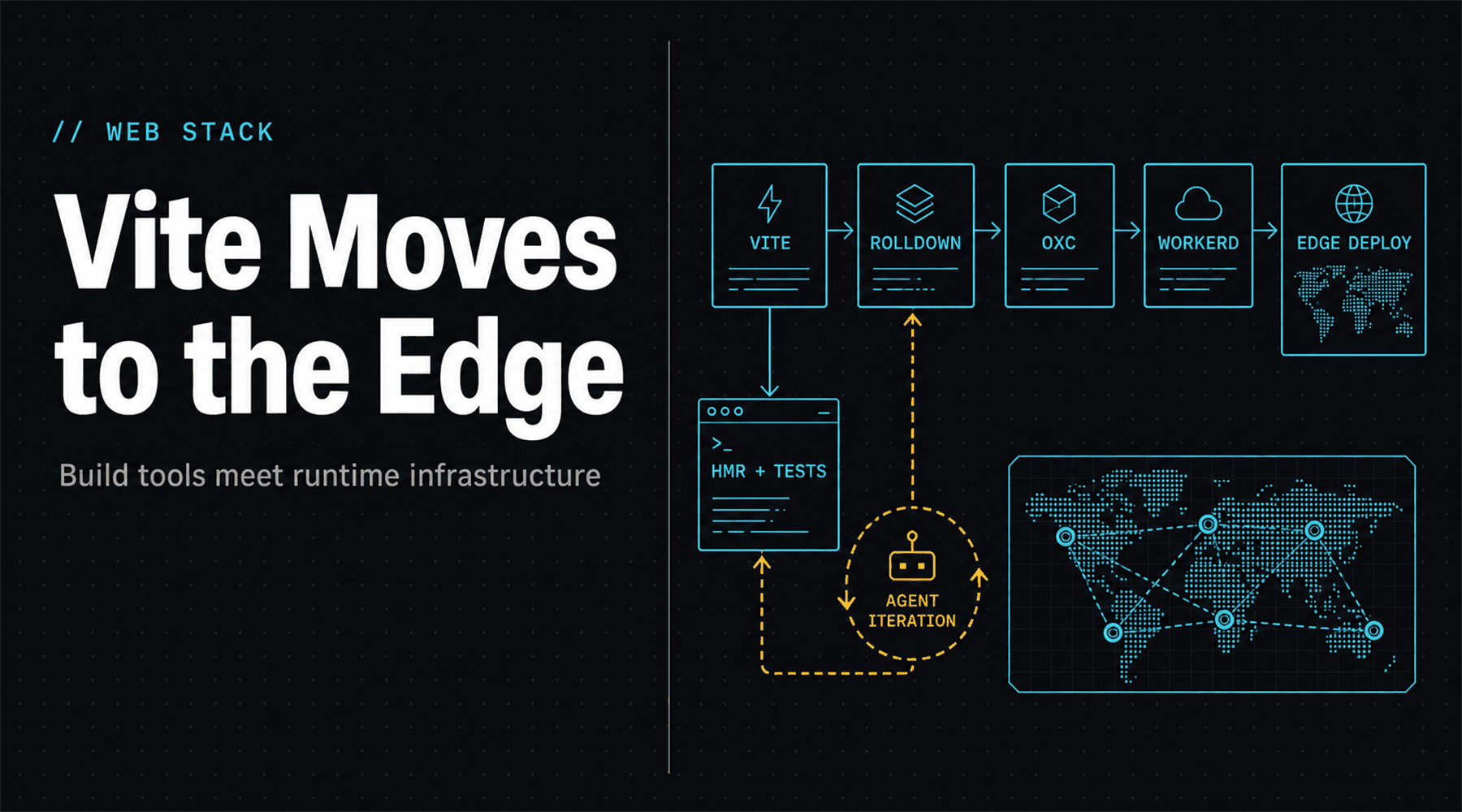
The web's build tools used to be treated like local machinery. They watched files, transformed modules, bundled JavaScript, and got out of the way. Cloud deployment lived somewhere else, usually behind adapters, CLIs, environment variables, and provider-specific rituals. VoidZero joining Cloudflare is a sign that those two worlds are collapsing into one developer surface.
On June 4, Cloudflare and VoidZero announced that VoidZero, the company behind Vite, Vitest, Rolldown, Oxc, and Vite+, is joining Cloudflare. Cloudflare says all VoidZero team members are joining as part of the move, while Vite, Vitest, Rolldown, Oxc, and Vite+ will remain open source, MIT-licensed, vendor-agnostic, and community-driven. The careful wording matters. Vite is not a niche framework tool anymore. It is shared infrastructure for a huge slice of modern web development.
The technical story is not simply that Cloudflare bought talent. It is that Cloudflare wants the path from local development to production runtime to look like one coherent system. That system starts with Vite, extends through the Rust-based toolchain work in Rolldown and Oxc, and ends in a production runtime that can be modeled locally through workerd, the same open source runtime that powers Cloudflare Workers.
Build tools are becoming runtime tools
For years, Vite's main promise was speed and simplicity. It made frontend development feel immediate by leaning on native ES modules in development and mature bundling for production. That alone made it useful, but the ecosystem kept asking more of it. Frameworks wanted server rendering. Apps wanted APIs, queues, databases, auth, storage, and background work. Developers wanted local environments that behaved like production without turning every project into a platform tutorial.
Cloudflare's announcement points directly at that pressure. The company says its Vite plugin uses the Vite Environment API so server code can run inside workerd during local development. Durable Objects, D1, KV, R2, Workflows, Workers AI, Agents, Service Bindings, and Workers RPC can be available inside the same runtime model developers deploy to production. That is a very different role for a build tool. Vite is no longer only the thing that prepares assets. It becomes the front door to the application's execution model.
The best version of this idea is not a Cloudflare-only fork of web development. It is a generic Vite mechanism with provider implementations behind it. Cloudflare is promising that Vite itself stays portable and that new full-stack primitives should be provider-agnostic. That promise will have to be earned in public, but the architecture is the right instinct. If Vite can expose clean hooks for runtimes, backends, agents, and deployment, every serious platform gets a place to plug in without requiring developers to relearn their workflow.
Why VoidZero matters
VoidZero has been trying to solve the less glamorous parts of the JavaScript toolchain: parsing, transforming, bundling, linting, formatting, testing, and keeping those pieces fast under real project load. Rolldown 1.0, announced in May, is the clearest example. It is a Rust bundler built with Vite in mind, combining esbuild-like speed with Rollup API compatibility. VoidZero says it is now the default bundler in Vite 8, powered by Oxc for the JavaScript language work.
That matters because compatibility is the hard part of moving an ecosystem. Developers do not adopt faster tools if every plugin breaks, every config file changes, and every edge case becomes their problem. Rolldown's pitch is that Vite can get a native-speed core without throwing away the Rollup plugin model that made the ecosystem productive. Oxc pushes the same direction for parsing, transforms, minification, linting, and formatting.
This is exactly the kind of infrastructure that becomes more important when AI agents enter the development loop. Agents do not merely write code once. They scaffold projects, run dev servers, read errors, rerun tests, lint, format, deploy previews, and iterate. If that loop is slow or inconsistent, agentic coding becomes expensive and brittle. Fast tools are not just a developer comfort feature anymore. They are part of the control system for automated software work.
The open source bargain gets sharper
Cloudflare knows the obvious concern: a foundational open source tool joining a large platform company can make the ecosystem nervous. The announcement addresses that head on. Vite remains MIT-licensed. Applications built with Vite still run anywhere. The roadmap remains open. The VoidZero team continues to lead the projects. Cloudflare is also committing $1 million to a Vite ecosystem fund administered by the Vite core team.
Those are useful commitments, but they are not the whole story. The real test is whether Vite's new primitives make non-Cloudflare runtimes better too. A vendor can say a project is neutral while still shaping the most polished path toward its own platform. That does not make the move bad. It makes governance, APIs, and contribution process more important than press-release language.
The optimistic read is that Cloudflare has an incentive to keep Vite broadly trusted. If Vite becomes seen as a Cloudflare funnel, it loses the neutrality that made it valuable. If it stays portable while Cloudflare builds the best implementation of the shared model, Cloudflare benefits without poisoning the commons. That is the healthier bargain: invest in the floor, compete on the implementation.
Cloud platforms are moving up the stack
There is a bigger platform shift underneath this. Cloud providers used to sell infrastructure primitives first: compute, storage, networking, databases, queues. Developers assembled those primitives through frameworks and deployment glue. Now the cloud is moving closer to the application shape. The question is not just where code runs. It is how the project is created, how local development mirrors production, how tests understand runtime bindings, how an agent gets a repeatable feedback loop, and how deployment becomes part of the toolchain instead of a final ceremony.
Cloudflare's stated plan is to move its own application tooling toward Vite. Its future CLI should make commands like dev, build, and deploy feel like a superset of the Vite workflow, with Cloudflare's runtime and bindings available when needed. That is a serious product direction. It says the platform is not trying to replace the developer's workflow with a dashboard. It is trying to inhabit the workflow developers and agents already use.
The risk is abstraction debt. A full-stack Vite can become too much if it tries to own everything. A provider plugin can become too magical if local behavior quietly diverges from production. A unified CLI can become another lock-in surface if escape hatches are weak. But the current fragmentation is not free either. Adapters, runtime shims, half-local databases, and deployment-specific config files already impose hidden costs on teams.
The takeaway
VoidZero joining Cloudflare is a bet that the future web stack will be organized around fast local loops, portable runtime hooks, and deployment-aware tooling. Vite is the center because it already has the trust and distribution. Rolldown and Oxc matter because the loop has to be fast enough for both humans and agents. workerd matters because local development has to model the real runtime instead of pretending every server is Node.
If Cloudflare keeps the neutral foundation real, this could be good for the web beyond Cloudflare customers. Better primitives for server code, agents, build output, runtime bindings, and deployment would help every platform that chooses to implement them. If the center of gravity becomes too vendor-shaped, the community will feel it quickly.
For now, the signal is clear: build tools are no longer just build tools. They are becoming the interface between source code, automated development loops, and the cloud runtime. The companies that understand that interface will shape how the next generation of web applications gets made.
// Discussion
Comments
No comments yet. Start the thread.