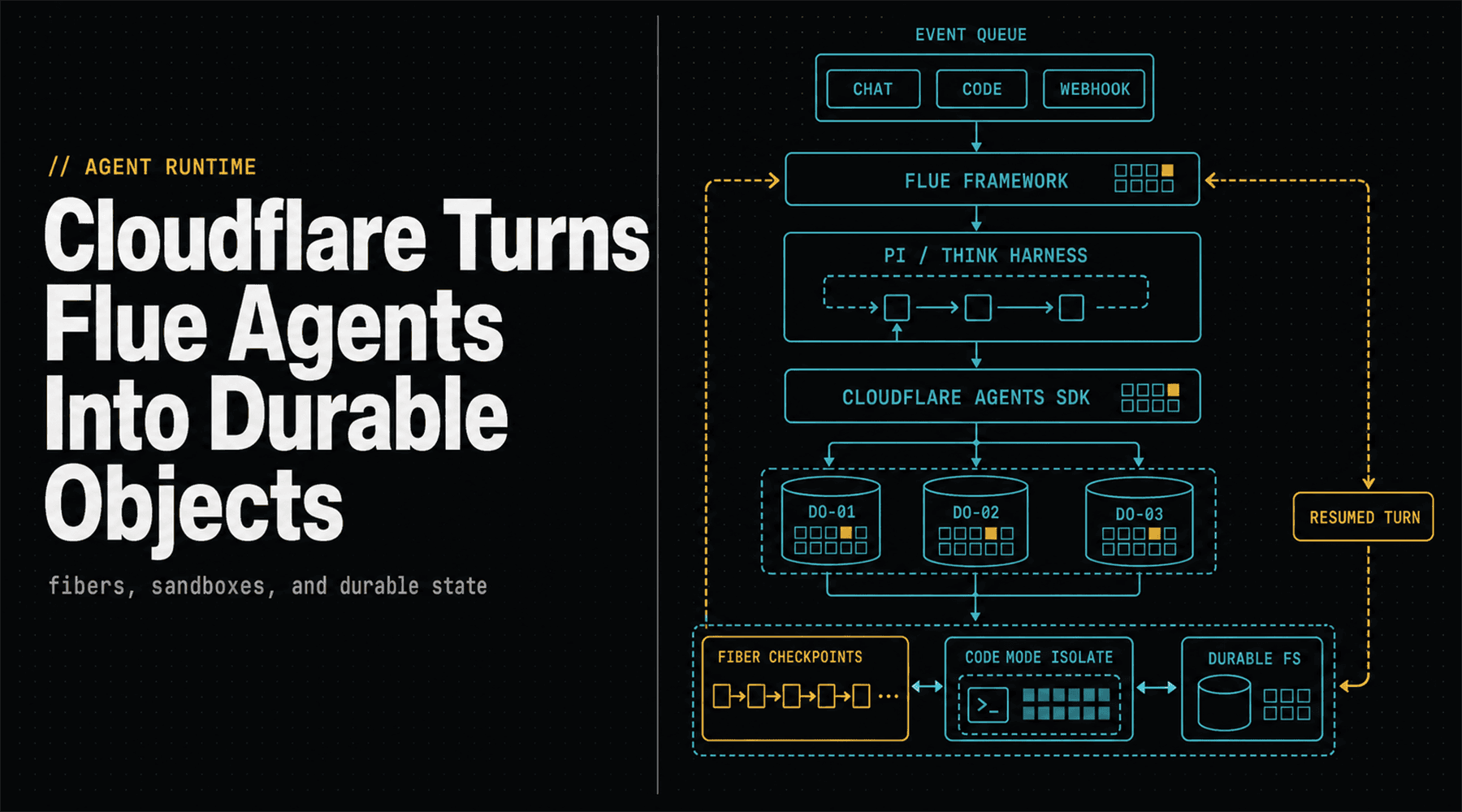
Cloudflare did not just announce another agent SDK sticker for the laptop lid. On June 17, it said the open-source Flue framework from the Astro team can target Cloudflare's Agents SDK, where each agent becomes a Durable Object with its own storage, lifecycle, and recovery path. That sounds like infrastructure boilerplate until you remember what agents are terrible at: staying alive while doing messy work.
An agent that answers one question in a browser tab can be cute. An agent that triages a bug report, calls tools, runs code, waits on an API, edits files, gets interrupted, and then resumes without pretending nothing happened is a different animal. That is a distributed system wearing a hoodie.
The Three-Layer Stack
Cloudflare frames the new setup as three layers. Flue is the framework layer: project structure, commands, channels, developer experience. Pi or Project Think is the harness layer: the loop that lets a model use tools, hold context, and decide what to do next. Cloudflare's Agents SDK is the bottom layer: compute, state, routing, storage, fibers, sandboxes, and bindings.
The useful part is not that Flue can run on one more host. The useful part is that a framework can hand off its survival instincts to the platform.
That is the part worth caring about. Most agent demos hide a boring truth: the agent's memory and progress are often balanced on process memory, a local folder, a websocket, and vibes. Kill the process at the wrong moment and the user gets a frozen spinner, a half-written patch, or a transcript that says the agent was very close to greatness before it wandered into the fog.
Cloudflare's pitch is that when Flue targets its platform, every Flue agent runs inside its own Durable Object. Durable Objects give each agent an addressable identity and a local SQLite-backed state store. The agent can hibernate when idle, wake on events, and keep its state near the runtime instead of dragging everything through an external queue plus database plus worker chain.
Why Flue Matters Here
Flue's own pitch is not just "call a model from TypeScript." The framework describes itself as an agent harness framework: sessions, tools, skills, instructions, filesystem access, and a sandbox wrapped into a programmable environment. It can run on Node.js, Cloudflare Workers, GitHub Actions, GitLab CI/CD, Daytona, and Render. That multi-host story matters because developers do not want to rewrite the agent every time they change where it runs.
But the Cloudflare target is more opinionated. The company says Flue agents deployed there get durable execution through runFiber(), stash(), and onFiberRecovered(). In plain English: start work as a recoverable fiber, checkpoint the useful bits as the turn advances, and receive a recovery hook if the runtime restarts before the turn finishes.
agent turn starts
  -> tool call succeeds
  -> checkpoint state
  -> runtime disappears
  -> new instance wakes
  -> recovery hook resumes from the checkpoint
That is not magic. It is bookkeeping. Good bookkeeping is what separates useful automation from a haunted progress bar.
Code Mode Is The Sneaky Bit
The other interesting move is code execution. Agent tool menus get ridiculous fast. Give a model fifty bespoke tools and it starts shopping in the wrong aisle. Cloudflare's answer is Code Mode: let the agent write a short TypeScript or JavaScript function, then run that code in a Dynamic Worker isolate with only the bindings the platform grants it.
For Flue on Cloudflare, that means the framework can offer an agent a durable workspace without firing up a full Linux container for every small file operation. Cloudflare's shell package exposes typed file operations such as read, write, edit, search, grep, and diff against a virtual filesystem inside the Durable Object, backed by SQLite. Containers are still there for jobs that need npm installs, compilers, native tools, or a full OS. The daily grind of reading files and producing patches does not always need the heavy machinery.
- Durable Objects give each agent a place to live.
- Fibers give long turns a way to survive interruption.
- Code Mode gives the model a narrow sandbox instead of a bag of fragile tools.
- Bindings let the runtime grant capabilities without handing secret keys to generated code.
The Bigger Shift
This is part of a broader 2026 pattern. The model is no longer the only product. The harness and runtime are now part of the product. The boring layer decides whether the brilliant layer can do useful work twice in a row.
Cloudflare is betting that agent frameworks will look less like chatbot libraries and more like deployable runtimes with identity, storage, recovery, observability, and sandbox boundaries baked in. That is a strong bet because serious agents are annoyingly stateful. They hold context across channels, touch files, invoke APIs, wait on people, and sometimes need to sleep for minutes or hours without losing the thread.
There is also a business angle with teeth. If every customer, repo, support inbox, or workflow wants its own persistent agent, the old "one container per long-lived assistant" model gets pricey and operationally weird. Durable Objects are Cloudflare's answer to that math: many addressable agents, mostly asleep, each waking when work arrives.
The risk is lock-in by plumbing. Once the framework learns to depend on a platform's recovery hooks, filesystem, sandbox, bindings, and workflow engine, "deploy anywhere" can become "deploy anywhere, but the good version lives here." That is not automatically bad. Good platform primitives are allowed to be useful. Developers just need to notice when portability moves from source code to behavior.
Takeaway
Cloudflare and Astro are putting a name on the next agent layer. Flue gives developers a cleaner way to describe autonomous work. Cloudflare gives that work somewhere durable to run. The interesting part is not the mascot-free marketing term "agentic cloud." The interesting part is that agents are finally being treated like production software that crashes, resumes, needs storage, needs sandboxes, and needs fewer excuses.
That is where the field is going. Not just smarter models. Better places for them to get things done without dropping the tray.
// Discussion
Comments
No comments yet. Start the thread.