The quietest package-manager bugs are often the ones that teach the loudest lesson.
On May 25, the Rust project disclosed CVE-2026-5223, a Cargo vulnerability affecting projects that use third-party package registries. The issue sits in a part of the toolchain most developers rarely think about: how Cargo extracts a package archive into its local source cache before a build starts.
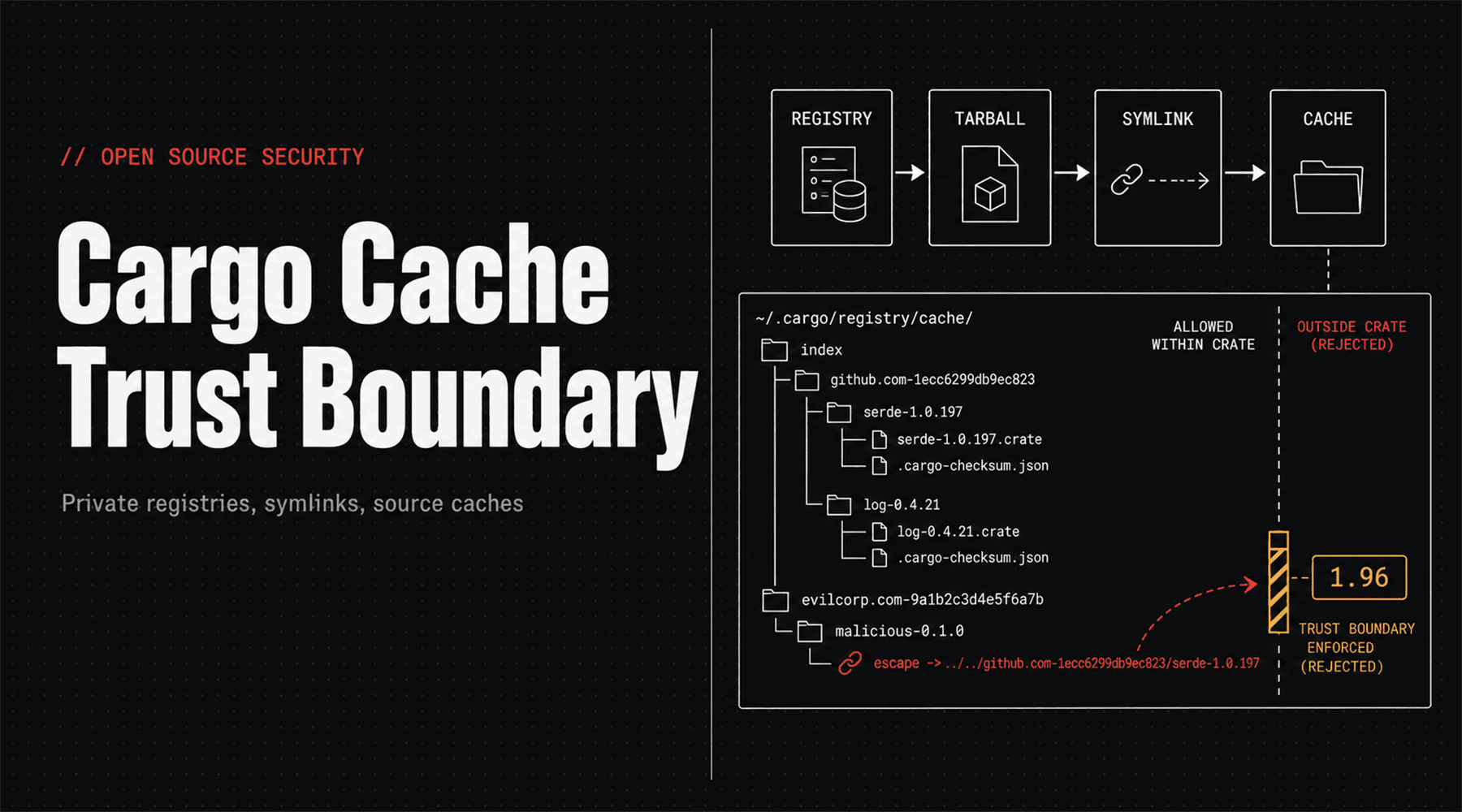
The short version is simple. Cargo allowed symbolic links in package archives from alternate registries. A malicious registry package could use those links during extraction to write files outside the intended crate directory and into the shared cache area that Cargo uses for sources. That does not automatically mean remote code execution, but it does mean an untrusted package archive could influence neighboring source-cache state on the developer or CI machine.
Crates.io was not affected because it already rejects packages containing symbolic links. The risk lives around private, internal, mirror, or third-party registries that are common in larger engineering shops. Cargo is changing the default behavior in Rust 1.96.0, scheduled for May 28, by rejecting symlinks in packages from all registries.
The cache is not just storage
Developers tend to picture a package cache as a boring speed feature. Download once, reuse often. For build systems, though, a cache is also an authority boundary. If multiple packages, registries, jobs, or projects share that directory, then the extraction rules decide whether one package can affect what another package later sees.
That is why this Cargo bug is more interesting than its immediate exploitability. The vulnerable operation happens before the compiler gets involved. It happens while the package manager is turning registry data into local filesystem state. If the archive format, the registry policy, and the local extraction code disagree about what is allowed, the build machine becomes the place where that ambiguity gets resolved.
In this case, crates.io had the stricter policy. Cargo itself had to catch up so alternate registries inherit the same safer assumption. That distinction matters because many organizations now use private registries as a control layer: to pin dependencies, mirror public packages, gate approved components, or distribute internal crates. The private registry is often treated as safer than the public internet. It may be safer, but it is still input.
Private registries need public-grade paranoia
The obvious fix is to update Cargo when Rust 1.96.0 lands. The Rust advisory also gives operators a manual audit path: inspect downloaded packages in local registry caches for symbolic links and remove affected cache entries. That is sensible cleanup, but it should not be the end of the response.
Teams running private registries should ask a broader question: what assumptions are they outsourcing to the client tool? A registry that accepts archive features the client later mishandles is not just storing packages. It is shaping filesystem behavior on every consuming developer laptop and build runner.
This becomes sharper in CI. Build machines are full of shared conveniences: dependency caches, workspace mounts, restored artifacts, source mirrors, and cross-job accelerators. Each exists to save time. Each also expands the number of places where one input can become another job's environment. A package archive that can write across a cache boundary does not need to look dramatic to matter.
The supply chain is local too
Software supply-chain security is often discussed as a problem of identity and provenance. Who published this package? Was it signed? Did it come from the expected registry? Those questions matter, but CVE-2026-5223 points at a lower layer. Even if the source of a package is known, the unpacking rules still have to keep it contained.
The practical takeaway is not to distrust Cargo. It is to respect the job package managers actually do. They are not passive downloaders. They are parsers, extractors, cache managers, policy enforcers, and build orchestrators. Any one of those roles can become a security boundary.
Cargo's upcoming fix is a good default: reject symlinks everywhere, not only on the public registry that already learned to say no. For teams using private Rust registries, the better lesson is to make registry policy, archive validation, cache isolation, and CI cleanup explicit parts of the platform. A fast build cache is useful. A fast build cache that can be shaped by an untrusted package is infrastructure debt with a stopwatch attached.
// Discussion
Comments
No comments yet. Start the thread.