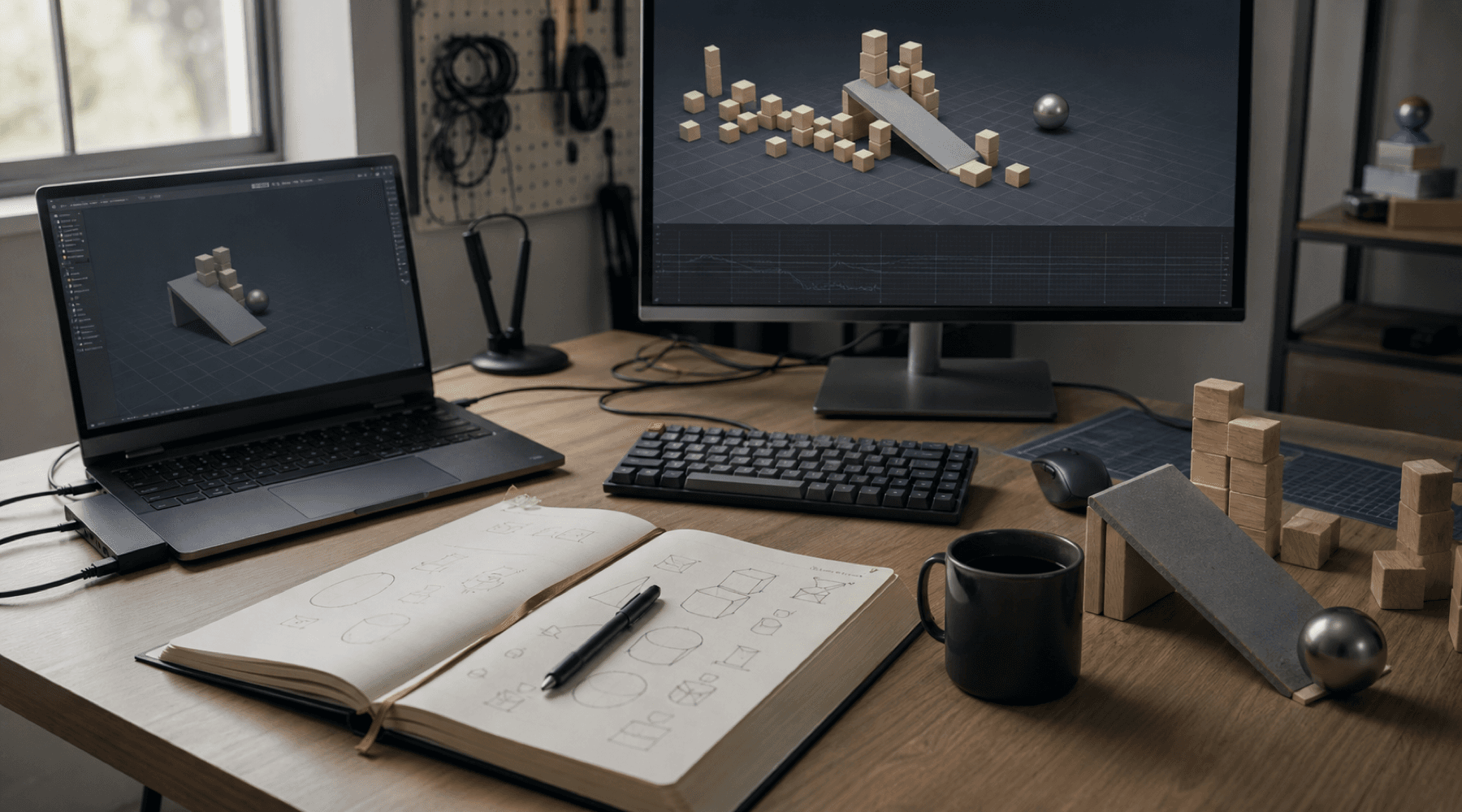
Game physics is one of those pieces of software that disappears when it works and takes over the room when it does not. A crate settles. A vehicle lands. A character brushes a wall. A tree falls into terrain. If the solver does the right thing, nobody praises the constraint graph. If it jitters, tunnels, teleports, or burns the frame budget, everyone suddenly becomes a physics engineer.
That is why Box3D is worth more attention than a normal library announcement. Phoronix highlighted the release this week, and the upstream announcement from Erin Catto gives the deeper reason it matters: Box3D is an open-source 3D physics engine for games, built by the creator of Box2D, with the explicit goal of carrying a familiar data-oriented physics architecture into the 3D work that commercial games keep needing.
The useful part of open source here is not ideology. It is that simulation knowledge stops being trapped inside one employer, one title, or one engine fork.
From Box2D To A 3D Workbench
Box2D has been the quiet default in a lot of 2D game development because it made rigid-body physics approachable without hiding all of the important behavior. Box3D keeps that lineage visible. Catto describes it as a fork of Box2D extended for 3D games, with the core architecture staying close to Box2D while adding the collision and systems features a 3D game actually needs.
The public feature set is practical rather than decorative. Box3D includes triangle mesh collision, height-field collision, baked compound collision, continuous collision, a sub-stepping solver, large-world support with doubles for position, cross-platform determinism, recording and replay, graph coloring for large islands, wide SIMD contact solving, and multithreading hooks. The GitHub README adds the day-to-day surface area: convex hulls, capsules, spheres, multiple shapes per body, shape casts, overlap queries, character movement, joint types, body events, samples, and a portable C17 core.
authoring code
+ collision shapes
+ broad phase
+ solver
+ determinism
+ replay
+ samples
+ docs in progress
+ MIT sourceThat last point matters. A physics engine is not a single clever equation. It is an operational tool. Developers need to reproduce a failure, capture a weird case, run the sample, compare platforms, isolate contact behavior, and ask whether the bug is in content, code, scheduling, or the solver itself. Recording and replay are not glamour features. They are how physics bugs become debuggable instead of anecdotal.
The Origin Story Is A Systems Story
The upstream post explains that Box3D grew out of production pressure on The Legend of California, a server-authoritative open-world game with falling trees, ragdolls, voxels, doors, tumbleweeds, and large numbers of entities. Catto says experiments with Unreal Engine's native physics created enough issues that the team had to decide whether to fix the native path or replace it.
The path that became Box3D passed through a home version of Valve's Rubikon physics work, then absorbed Box2D-style APIs, data structures, and algorithms where the 2D and 3D versions could stay similar. That history is useful because it explains the shape of the project. This is not a clean-room attempt to win a feature checklist. It is a production engine being pulled toward public reuse.
That also explains why the announcement spends time on broad-phase data structures, mesh collision, compound collision, runtime voxel collision generation, and large streaming scenes. Those are not library brochure words. They are the places where a game turns a physics engine into infrastructure.
Open Source Changes The Physics Memory Budget
Catto frames one motivation plainly: after years of making physics engines for different jobs, each move can leave the work behind. Box2D was partly a way to capture and carry that knowledge. Box3D applies the same idea to 3D.
That is a real software maintenance problem. Specialized systems knowledge often lives in private codebases, shipped games, conference slides, and the heads of people who have already been paged by the same class of bugs. When that knowledge is open source, the memory budget changes. New teams can inspect implementation choices instead of reverse-engineering old talks. Engine programmers can compare behavior. Researchers and indie developers can test ideas against a serious baseline. Commercial teams can decide where they need custom work and where they do not.
- For game teams: Box3D is a readable starting point for 3D rigid-body behavior, not only a black box under an editor checkbox.
- For engine developers: the C17 core, C API, samples, replay support, SIMD path, and multithreading hooks make the integration surface concrete.
- For tool builders: deterministic simulation and replay create better handles for tests, recordings, regression cases, and bug reports.
- For open-source game infrastructure: the MIT license makes experimentation easier without turning early adoption into a legal maze.
Alpha Is The Right Label
The announcement is also careful about maturity. Box3D is already used in a few places, including The Legend of California, Facepunch's s&box platform, Esoterica, and a multiplayer space game. But Catto still calls it alpha software and says more testing and more complete documentation are needed before a 1.0 release.
That caveat is not weakness. It is a useful boundary. A physics engine can look stable in a demo and still have rough edges when a production team throws thousands of odd shapes, platform differences, and gameplay hacks at it. Calling the project alpha sets the right contract: promising architecture and useful code, but not yet a drop-in answer for every serious game.
Operational note: alpha infrastructure can still be valuable when teams treat it as source they can study, test, and shape, not as magic middleware.
The Takeaway
Box3D is interesting because it puts a serious game-physics lineage where developers can inspect it. The story is not that every 3D game should immediately replace its physics stack. The story is that a hard, specialized part of game infrastructure now has another open implementation with a known author, a familiar sibling in Box2D, a permissive license, and a public roadmap toward maturity.
That is how mature developer tools often start to matter. Not as instant standards. As well-shaped workbenches. Box3D gives teams a place to run samples, read source, test assumptions, and borrow design pressure from someone who has spent years turning unstable collisions into shippable games.
For a field where the hard lessons are usually embedded in proprietary engines and old production scars, that is a useful release.
// Discussion
Comments
No comments yet. Start the thread.