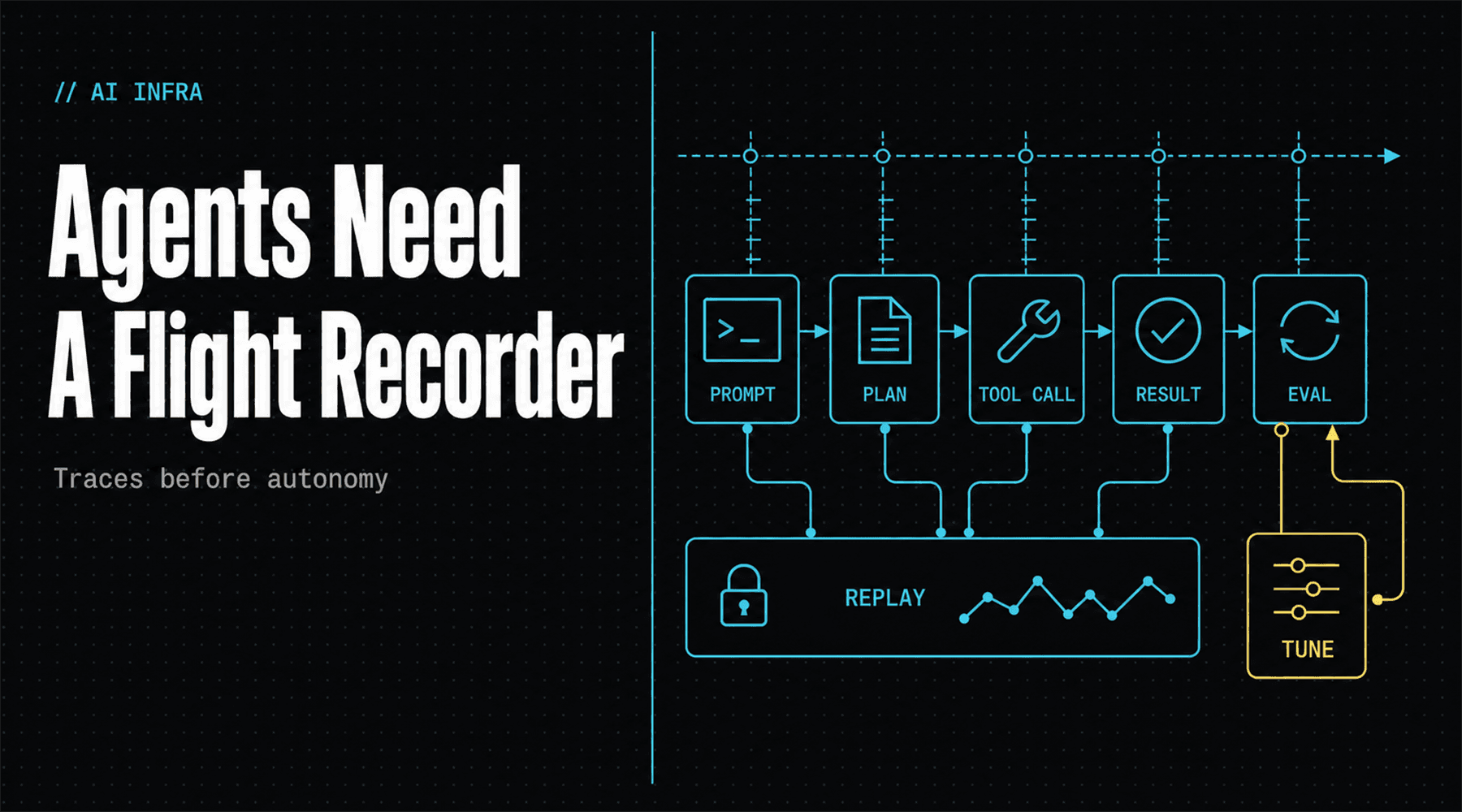
The next serious AI infrastructure fight is not just about faster inference or cheaper GPUs. It is about whether anyone can explain what an agent did after it touches a real system. Once an agent can call tools, modify tickets, query databases, deploy code, or spend money, a normal log line is not enough. The system needs a flight recorder.
CoreWeave pushed that idea into the open on May 28 with a new package of agentic AI capabilities around reinforcement learning, production inference, W&B Weave observability, W&B Skills, and an MCP server. The company frames it as closing the loop between training and inference: agents work in production, their behavior is observed, failures become evaluation material, and the system improves from real-world data instead of months of offline testing.
That is a real technical direction, even if the marketing language runs hot. Offline evals are useful, but they are never wide enough to cover the weirdness of production. Users combine tools in odd sequences. APIs return partial failures. Permissions drift. A retrieval system finds the wrong document. A planner takes a shortcut that passes a shallow test but violates a business rule. If those events are not captured with enough structure to replay and score them, the team has anecdotes instead of an improvement loop.
The missing layer is agent observability. For conventional services, observability usually means traces, metrics, and logs that help engineers understand latency, errors, saturation, and dependency behavior. For agents, the unit of failure is richer. You need to know the prompt, selected tools, tool inputs and outputs, intermediate plan, policy checks, retries, human approvals, model version, retrieval context, cost, latency, final answer, and whether the outcome later proved correct. That is not dashboard garnish. It is the raw material for debugging and training.
This is why OpenTelemetry's recent CNCF graduation matters beyond ordinary cloud plumbing. The project has become the default vendor-neutral language for software telemetry, with CNCF pointing to broad production adoption and thousands of contributors. More important for AI, OpenTelemetry's GenAI work is trying to standardize how agent frameworks report traces, metrics, and logs so teams do not end up trapped in one vendor's private event format.
Standard shape matters. If every agent framework invents its own trace schema, production teams will get the same fragmentation that distributed tracing was supposed to fix. One tool will call a model request a span. Another will call it an evaluation event. A third will hide tool calls inside opaque JSON. That makes comparison hard, migration expensive, and independent review nearly impossible. Agents are too consequential for observability to become a screenshot feature.
The practical test is replay. A useful agent trace should let a team reconstruct why the system acted, not merely that it acted. If an agent created a bad support refund, changed the wrong config flag, or approved a risky pull request, the trace should show the inputs it saw, the policy gates it passed, the tool calls it made, and the exact point where judgment failed. Without that, a self-improving loop is just production traffic flowing into a black box with a hopeful label.
There is also a governance angle that is easy to miss. Agent telemetry is where safety, security, and product quality meet. The same trace that helps an engineer find a broken tool call can help a security team spot data exfiltration, a compliance team prove an approval happened, and a product team find recurring task failures. For high-stakes systems, the audit trail is not paperwork after the fact. It is part of the runtime boundary.
That does not mean every token should be dumped forever into a vendor cloud. Agent telemetry can contain secrets, personal data, proprietary source code, customer records, and internal reasoning traces. Serious deployments will need redaction, retention controls, tenant isolation, access policy, and local export paths. The more valuable the trace becomes for improvement, the more sensitive it becomes as data.
The shape of the stack is becoming clear. Agents need instrumentation at the framework level, standardized semantic conventions, evaluation hooks, production monitors, replay buffers, and controlled paths from observed failures back into tests or fine-tuning. MCP helps agents reach tools. Skills help agents learn procedures. OpenTelemetry-style traces help humans and other systems inspect what happened. Those pieces together are closer to an operating model than a feature checklist.
The optimistic read is that this makes agents more deployable, not less. Teams do not need perfect agents to start using them. They need agents whose failures can be caught, explained, compared, and converted into better behavior. The old software rule still applies: if you cannot observe it, you cannot operate it. AI does not repeal that rule. It makes the rule stricter.
CoreWeave's announcement is one more sign that the market is moving from demo agents toward production agent fleets. The companies that win will not be the ones that simply let agents run longer. They will be the ones that make every run inspectable enough to trust, debug, and improve. Autonomy starts looking real when the flight recorder becomes part of the system.
Sources: CoreWeave agentic AI announcement, CNCF OpenTelemetry graduation announcement, OpenTelemetry AI agent observability guidance, Weights & Biases Skills documentation.
// Discussion
Comments
No comments yet. Start the thread.