Quantum computing has a problem most hype cycles politely step around: the machines are fascinating, fragile, and extremely good at producing answers you cannot trust for long enough.
That is why QuEra and AWS putting a 2028 date on Libra is worth more than another quantum ribbon-cutting. The news is not just that a new box is coming to Amazon Braket. The news is that QuEra is selling a specific kind of box: a fault-tolerant neutral-atom system with hundreds of logical qubits, a target logical error rate of one in a million operations, and enough reliable operation budget to start running scientific workloads that are not just lab demos wearing a tie.
The useful number is not how many qubits fit on the brochure. It is how long the calculation can keep its dignity before errors turn the result into soup.
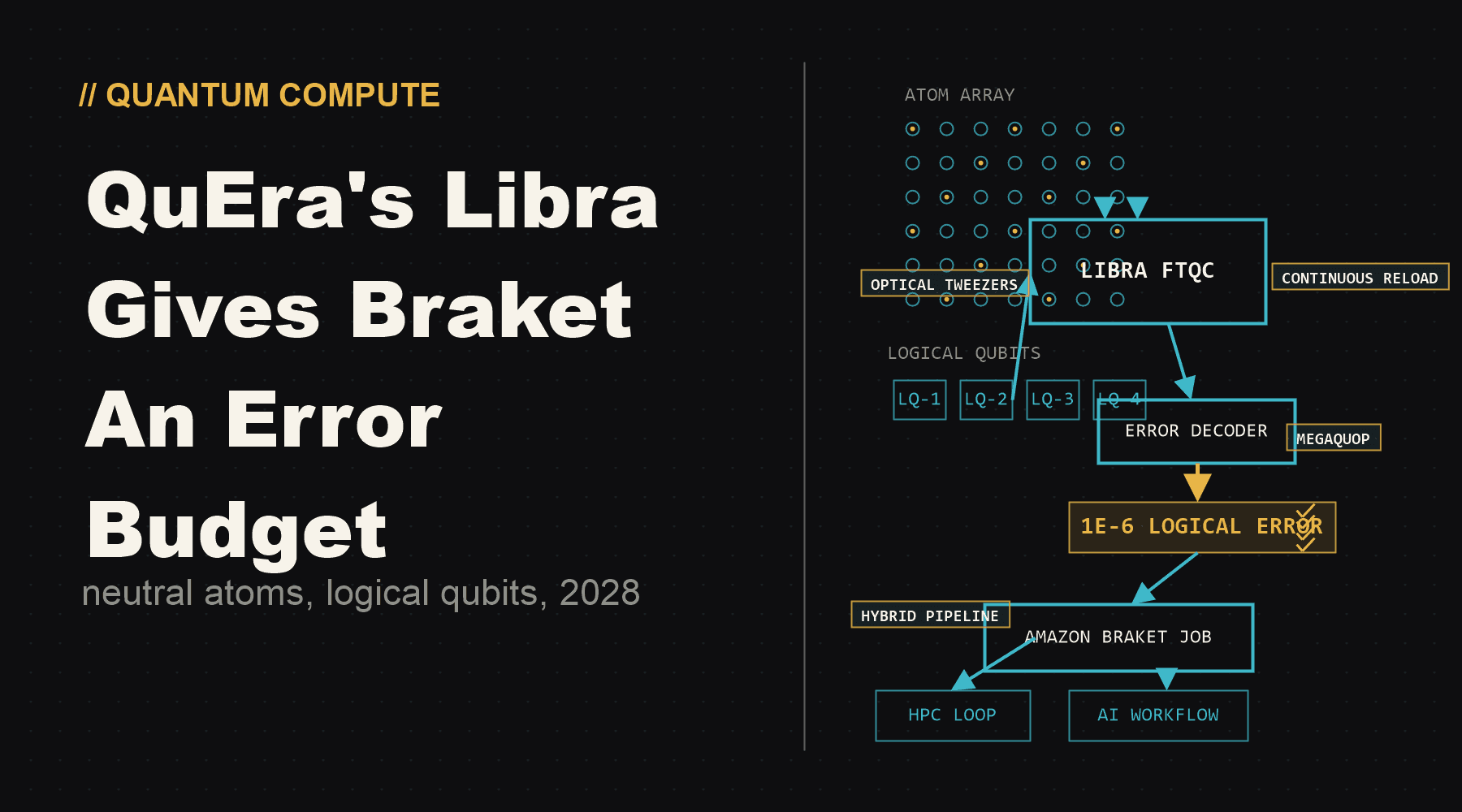
AWS says Libra will come to Braket in 2028 as a Megaquop-scale device, meaning it is designed to execute one million quantum operations over hundreds of logical qubits. QuEra says the system is built from peer-reviewed building blocks: logical qubits, below-threshold error correction, transversal operations, fast decoding, continuous atom reloading, and resource-efficient error-correcting codes.
That is a lot of quantum vocabulary in one paragraph, but the plain-English point is simple. QuEra is not saying, "Here are more physical qubits, please clap." It is saying, "Here is a path to qubits that survive long enough to do a job."
Physical Qubits Are the Raw Ingredients
Most people hear "qubit count" and instinctively treat it like horsepower. More must be better. In early quantum hardware, that habit is dangerous. Physical qubits are the raw, noisy ingredients. Logical qubits are the protected abstractions built from many physical qubits so the system can detect and correct errors as it computes.
If a physical qubit has an error often enough, deep algorithms fall apart. A calculation that needs hundreds of thousands of steps cannot tolerate a mistake every few thousand operations and still be useful. It is like trying to bake a cake while someone randomly swaps salt for sugar every few minutes, then asking why dessert tastes haunted.
Fault tolerance is the attempt to make the recipe survive the kitchen. The system spreads information across groups of physical qubits, checks for error patterns, corrects them, and keeps going. That burns hardware overhead, but it buys time. Time is the thing useful quantum algorithms need.
physical atoms
  -> encoded logical qubits
  -> error syndrome checks
  -> decoder decisions
  -> longer reliable circuits
  -> chemistry, materials, and physics workloads
Libra's pitch lives right there. QuEra wants neutral atoms to stop being a neat experimental modality and start acting like cloud infrastructure with a measurable reliability budget.
Why Neutral Atoms Are Having a Moment
QuEra's machines use neutral atoms, specifically Rydberg atom arrays. The short version: individual atoms can be trapped and moved with tightly focused laser beams called optical tweezers. That lets researchers arrange qubits in flexible patterns, bring atoms near each other for operations, and reconfigure arrays without physically rewiring a chip.
AWS points to two advantages. First, Rydberg atom arrays can scale spatially to large numbers of qubits inside a module. Second, the arrays can be dynamically reconfigured, which can make some fault-tolerant operations less wasteful than rigid layouts.
This is not the only quantum path. Superconducting qubits, trapped ions, photonics, and cat-qubit architectures are all chasing different tradeoffs. AWS even mentions its own Ocelot cat-qubit work as complementary. That is healthy. Quantum computing should not pretend there is one holy architecture. Compute history says otherwise. CPUs, GPUs, TPUs, FPGAs, network cards, and storage controllers all exist because different workloads punish different bottlenecks.
Neutral atoms look especially interesting when the bottleneck is building many qubits and arranging them flexibly. Libra is the bet that those strengths can be converted into reliable cloud-accessible computation.
Braket Is the Other Half of the Story
The Amazon part matters because early fault-tolerant quantum computing will not be a standalone appliance where a researcher ships a notebook to a magic refrigerator and waits for truth to pop out.
AWS is framing Braket as the place where quantum processors sit next to classical infrastructure. That matters because fault-tolerant quantum workloads are hybrid by default. You need classical code to prepare circuits, optimize decompositions, handle decoding and orchestration, analyze outputs, and loop the result back into conventional high-performance computing or AI tooling.
Braket already gives developers one managed environment for multiple quantum hardware types. AWS says Libra will plug into that environment with support around frameworks such as Qiskit, PennyLane, Bloqade, and CUDA-Q, plus native integration with HPC and AI resources. In other words, Amazon is trying to make quantum less like a weird off-world experiment and more like a strange accelerator in the cloud rack.
That is the right idea. The first useful quantum applications will probably be messy co-designed pipelines, not clean push-button miracles. Chemistry, high-energy physics, and materials simulation are the named early targets because they are places where quantum systems are naturally hard for classical machines to model. Even there, the software has to be shaped around the hardware's constraints.
The Calendar Is a Product
The boldest part of the announcement is not the acronym pile. It is the year: 2028.
Quantum roadmaps often hide behind roomy language. Libra gives customers and researchers a calendar date close enough to plan around and far enough away to remain risky. That is useful. A date forces better questions. Which algorithms are mature enough to try? Which chemistry or materials problems justify early access? Which teams can write hybrid workflows instead of waiting for a mythical quantum app store?
QuEra's commercial line is blunt: waiting until 2028 to build a strategy is a competitive risk. That sounds like sales copy because it is, but there is a real technical point underneath. If the first systems are capacity-limited and workload-specific, the advantage goes to teams that have already learned how to translate a problem into circuits, error budgets, and hybrid orchestration.
- Researchers get a target: design algorithms for hundreds of logical qubits, not imaginary millions.
- Cloud teams get an integration problem: treat quantum jobs as part of a larger compute pipeline.
- Executives get a better buying question: ask for logical qubits, error rates, and operation budgets, not just qubit counts.
- The industry gets a scoreboard: 2028 is close enough that missed milestones will be visible.
Do Not Call It Victory Yet
Libra is still a roadmap. The machine has to be built, delivered, exposed through Braket, and made useful to real scientific users. Error correction has to work at scale under production conditions. Developers have to build algorithms that do something worth paying for. Cloud plumbing has to make the workflow boring enough that the science can be exciting.
There is also a capacity caveat. Hundreds of logical qubits would be a serious milestone, but it is not a universal quantum computer for every problem people have pinned to the fridge. AWS is careful to say early adopters will need co-design with hardware and software experts. That is not fine print. That is the operating model.
Still, this is the kind of quantum announcement that deserves attention because it shifts the conversation away from spectacle and toward engineering accounting. Logical qubits. Error rates. Operation budgets. Decoder speed. Hybrid pipelines. These are the details that separate computing from confetti.
The Takeaway
QuEra and AWS are not promising that 2028 will be the year quantum computers eat the data center. They are promising something narrower and more interesting: a fault-tolerant neutral-atom system on Amazon Braket that gives early users a real error budget to spend.
That is how new compute categories usually grow up. Not with one grand arrival, but with a better contract between hardware, software, and the people trying to get work done. Libra's contract is clear enough to argue with. In quantum, that alone is progress.
Sources
- AWS Quantum Technologies Blog: AWS Deepens Strategic Collaboration with QuEra to Bring Fault-Tolerant Quantum Computing to Amazon Braket
- QuEra: 2028 fault-tolerant quantum computer and expanded AWS collaboration
- The Next Platform: QuEra's Libra Fault-Tolerant Quantum System Heading To Amazon Braket Service
// Discussion
Comments
No comments yet. Start the thread.