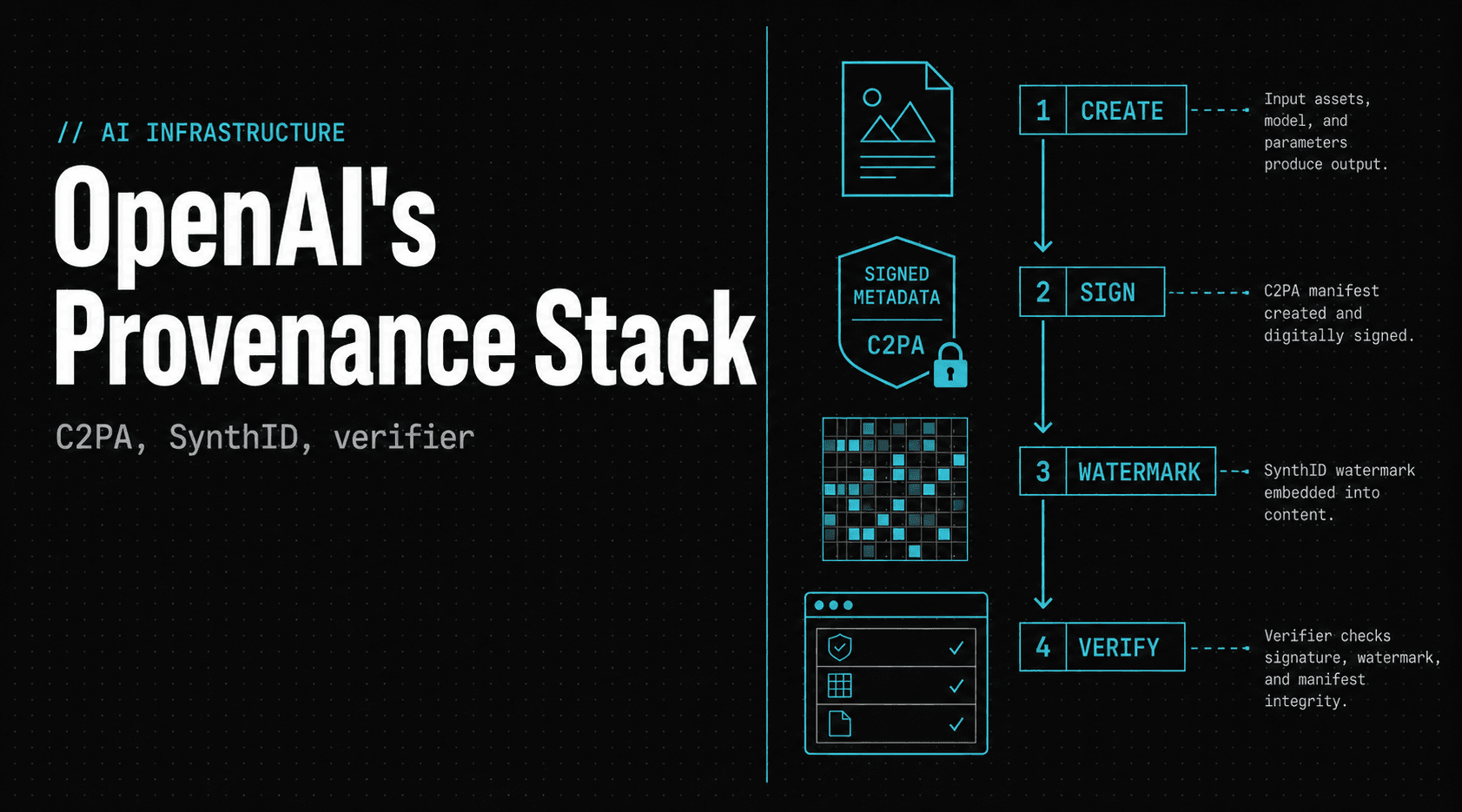
The most important part of OpenAI's latest provenance push is not the verifier demo. It is the stack design behind it.
On May 19, 2026, OpenAI said it had made its media pipeline conformant with the C2PA standard, started adding Google's SynthID watermarking to images generated through ChatGPT, Codex, and the OpenAI API, and opened an early public verification tool for checking whether an image carries those signals. That combination matters because each layer covers a different failure mode.
One signal was never going to be enough
C2PA metadata is the clean, standards-based answer. It can carry signed information about where a piece of media came from, how it was edited, and which system asserted those claims. That is useful for platforms, newsrooms, and anyone building moderation or authenticity tooling. The problem is that metadata is fragile in the wild. Re-uploads, screenshots, format conversion, and social platform processing can strip or break it.
SynthID tackles the opposite side of the problem. Instead of attaching context as metadata, it embeds a harder-to-notice watermark signal into the image itself. Google DeepMind says the approach is designed to survive common transformations like cropping, compression, and filtering. That does not make it magic, but it does make provenance more likely to survive the way people actually move media around.
The public verifier is the third piece. Standards and watermarking do not matter much if the only people who can inspect them are platform operators and forensic specialists. OpenAI's preview tool turns provenance from a backend feature into something users can actually query.
This is what AI disclosure looks like when it grows up
A lot of the AI labeling debate has been stuck in a false binary. Either stamp a visible badge on everything, or trust that platforms will handle provenance behind the scenes. Neither approach scales well.
Visible labels are easy to crop and often destroy the value of the media. Pure metadata works great until content gets copied into systems that do not preserve it. Pure watermarking can tell you that a model touched the file, but not much about the context around it. OpenAI's new stack is more serious because it treats provenance as infrastructure with redundancy instead of a single badge or policy checkbox.
That is also why C2PA conformance matters more than it sounds. The point is not just that OpenAI can attach credentials. The point is that the wider ecosystem can recognize, preserve, and pass those credentials along with fewer custom integrations. Provenance only becomes useful when it survives multiple hops between tools.
Why this changes the competitive baseline
Once one major model provider ships a layered provenance system, the bar moves for everyone else. Image generators can no longer wave at disclosure in the abstract. They need a concrete answer for standards, durable signals, and verification.
This will matter for more than misinformation debates. Enterprise design teams, publishers, marketplaces, educators, and API integrators all need better ways to separate human-made, AI-generated, and AI-edited assets. The closer AI gets to ordinary production tooling, the less acceptable it becomes to treat origin tracking as an optional add-on.
It also creates pressure on platforms. If model companies are attaching machine-readable provenance and verification signals, social networks, CMS vendors, asset libraries, and chat apps will increasingly have to explain what they preserve, what they strip, and why.
The real test is survival, not launch
OpenAI is right to avoid overclaiming. Its own post notes that no detection method is foolproof and that a missing signal does not prove a file was not generated with its tools. That restraint is healthy. Provenance systems break down at the edges, and the internet is mostly edges.
But this launch still marks a real shift. The industry is moving away from the idea that AI disclosure is a single watermark, a corner badge, or a policy statement. The emerging model is layered provenance: signed metadata for context, embedded signals for durability, and public tooling for verification.
That is the first version of an AI disclosure system that actually has a chance of surviving contact with the web.
Sources
// Discussion
Comments
No comments yet. Start the thread.