Linux 7.1-rc4 looks like a normal release candidate at first glance. More laptop quirks, more device fixes, more security patches, more cleanup before the stable release.
That is the surface story. The more interesting part is what showed up outside the code: new Linux kernel documentation covering what qualifies as a security bug and responsible AI use around kernel development and possible security issue discovery.
That is a small item with a bigger meaning. AI is no longer sitting outside the development process as a novelty. It is becoming part of the environment serious projects have to govern.
What changed in Linux 7.1-rc4
According to Phoronix, Linux 7.1-rc4 includes a wide mix of fixes and hardware updates.
The release candidate brings more Intel and AMD laptop quirks, including a microphone fix for the upcoming Framework Laptop 13 Pro model powered by Intel Panther Lake. It adds support for newer Logitech Bluetooth keyboards to use the HID++ protocol properly. It also addresses some AMD Dynamic EPP problems tied to new Linux 7.1 kernel feature code.
There is also an option to disable KVM with CET virtualization because some hosts were hanging.
That is typical kernel release candidate work. Hardware support gets sharper. Power management bugs get found. Virtualization problems get narrowed. Input devices get cleaned up. Small fixes accumulate until the release is ready.
Linux development is not one grand event. It is a constant grind of edge cases.
The security timing matters
Linux 7.1-rc4 also includes the latest kernel security fixes that had already moved into stable releases. Phoronix points specifically to the ssh-keysign-pwn vulnerability, which allowed unprivileged users to read root-owned files. It also mentions Dirty Frag and Fragnesia as recent Linux kernel security issues.
That context matters because it explains why documentation around security bug handling is not just administrative housekeeping.
Kernel security depends on process. It depends on how bugs are reported, triaged, classified, patched, disclosed, backported, and shipped through distribution channels. A vulnerability is not finished when a patch lands upstream. It still has to reach the machines people actually use.
Recent kernel vulnerability traffic makes the documentation work look less like paperwork and more like infrastructure.
The AI documentation is the real signal
The responsible AI documentation is the part worth watching.
Kernel development is one of the highest-stakes software environments in the world. The Linux kernel sits underneath servers, phones, embedded systems, cloud infrastructure, desktops, routers, appliances, industrial systems, and developer machines. If AI is going to enter that workflow, the project needs rules before the tools become invisible.
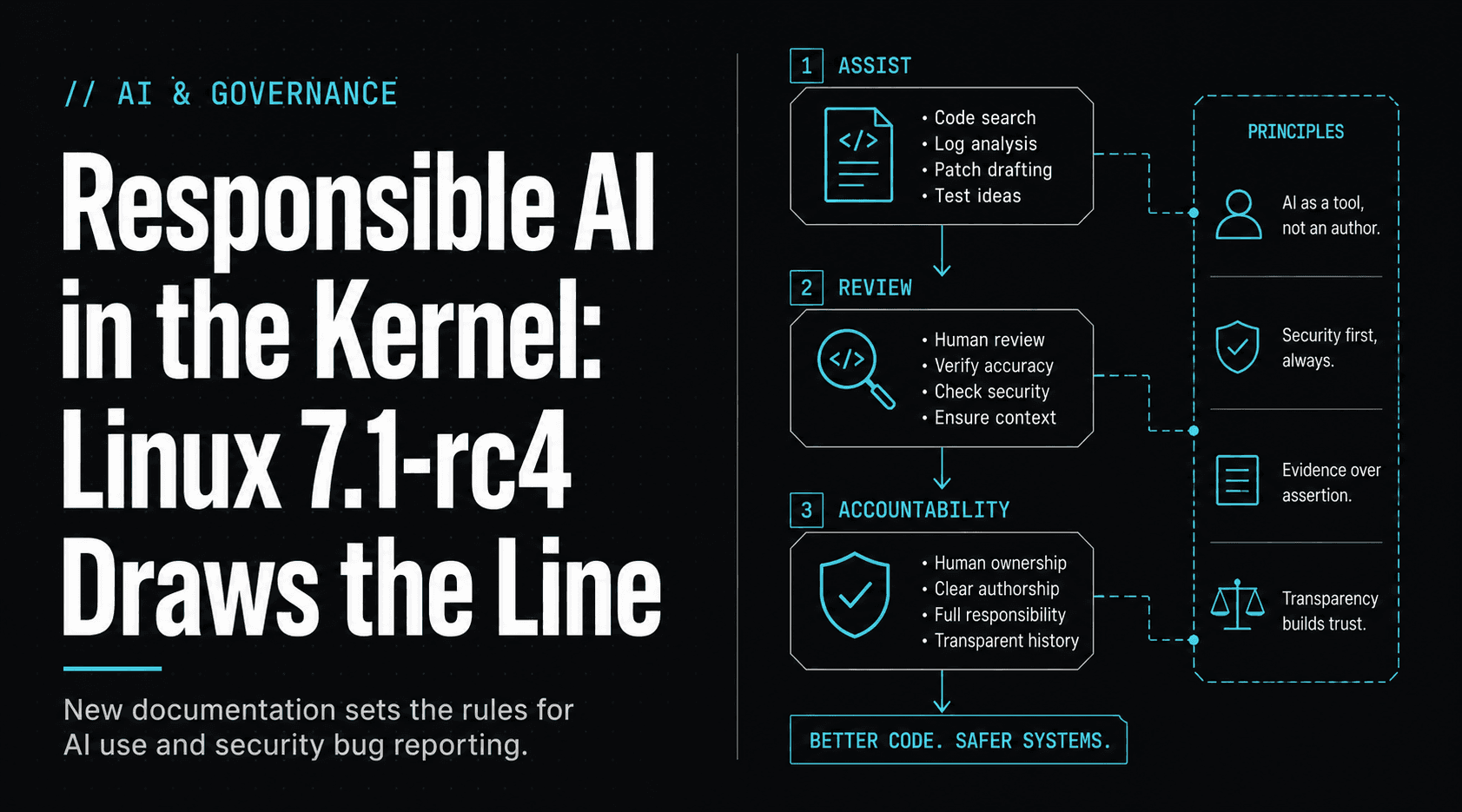
That does not mean AI should be kept out. The opposite is more realistic. AI can help developers search code, summarize bug reports, examine crash logs, find patterns, generate test ideas, and reason through unfamiliar subsystems. It can also help security researchers move faster when investigating possible vulnerabilities.
The kernel community does not need to pretend those tools are going away. It needs to decide how they can be used without weakening accountability.
Acceleration still needs maintainership
The useful framing is simple: AI can accelerate development, but it does not replace maintainership.
Linux works because patches have authors, reviewers, subsystem maintainers, mailing list history, commit messages, testing expectations, and a culture of blunt technical review. That system is not perfect, but it is one of the reasons the kernel can evolve without becoming random.
AI-generated or AI-assisted work has to fit into that structure. A patch still needs a human who understands it. A bug report still needs enough detail to reproduce the issue. A claimed security vulnerability still needs technical evidence. A generated explanation still needs verification.
That is not anti-AI. That is how serious engineering absorbs a new tool.
Security discovery is changing
The security side is where this gets sharper.
AI systems can help find bug classes, connect patterns across subsystems, and shorten the time between a weird behavior and a plausible root cause. That is useful for defenders and maintainers. It also means more people will be able to produce more vulnerability reports, some good, some weak, and some noisy.
Documentation about what counts as a security bug becomes more important in that environment. Without clear standards, maintainers get flooded with vague claims, model-assisted guesses, incomplete reports, and security theater. With clear standards, AI-assisted discovery can be channeled into work the project can actually use.
The goal should not be less AI. The goal should be better intake, better evidence, better review, and faster movement from discovery to patch.
Linux is treating AI as governance, not branding
That is what makes this release candidate interesting. The kernel is not adding some flashy AI feature for users. It is adjusting the rules around how AI interacts with the development process.
That is the mature version of AI adoption. Not every AI story has to be a product launch. Sometimes the important shift is a project deciding how a powerful tool enters its workflow without damaging the norms that make the project work.
For Linux, that means keeping responsibility attached to people. AI can help with discovery, analysis, and drafting. It cannot be the accountable maintainer of a patch. It cannot stand behind a security report. It cannot absorb the long-term consequences of a bad change.
Humans still own the work.
The bigger takeaway
Linux 7.1-rc4 is still mostly a normal release candidate. It has hardware fixes, security updates, driver cleanup, and stabilization work on the road to Linux 7.1.
But the new documentation points to where large software projects are going. AI is becoming part of development infrastructure. Security pressure is increasing. Maintainers need clearer rules for both.
The strongest projects will not be the ones that ban new tools or blindly accept them. They will be the ones that make AI useful while keeping review, evidence, and responsibility intact.
That is the right direction for the kernel. Faster tools, sharper process, and no confusion about who owns the code.
// Discussion
Comments
No comments yet. Start the thread.