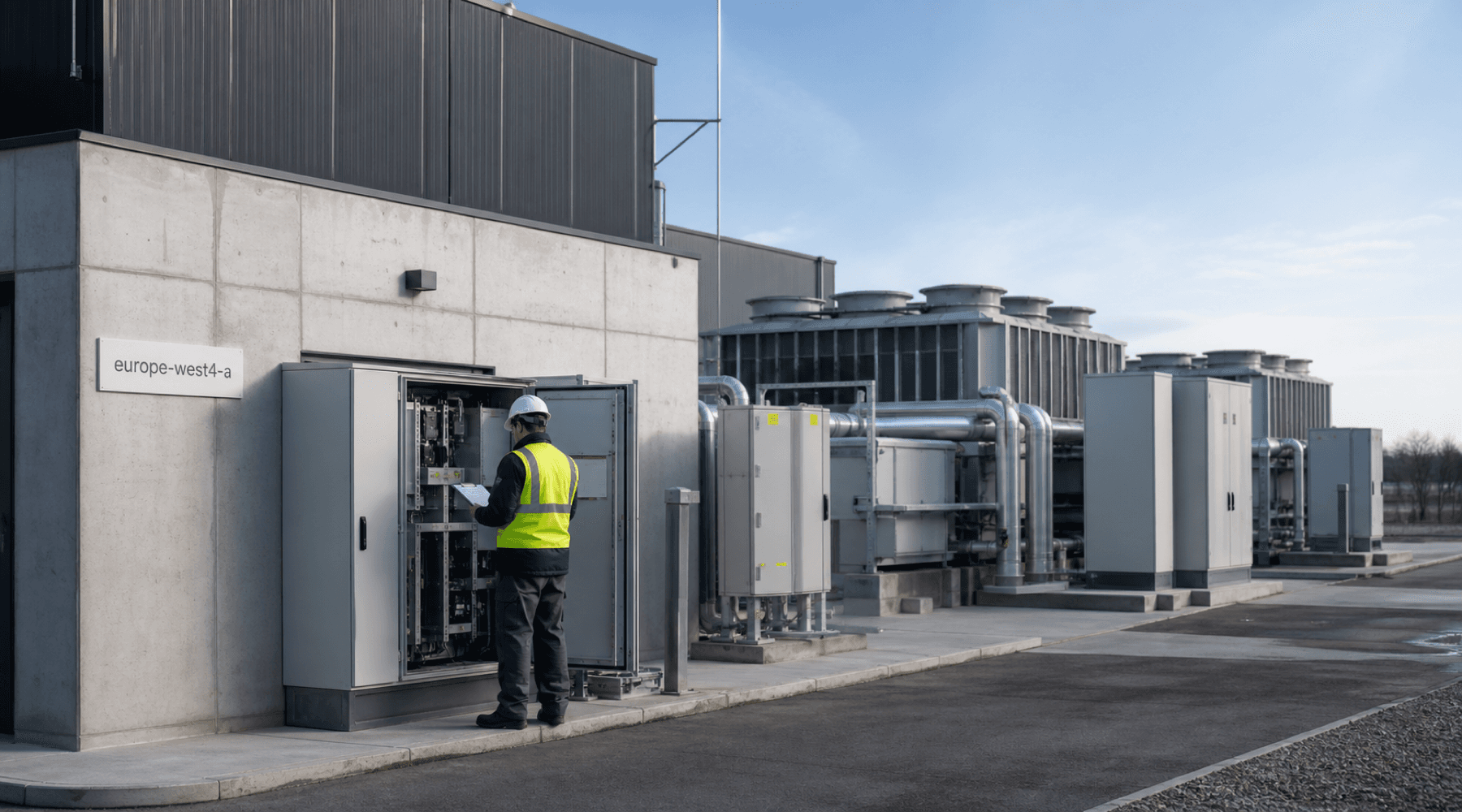
Cloud regions are designed to feel like software. You choose a location, pick a zone, attach a managed service, and the messy physical world disappears behind an API. That abstraction is useful, but it is not magic. Somewhere underneath every managed service are power feeds, cooling loops, network switches, storage nodes, host servers, facility operators, and placement decisions that customers usually cannot see.
4sysops highlighted that boundary on July 21 after a Google Cloud outage in europe-west4-a affected three specialized services: Google Cloud VMware Engine, Google Cloud NetApp Volumes, and Bare Metal Solution. Google's incident report says the service interruptions started on July 15 and ran into July 16, with a total incident duration of 14 hours and 55 minutes across the affected services. The root cause was physical: a regional datacenter hosting those services lost utility power and then cooling capacity.
region: europe-west4
zone:   europe-west4-a
scope:  VMware Engine / NetApp Volumes / Bare Metal Solution
edge:   utility power + cooling + dedicated hardware
The Zone Was Not The Whole Story
The important detail is not simply that Google Cloud had an outage. Large platforms have incidents. The useful lesson is that the rest of a zone or region can appear healthy while a subset of managed services is tied to a narrower physical dependency. In this case, the affected services were not ordinary stateless compute spread through the user's mental model of a region. They were specialized managed offerings with service-specific infrastructure.
Google's report lists different impact windows. VMware Engine was affected for 9 hours and 24 minutes. NetApp Volumes was affected for 8 hours and 31 minutes. Bare Metal Solution was affected for 12 hours and 57 minutes. Customers saw loss of connectivity to private clouds, database servers, storage appliances, and storage volumes. Some control-plane operations for NetApp Volumes also failed in the affected region.
That kind of split matters. A cloud outage is rarely one uniform thing. One product may recover while another is still being validated. One control plane may fail while a neighboring data path keeps working. One service may depend on dedicated hardware that does not move like generic VM capacity. The customer's architecture diagram may show a clean zone label, but the provider's implementation has more texture.
A managed service can be regional in the contract and still carry service-specific physics in the implementation.
Facilities Are API Dependencies
The incident report says an electrical fault upstream of the datacenter disrupted electrical distribution gear and cooling equipment. As temperatures rose, host servers, storage clusters, and network switches were shut down to avoid heat damage. Google then restored power and cooling, brought temperatures back into a safe operating range, and recovered servers, storage nodes, switches, and routing infrastructure in a controlled sequence.
That remediation path is a reminder that facilities are not beneath the cloud stack. They are part of it. Cooling is not just a real-estate concern. It decides whether a host remains safe to run. Electrical distribution is not just a utility contract. It decides whether the service can keep its hardware alive. A data hall temperature curve can become a control-plane failure, a storage outage, and an application incident several layers above it.
This is especially visible with managed services that wrap existing enterprise shapes: VMware private clouds, dedicated bare-metal systems, and managed storage appliances. These products often exist because customers need familiar operational models, licensing paths, hardware characteristics, or migration bridges. The tradeoff is that they may not inherit the same failure behavior as a fully cloud-native, horizontally replicated service.
What Operators Should Ask
The wrong lesson is to abandon managed services or pretend every workload needs heroic multi-cloud machinery. Most teams need fewer moving parts, not more. The right lesson is to ask sharper questions about the specific service being consumed.
- Failure domain: is the service spread across multiple facilities, one zone, one building, or dedicated hardware pools?
- Control plane: which management operations continue if the data path is impaired?
- Recovery order: what comes back first: networking, storage, hosts, control-plane APIs, or customer workloads?
- Portability: can the workload be restored into another zone or region without provider-specific manual recovery?
- Evidence: does the provider publish enough incident detail to validate the assumptions in the architecture?
Those questions are not procurement theater. They change the shape of the runbook. If a service has a facility-level dependency, backups alone may not be enough. Teams may need tested restore paths into another service class, another region, or a degraded mode that can operate without the affected managed dependency. For storage-heavy workloads, they need to know whether snapshots, replication, and control-plane operations are inside or outside the failure boundary.
Resilience work also has to be honest about cost. It is easy to say every dependency should be active-active across regions. It is harder to fund, operate, and test that design. The useful bar is not perfection. It is explicitness: know which services can fail together, know which assumptions are guesses, and rehearse the recovery path for the systems that matter.
The Takeaway
The Google Cloud europe-west4-a incident is a good systems reminder because it punctures a quiet assumption. A region is not one uniform resilience product. It is a geography, a provider architecture, a set of zones, and many service-specific implementations living underneath the same control surface.
Cloud abstractions are still worth using. The danger is treating the abstraction as a full explanation of the failure domain. When a power and cooling failure can take down three specialized services while the surrounding region keeps running, operators should update their mental model: managed services do not erase physical edges. They move those edges somewhere else and make it your job to ask where.
// Discussion
Comments
No comments yet. Start the thread.