Endpoint isolation used to be the moment when a human security team decided the machine was too risky to keep on the network. Microsoft is turning that moment into an automated control.
Microsoft Defender for Endpoint can now automatically isolate compromised Windows devices when Defender XDR determines that an active attack is underway. The feature is in public preview, and BleepingComputer reported the new capability on May 26 after Microsoft added it to the Defender for Endpoint release stream. The move sounds like a product toggle, but the architectural point is bigger: containment is moving closer to the detection pipeline.
That matters because the fastest part of an intrusion is often not the initial foothold. It is the step after it. Once an attacker has code running on an endpoint, the race becomes credential access, discovery, lateral movement, and persistence. A response workflow that waits for a queue, an analyst decision, and a manual isolation click can still be correct, but it may be correct too late.
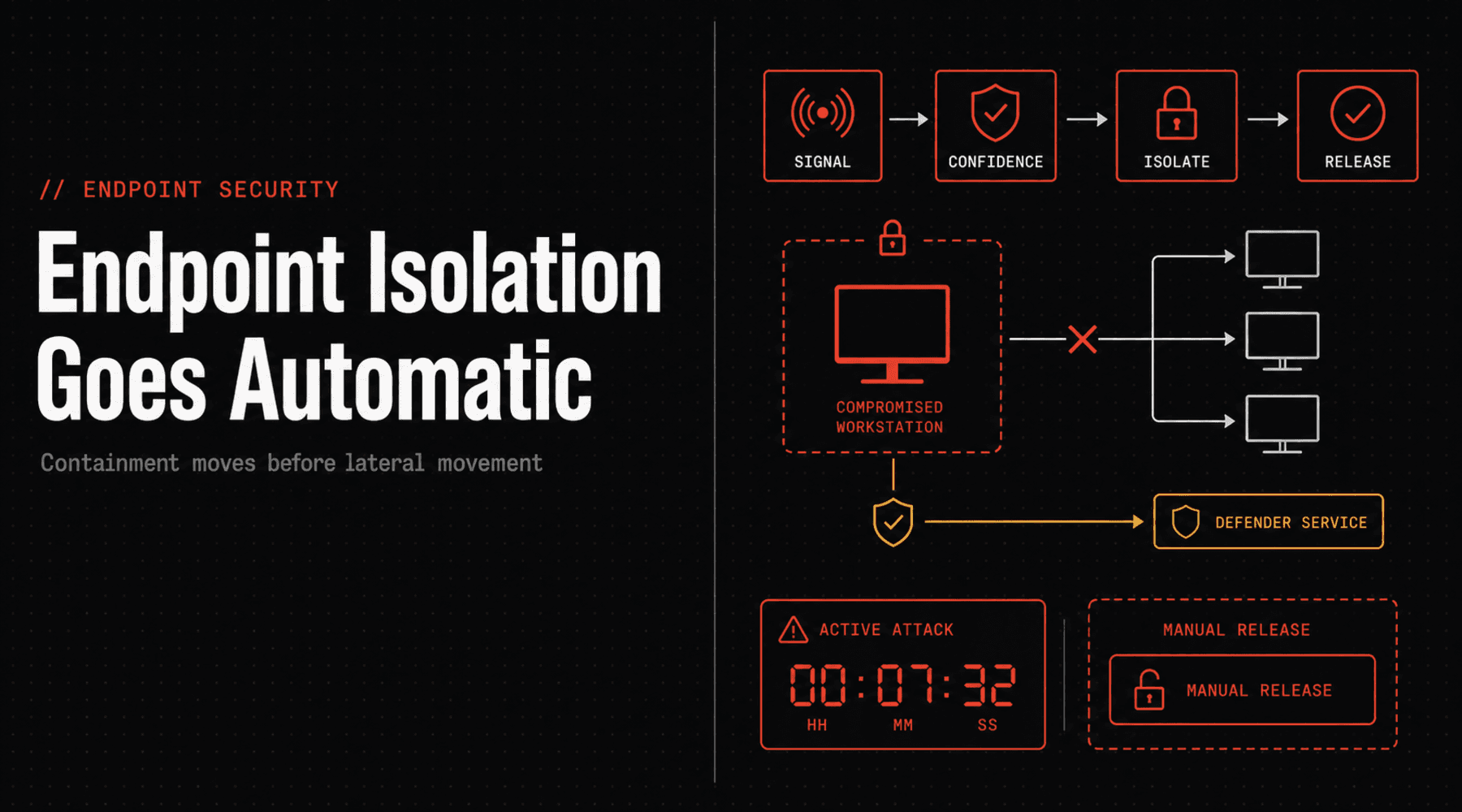
Automatic isolation changes the default rhythm. If the detection system has enough confidence that an endpoint is participating in an active attack, the endpoint can be cut off from most network communication while preserving the management channel Defender needs for investigation and recovery. The machine is not magically cleaned. It is put in a narrow lane so the attacker has less room to move.
Isolation is a blast-radius control
The useful way to think about this feature is not as remediation. It is blast-radius reduction.
Device isolation in Defender for Endpoint is designed to block most traffic to and from a machine while keeping connectivity to the Defender service. Administrators can still investigate, collect evidence, run response actions, and release the device when the incident is understood. In the manual version of this control, the security team decides when that tradeoff is worth it. In the automated version, the system can make that call during certain active-attack scenarios.
That is a meaningful boundary. Security products already generate too many alerts. Giving them the power to take machines off the network raises the stakes, because a false positive is no longer just noise in a console. It can interrupt work. The preview label is doing real work here. Microsoft is not simply saying every suspicious endpoint should be isolated by a model. It is adding a high-impact response action to Defender XDR's attack disruption path, where the product is already trying to stop hands-on-keyboard intrusions before they spread.
The reason this belongs in the product is time. Ransomware crews, token thieves, and remote operators do not need a long window to turn one compromised host into a domain problem. If the EDR can identify the shape of an active attack and isolate the machine before the attacker pivots, the defender gets back something scarce: minutes.
The management channel matters
A crude version of isolation would just drop the endpoint off the network. That sounds decisive, but it can make response worse. If the security team loses its control channel, it may also lose telemetry, remote collection, and the ability to push a recovery action.
Defender's model is more useful because isolation is selective. The compromised device is cut off from ordinary network paths, but the Defender for Endpoint service path remains open. That keeps the containment action attached to the investigation workflow. The endpoint becomes less useful to the attacker without becoming invisible to the defender.
This is the pattern more security automation should follow. A response action should not only stop damage. It should preserve the operator's ability to understand what happened. Quarantining a machine while keeping the telemetry and command channel alive is closer to an airlock than a power switch.
Automation needs policy, not vibes
The hard part is governance. Automatic isolation is powerful precisely because it reaches into the network and changes what a computer is allowed to do. That means organizations need to decide where it is allowed, which device groups are eligible, how exceptions are handled, and what the release process looks like.
A development laptop, a call-center desktop, a factory workstation, and a domain controller do not carry the same operational risk. The security value of fast isolation is real across all of them, but the business impact is not the same. Mature use of this feature will look less like blind trust in automation and more like targeted policy: enable aggressive containment where lateral movement risk dominates, stage carefully where uptime or safety constraints are different, and make manual release auditable.
The point is not to keep humans out of response. It is to put humans at the right layer. Analysts should design the thresholds, review the incidents, tune the scope, and decide whether the endpoint can come back. They should not always be the bottleneck between a confirmed active attack and the first containment action.
Endpoint security is becoming infrastructure
The broader trend is that endpoint tools are no longer just sensors. They are becoming distributed enforcement infrastructure.
That shift has been building for years. EDR started as visibility and investigation. Then it added response actions: kill a process, collect a file, quarantine an artifact, isolate a machine. XDR connected those signals across identity, email, cloud apps, and endpoints. Automatic attack disruption is the next logical step: use the connected signal to take a constrained action quickly enough to matter.
This is also why the feature should be judged differently from an alert-quality improvement. Better detections help the analyst know what to do. Automated isolation changes the system's behavior while the incident is still unfolding. It turns security judgment into a live control path.
That path will need measurement. Teams should track how often automatic isolation fires, how quickly it fires, how many incidents it contains, how many legitimate workflows it interrupts, and whether release decisions are documented. The best version of this technology is not dramatic. It is boringly accountable: clear eligibility, clear audit trail, clear rollback, clear evidence that it reduced lateral movement.
The takeaway is simple. If an endpoint is already confirmed to be part of an active attack, waiting can be the riskiest action. Automatic isolation gives defenders a faster way to buy time. Used carefully, it turns the endpoint fleet into a containment layer instead of a collection of machines waiting for an analyst to click the right button.
// Discussion
Comments
No comments yet. Start the thread.