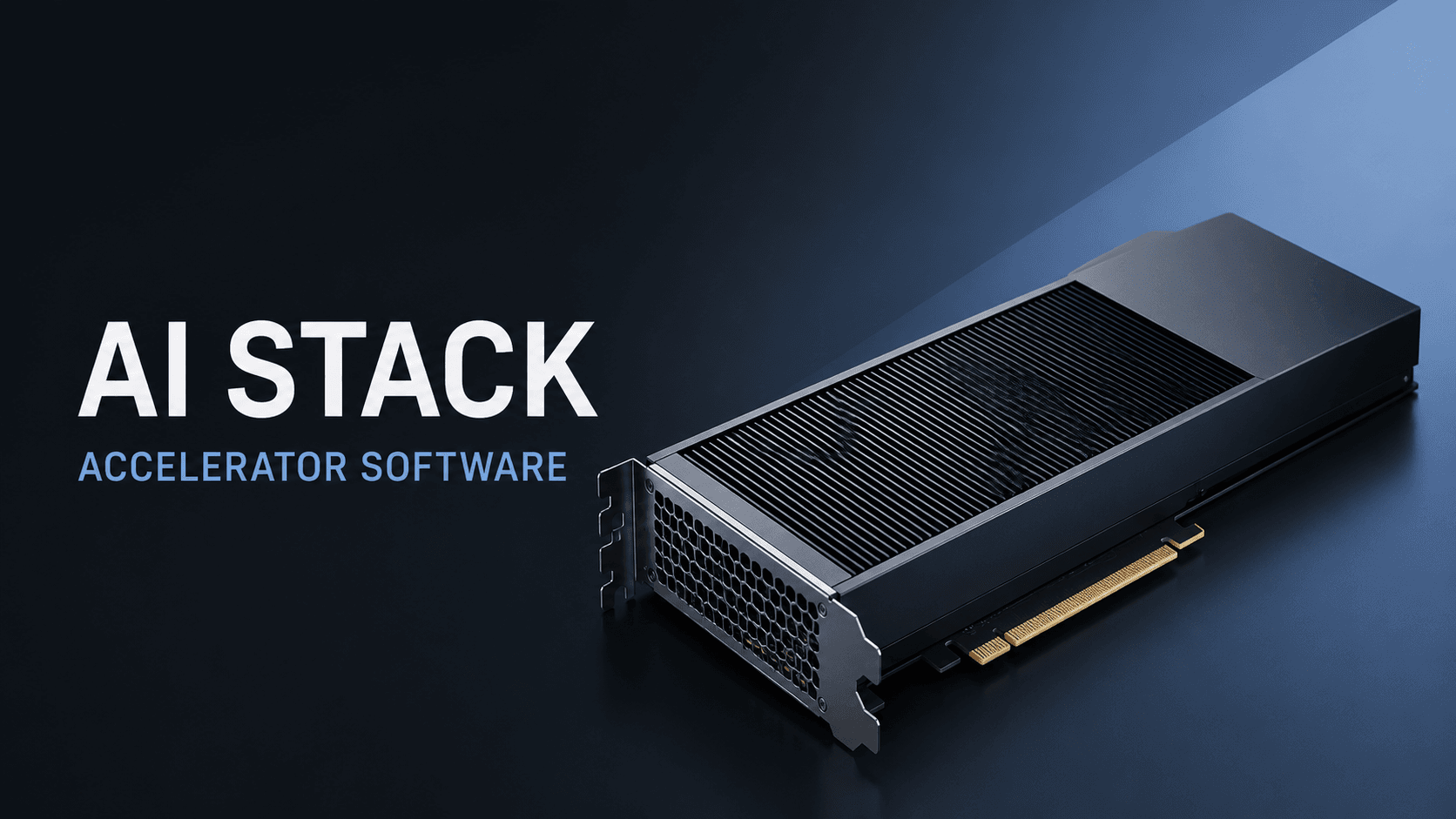
AMD’s latest ROCm release is not just a driver update. It is another signal that the AI accelerator race is moving from raw silicon into the full stack around it.
ROCm 7.13 is out as a technology preview release, adding support for AMD’s Instinct MI350P PCIe accelerator, more Ryzen AI parts, expanded Radeon PRO support, Ubuntu 26.04 LTS support, improved GPU virtualization, better partitioning, and more optimization work around Ryzen AI Max 300 systems.
That list sounds like normal release-note material. It is more important than that.
AI compute is not won by hardware alone. The accelerator matters, but the software path into that accelerator decides whether developers, researchers, startups, enterprises, and infrastructure teams can actually use it without burning weeks on setup, compatibility, and deployment work.
That is where ROCm sits. It is AMD’s open GPU software stack for accelerated computing, and its direction says a lot about how AMD wants to compete in AI.
The accelerator race is becoming a software race
For years, the easiest way to talk about AI hardware was with numbers: memory, bandwidth, FLOPs, power, price, process node, interconnect, and benchmark charts. Those still matter. Nobody buying accelerators at scale is ignoring throughput or thermals.
But the real product is not just the card. The real product is the path from model to useful work.
That path includes drivers, runtimes, compilers, profiling tools, math libraries, framework support, container images, deployment recipes, debugging tools, monitoring, virtualization, and documentation. It includes whether PyTorch works cleanly. Whether JAX works cleanly. Whether the system can be shared across teams. Whether operators can partition GPUs. Whether admins can update the stack without breaking everything.
ROCm 7.13 points directly at that reality. The release is not only about adding another supported accelerator. It is about widening the set of machines AMD’s AI stack can reach.
MI350P matters because it fits existing infrastructure
The most important hardware addition is support for the AMD Instinct MI350P, a PCIe card in the MI350 series.
PCIe is the important part. Not every organization is going to rebuild around the most exotic AI infrastructure available. Many teams want a path that works inside existing servers, existing procurement patterns, existing data centers, and existing operations.
AMD describes the MI350P as designed to deploy and scale generative and agentic AI inside existing infrastructure. That is exactly where a lot of enterprise AI adoption lives. The interesting question is not whether a lab can build a giant cluster. The question is whether serious AI compute can move into more normal environments without becoming a months-long infrastructure project.
That is a pro-acceleration story. The faster AI compute becomes deployable in ordinary enterprise environments, the faster useful models can move from demo to workflow.
But the hardware only gets that far if the software stack is ready.
ROCm is AMD’s bridge from silicon to developers
ROCm is AMD’s open software ecosystem for GPU-accelerated computing. The ROCm 7.13 preview docs describe it as open, modular, and performance-focused across data centers, workstations, and edge devices.
That positioning matters because AMD is not simply selling chips into a vacuum. It is trying to build a usable compute platform around those chips.
The stack includes the unglamorous pieces that decide whether an accelerator becomes widely useful: runtimes, compilers, math libraries, communication libraries, profiling tools, debugging tools, management utilities, and framework support.
That is the layer developers touch. That is the layer infrastructure teams live with. And that is the layer where AMD has to keep closing distance if it wants more AI workloads to land on its hardware.
In that sense, ROCm is not a side project attached to AMD’s AI ambitions. It is one of the main products.
Ryzen AI support brings acceleration closer to the edge
ROCm 7.13 also expands official support for more Ryzen AI 300 series parts, including several Ryzen AI 7 and Ryzen AI 5 chips.
That is smaller than the Instinct news in raw compute terms, but strategically important. AI acceleration is spreading in two directions at once. One direction is the data center, where larger models and enterprise workloads need serious accelerator density. The other direction is local compute, where laptops, workstations, edge devices, and personal machines start doing more AI work directly.
That second path matters because not every AI task should require a round trip to a cloud service. Local inference, private workflows, creative tools, development assistants, small models, embeddings, indexing, media processing, and on-device agents all benefit from better hardware and better software access.
Ryzen AI support is part of that longer road. The more normal it becomes for local machines to have usable AI acceleration, the less AI feels like something reserved for cloud providers and giant labs.
That is the acceleration curve worth watching: AI moving from centralized infrastructure into everyday developer and creator hardware.
Open stacks are strategically important
AMD’s open-stack posture is one of the most important parts of the story.
AI infrastructure is already too concentrated around a few platforms, a few suppliers, and a few deployment patterns. More credible accelerator options are good for the market. More credible software stacks are even better.
An open GPU software ecosystem gives developers and companies more room to inspect, adapt, build, and deploy without treating the accelerator as a sealed appliance. That does not automatically make everything easy. Open software can still be messy. Compatibility can still be uneven. Performance tuning can still be hard.
But openness gives the ecosystem a way to compound. Developers can diagnose problems. Partners can integrate. Researchers can experiment. Infrastructure teams can build around visible assumptions instead of waiting for a black box to change.
For AI acceleration, that matters. The market needs more than one mature path.
The preview label is still important
ROCm 7.13 is a technology preview release, not the main production stream. That matters for anyone planning real deployment.
A preview can show direction before it becomes the safest default. It can bring early hardware support, new components, and changes that developers want to test. But production teams still need to care about stability, validated configurations, framework compatibility, kernel support, upgrade paths, and support windows.
That does not make the release less important. It just puts it in the right category.
ROCm 7.13 is a signal of where AMD’s stack is going. It is not a reason for every team to rip out a working production environment overnight.
The useful version of the AI hardware race
The AI hardware race can easily collapse into theater: bigger numbers, bigger clusters, bigger keynote claims. The more useful version is quieter and more practical.
Can a company deploy accelerators in the systems it already owns?
Can developers use the hardware through standard frameworks?
Can operators monitor, partition, virtualize, and manage the devices?
Can local machines participate in AI workflows instead of handing everything to remote infrastructure?
Can open software make the stack easier to trust and easier to improve?
Those are the questions ROCm is built to answer. ROCm 7.13 does not answer all of them completely, but it pushes in the right direction: more hardware support, more platform coverage, more enterprise relevance, and more local AI reach.
AMD’s real AI challenge
AMD does not just need strong accelerators. It needs developers to believe that using those accelerators will not be a punishment.
That is the real challenge. AI teams move fast. Tooling friction compounds quickly. If the software path feels uncertain, the hardware advantage has to be overwhelming to compensate. If the software path improves, AMD has a much cleaner argument: more options, more openness, more deployable AI compute.
ROCm 7.13 is part of that argument.
The headline feature is MI350P support. The bigger story is that AMD’s AI platform is becoming more complete. Hardware gets attention. Software decides adoption.
For AI acceleration to spread, the industry needs more usable stacks, more hardware diversity, and more ways to run models where the work actually happens.
That is why ROCm matters.
// Discussion
Comments
No comments yet. Start the thread.