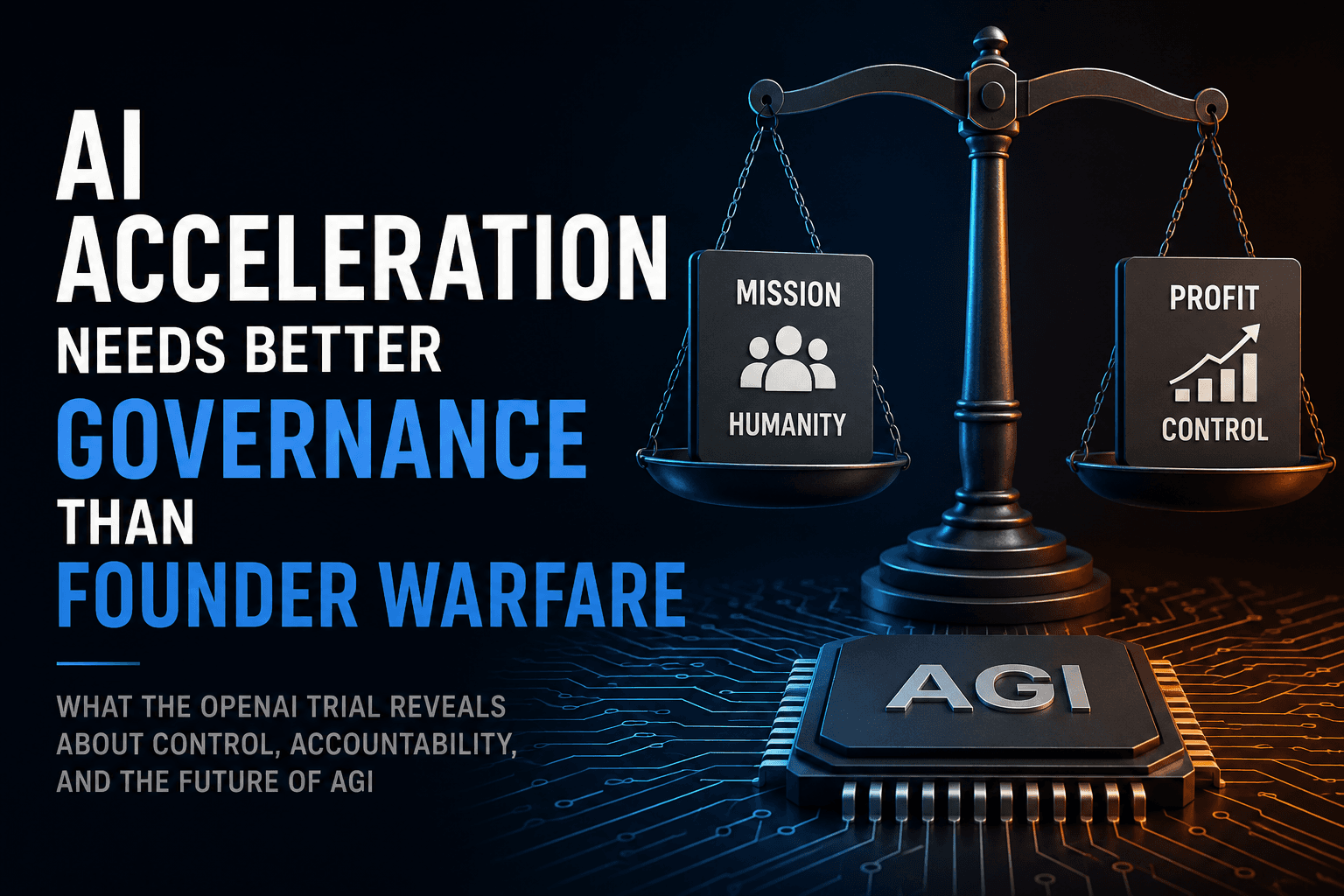
The Musk v. Altman trial is easy to read as founder drama. That is the shallow version.
The deeper version is more important: frontier AI is moving fast enough that the institutions around it are now being stress-tested in public. Nonprofit missions, for-profit subsidiaries, public benefit corporations, investor incentives, personal rivalries, safety claims, governance documents, and trillion-dollar valuations are all colliding in the same courtroom.
That does not mean AI acceleration should stop. It means acceleration needs governance that can survive contact with money, power, and founder mythology.
The final week of the trial sharpened that problem. Lawyers for Elon Musk and OpenAI CEO Sam Altman traded attacks over credibility, motives, nonprofit promises, conflicts of interest, and who actually gets to control the development of artificial general intelligence.
The jury will deliver only an advisory verdict. The judge will ultimately decide the case. But the trial has already exposed the harder question underneath it: what kind of institutional structure is strong enough to guide frontier AI without becoming either a speed bump or a costume?
The fight is about control
Musk argues that Altman, Greg Brockman, OpenAI, and Microsoft broke the original promise behind OpenAI: that donated money would support a nonprofit effort to develop AI for the benefit of humanity. He is asking the court to unwind OpenAI’s 2025 restructuring, remove Altman and Brockman from their roles, and award as much as $134 billion in damages to OpenAI’s nonprofit.
OpenAI argues that no binding promise was made to keep the organization purely nonprofit. Its lawyers say the nonprofit still controls the structure and remains committed to developing AI safely.
That is the formal legal fight. The practical fight is about control.
Who controls the lab that may build the most important technology platform of the next decade? The nonprofit board? The executives? Investors? A public benefit corporation? A founder who left? A court? A future public market?
That question matters because frontier AI is not just another software category. It is infrastructure, labor market pressure, national strategy, research platform, consumer product, developer tool, and geopolitical object all at once.
Control over that kind of system cannot be reduced to vibes about safety or disruption. It has to be legible.
Acceleration makes governance more important, not less
There is a lazy version of the argument that says governance is anti-acceleration. That is wrong.
Bad governance slows acceleration because it creates instability. It creates lawsuits, staff revolts, board crises, investor uncertainty, regulatory openings, public distrust, and strategic hesitation. A lab that cannot explain who controls it and why will eventually spend more energy defending its structure than building.
Good governance does the opposite. It gives an organization enough legitimacy to move fast without constantly reopening the same existential questions.
OpenAI’s problem is not that it wants to build powerful AI. That ambition is the point. The problem is that the institutional story around that ambition keeps changing under pressure: nonprofit origin, capped-profit structure, Microsoft partnership, public benefit corporation conversion, possible IPO path, and continuing claims that the nonprofit mission remains in charge.
Each individual move may have a rationale. Taken together, they create a trust problem.
Founder credibility is a weak foundation
The trial leaned heavily into personal credibility. Musk’s side attacked Altman’s alleged history of lying and conflicts of interest. OpenAI’s side painted Musk as a power-seeker trying to sabotage a competitor to xAI.
Both lines of attack may matter legally. But for AI governance, they reveal the weakness of relying on founders as moral infrastructure.
Founders can be brilliant. They can also be self-interested, erratic, strategic, sentimental, vindictive, visionary, or all of those things in the same week. That is not unique to AI. It is normal corporate reality.
But frontier AI raises the stakes. If a lab’s public-interest mission depends on trusting one charismatic executive, one boardroom faction, or one founder’s version of history, then the structure is not strong enough.
Good institutions are built so that the mission does not depend on everyone liking the same person.
The nonprofit question is not cosmetic
One of the core questions in the trial is whether OpenAI remains a nonprofit in any meaningful controlling sense.
OpenAI’s lawyer argued that the nonprofit still controls the for-profit and that the for-profit has made the nonprofit unusually well-resourced. Musk’s lawyer countered that the nonprofit’s control is largely nominal, pointing to overlapping board membership, limited nonprofit staffing, and the nonprofit’s apparent distance from the research work itself.
This is not an academic governance puzzle. It is the central tension in the OpenAI model.
If a nonprofit controls a for-profit AI company, the control has to be real enough to matter when commercial pressure pushes one way and the mission pushes another. If it is real only on paper, then the nonprofit becomes a legitimacy wrapper. If it is too strong or too vague, it can become a source of paralysis.
The right balance is hard. That is why it matters.
Safety became theater because structure was unclear
The trial was not supposed to be about AI safety, but safety kept breaking through anyway.
OpenAI brought out a golden trophy of a donkey’s ass, reportedly given to an employee after he was called a jackass for objecting to Musk’s push to race toward AGI. Lawyers also traded attacks over the safety records of ChatGPT and Grok. Protesters outside the courthouse turned the whole thing into public spectacle.
That is what happens when governance questions are unresolved. Safety becomes a prop. Mission language becomes evidence. Old insults become symbols. Every side tries to claim the public-interest mantle while also pursuing its own institutional advantage.
That does not mean safety is fake. It means safety claims need structure behind them.
A serious AI lab should be able to answer basic questions without relying on courtroom theater: Who has authority? What are the override mechanisms? What happens when safety and revenue conflict? Who can remove leadership? How is independence preserved? What information reaches the board? What commitments survive a restructuring?
Those answers matter more than slogans.
The market is moving faster than the legal system
The possible stakes are enormous. If Musk wins, OpenAI’s restructuring could be disrupted, along with its path toward an IPO at a valuation approaching $1 trillion. Meanwhile, xAI is reportedly moving toward a public-market path of its own at an even larger target valuation through SpaceX.
Whether those numbers hold or not, the direction is obvious: frontier AI is becoming capital infrastructure.
That creates a mismatch. Courts move slowly. Corporate restructurings move carefully. Regulators move unevenly. But AI labs move on model releases, compute deals, enterprise deployments, developer adoption, and investor timelines.
The faster the technology moves, the more important it becomes to settle the institutional questions early. Otherwise governance becomes something handled after the fact, in lawsuits, crises, and emergency board meetings.
Acceleration needs durable institutions
The pro-AI position should not be institutional nihilism.
Building more capable systems is good. Making them cheaper, faster, more useful, and more widely available is good. Expanding the frontier matters. So does creating institutions that can keep building when founders fight, boards fracture, markets turn, or public pressure spikes.
That is the lesson of the Musk v. Altman trial. The question is not whether AI should accelerate. It will. The question is whether the organizations accelerating it are built for the pressure they are creating.
Frontier AI companies are no longer small research labs with grand mission statements. They are becoming some of the most important institutions in the world. They need governance that reflects that reality.
Not because acceleration is bad.
Because acceleration is too important to leave to founder warfare.
// Discussion
Comments
No comments yet. Start the thread.