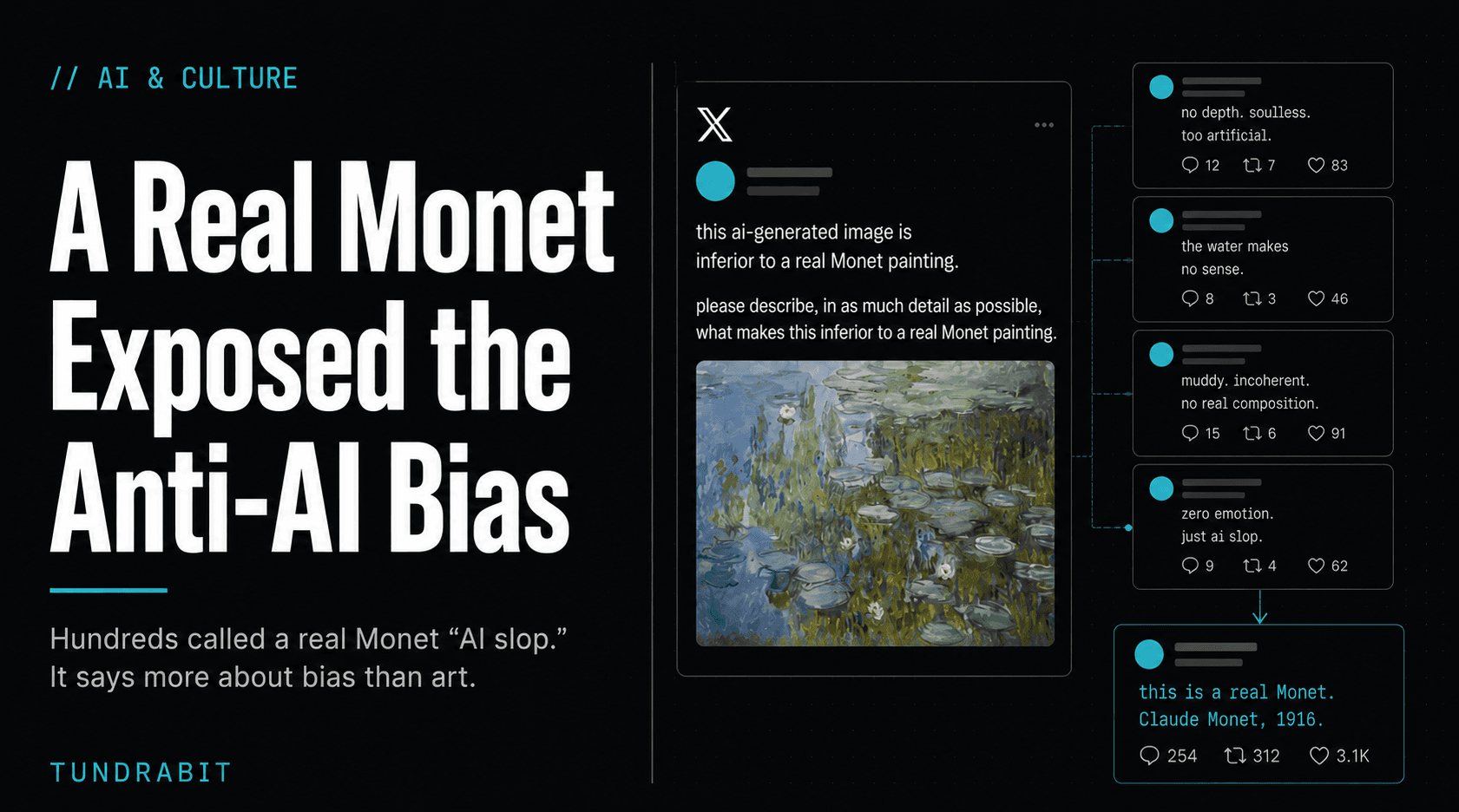
A funny thing happens when people are told an image was made by AI. They stop looking at the image and start looking for permission to dislike it.
That is the lesson from a viral post where a real Monet was presented as an AI generated image. The prompt was simple: describe what makes it inferior to a real Monet painting. The responses arrived on schedule. People called it shallow. Soulless. Incoherent. Emotionless. Too soft. Too harsh. Too blended. Too muddy. Too busy. Too empty. Too much like a student exercise. Too little like art.
The problem, of course, is that the target was not some disposable AI image. It was Monet.
That does not make every criticism automatically wrong. A person can dislike a Monet. A famous painting can still fail for a viewer. Taste is not a court order. But that is not what happened here. The interesting part is not that people had negative reactions. The interesting part is how confidently they reverse-engineered those reactions from the label.
The label came first
Most people are not good at separating perception from context. That is normal. Context changes how we hear music, taste food, judge writing, price objects, and assign status to art.
Tell someone a bottle of wine is expensive, and it may taste better. Tell someone a painting is canonical, and flaws become intentional. Tell someone an image is AI generated, and every ambiguity becomes evidence of machine failure.
The Monet test exposes that bias cleanly. The critics were not responding to the image alone. They were responding to the category they thought the image belonged to.
Once the image was labeled AI, the judgment became a hunt for defects. Brushwork became fake. Composition became incoherent. Atmosphere became muddiness. Impressionist looseness became lack of skill. The same visual qualities that might be forgiven or praised in a museum context became signs of synthetic emptiness.
That is not criticism. That is identity maintenance.
Anti-AI criticism has a prestige problem
A lot of anti-AI art discourse borrows the language of expertise without doing the work of looking.
The vocabulary sounds serious: cohesion, depth, intention, composition, gesture, texture, atmosphere, soul. These are real concepts. They matter in art. But in this case, many of them were being used as decorative weapons. The critic already knew the conclusion, then went shopping for words to support it.
That is why the episode is so revealing. It shows how quickly aesthetic judgment can turn into social signaling. People were not simply saying, “I do not like this image.” They were performing the approved reaction to AI art.
The approved reaction is easy: the image is hollow because it is AI. It lacks soul because it is AI. It has no intention because it is AI. If it looks good, it is trickery. If it looks bad, it proves the point. If someone likes it, they have been fooled. If someone dislikes it, they are defending humanity.
That loop is unfalsifiable. The Monet test broke it by swapping the object underneath the label.
This is not about Monet being perfect
The point is not that Monet is above criticism. That would be the opposite mistake.
The point is that the same image produced different standards depending on whether people believed it came from a human master or a machine. That should bother anyone who cares about art.
If an image has weak composition, say so. If the color choices fail, say so. If the piece leaves you cold, say so. But if those judgments only appear after someone whispers “AI,” then the criticism is not as independent as it pretends to be.
Real criticism starts with attention. Bad criticism starts with a team jersey.
The irony is hard to miss
Anti-AI critics often accuse generative systems of producing shallow imitations of human judgment. Yet in this episode, the humans produced exactly the kind of pattern-matching they claim to despise.
They saw a label, predicted the socially acceptable next response, and filled in the rest with plausible criticism.
That does not mean humans are machines. It means humans are also vulnerable to imitation, group pressure, and lazy inference. People can hallucinate authority just as confidently as a model can hallucinate a citation.
The internet makes this worse because public taste is often rewarded as performance. You are not just deciding what you think. You are deciding what kind of person your reaction makes you appear to be. In some circles, liking an AI image marks you as gullible, anti-artist, or aesthetically dead. So the safe move is to reject first and explain later.
AI art exposed a weakness that was already there
The art world had status games long before generative AI. People have always confused reputation with quality, difficulty with value, and insider language with perception.
AI did not create that problem. It made the problem easier to see.
When a machine can produce images that are visually interesting enough to force disagreement, the old shortcuts start to break. People cannot rely only on surface reaction, because they may like something they are supposed to reject. They cannot rely only on origin, because origin does not always predict visual experience. They cannot rely only on prestige, because AI can mimic prestige and real masters can look strange, loose, unfinished, or awkward outside their usual frame.
That is uncomfortable. It should be.
AI art forces people to ask what they actually value. The image? The process? The artist’s biography? The labor? The intention? The scarcity? The market? The cultural signal? Different people will answer differently, but pretending the answer is obvious is where the dishonesty starts.
The better standard
The right response is not to declare that AI art is always good or that human art criticism is fake. That would be just as lazy.
The better standard is simpler: judge the object first, then argue about the process honestly.
If an AI image is boring, call it boring. If a human painting is weak, call it weak. If a generated image has striking composition, admit it. If a handmade work has depth that comes from lived practice, explain where that depth shows up. Do not hide behind words like soul when the real claim is discomfort with the tool.
Process matters. Authorship matters. Labor matters. But they do not excuse bad looking, and they do not erase good looking.
AI does not end art. It makes lazy art criticism harder to get away with.
The anti-AI panic will not survive contact with ordinary taste
Most people are not going to inspect every image like a courtroom exhibit. They will respond to what they see, what they need, and what the work does for them. Some will care deeply about human authorship. Some will care about utility. Some will care about beauty. Some will care about speed. Some will care about cost. Most will shift depending on the context.
That is how technology adoption usually works. Moral panic dominates the early discourse, then everyday use starts making the panic look smaller.
The Monet bait is useful because it shows how fragile some of the panic already is. When people thought the painting was AI, they found machine failure everywhere. When the premise changes, the same observations look less like insight and more like projection.
AI critics can still make serious arguments. They can talk about training data, consent, labor markets, platform power, attribution, economic displacement, and the difference between tool use and mass substitution. Those are real issues.
But “I can tell because it has no soul” is not serious. The Monet test shows why.
Sometimes the viewer is not detecting the absence of humanity in the image. Sometimes they are revealing the presence of bias in themselves.
// Discussion
Comments
No comments yet. Start the thread.